



The land nonprofit has been the subject of considerable controversy recently as abutters, recreational beachgoers, and conservation officials dispute the Trustees’ management approach.
The Trustees of Reservations went before the Edgartown conservation committee Wednesday seeking approval to continue oversand vehicle (OSV) access on its Chappaquiddick properties.
The land nonprofit, which manages multiple properties on the Island and around the state, has been the subject of considerable controversy recently as abutters, recreational beachgoers, and conservation officials dispute the Trustees’ management approach on the delicate barrier beach and wetland area. This week’s public hearing saw more than 80 written comments and attendees aired concerns about the organization’s staffing challenges, infrastructural maintenance, and ecological management.
After pressure from town officials during the permitting process last year, the Trustees this year opted to break its applications into two parts, one for Cape Pogue and another for Leland Beach and Wasque.
The organization is currently being sued by two Cape Pogue landowners over its ecological management in the area, making approval all the more contentious. The hearing Wednesday only pertained to the Leland Beach and Wasque properties, with further discussion on all properties continued to Oct. 25.

The Trustees of Reservations will be back before the Edgartown Conservation Commission on Oct. 25.
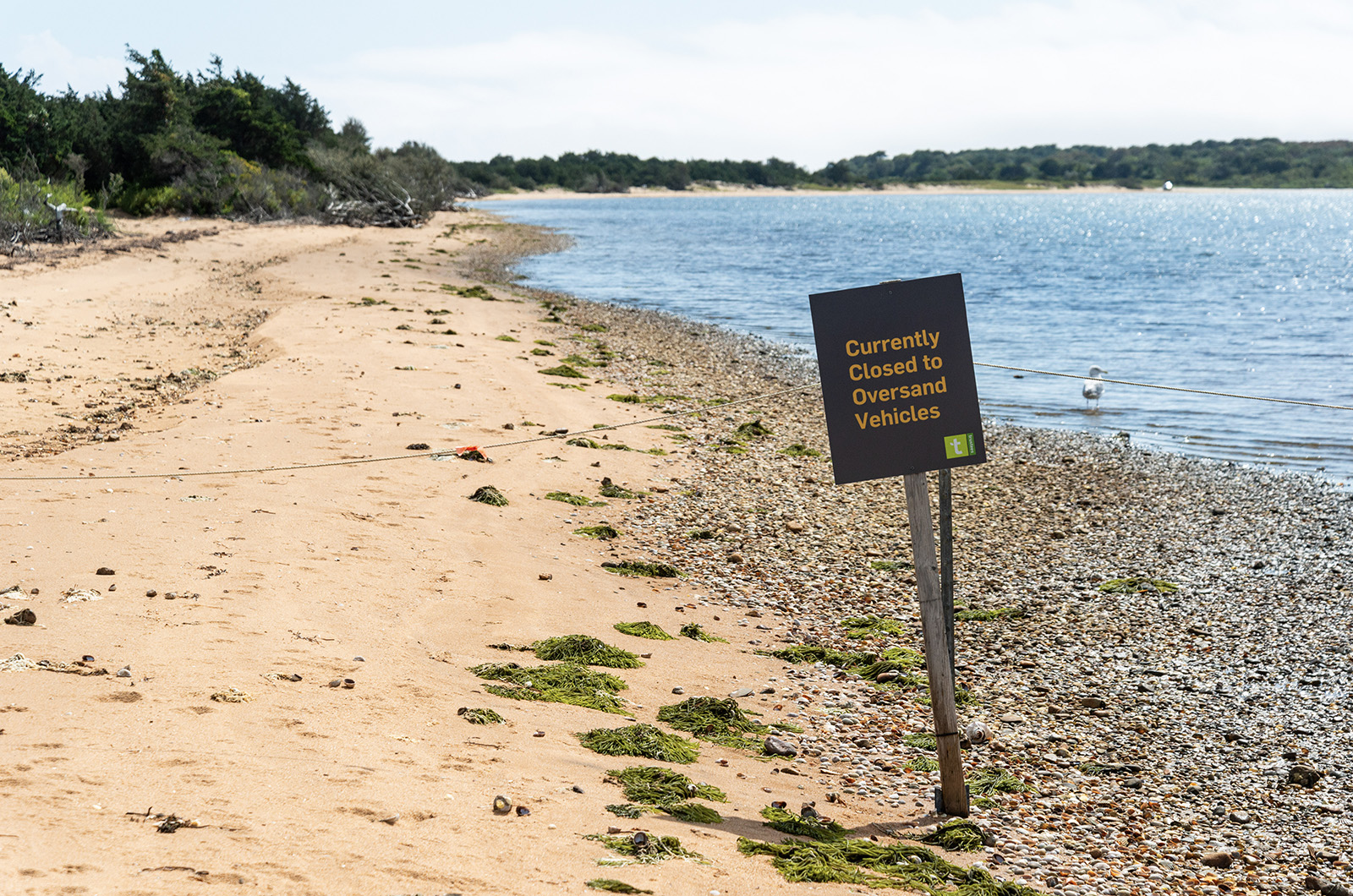
The Trustees of Reservations will be back before the Edgartown Conservation Commission on Oct. 25.
Trustees Islands director Darci Schofield began her presentation to the commission with a summary of the organization’s new beach management plan unveiled earlier this summer. Its previous plan had been pulled last year after public outcry, prompting the Trustees to hold a series of working groups to develop its new plan.
Ms. Schofield expressed optimism that the new plan addressed beachgoers’ concerns. Changes include expanding the trust’s dog policy, increasing communication with the public, and increasing public safety and training requirements for OSV users. The new plan also adopts an “adaptive management strategy,” Ms. Schofield said, in which the organization decides on issues like capacity limits and trail closures based on the current beach conditions of the day. The new strategy is similar to the approach currently used by the town at Norton Point, Ms. Schofield added.
The new plan also sets a new capacity limit of 300 vehicles on both Leland and Wasque properties, although Ms. Schofield noted that beach activity even in peak season rarely breached 250 vehicles. In previous hearings, the organization was hesitant to cap vehicles at a specific number.
Commission member Geoffrey Kontje said that while he liked the plan overall, he questioned whether the organization employed enough staff to handle 300 vehicles.
“I don’t have a strong answer for that question,” Ms. Schofield began, reiterating that she had never managed the beach when it had that many vehicles. The highest daily record occurred in 2020 with 317 vehicles, she said.
“When we’re doing regular patrols, what we’ve been doing is sufficient,” she said.
Commission member Christina Brown expressed concern for the impact 300 daily vehicles could have on the dynamic barrier beach.
“How much sustainability does that beautiful skinny beach have?” Ms. Brown asked.
The Trustees would be open to decreasing the maximum capacity based on beach conditions and has capped vehicle entry to Leland Beach in the past when activity began to encroach on public safety.
“Three hundred was a place to start with this commission,” Ms. Schofield said.
Infrastructure maintenance has been another point of contention between the town and the Trustees. In this hearing and in previous ones, attendees have complained about the deteriorating quality of structures like the Cape Pogue lighthouse and the Dike bridge bulkhead. In the case of both, the Trustees have shared ownership and management of the structures with outside organizations and in turn, disputed its responsibility to maintain them.
Mr. Kontje had been particularly concerned about the Dike bridge bulkhead, given that it’s the major point of entry to the Trustees’ properties. Trustees attorney Dylan Sanders said the organization is in the process of tracking down all joint owners of the bulkhead and adjoining land to begin repairs.
“We are working…to assess the condition of the bulkhead and to arrange the work necessary,” Mr. Sanders said.
Mr. Sanders did not commit to paying for the repairs, which were last estimated to cost upwards of $4 million.
One member of the public also raised concerns about the condition of the boardwalk to East Beach, to which Ms. Schofield responded that they are in the process of evaluating.
Last month, the conservation commission chastised the Trustees for failing to properly demarcate OSV trails as required by the commission. One attendee questioned what recourse the commission would have should the organization continue to fail to comply.
“Our enforcement capabilities are somewhat limited,” conservation agent Jane Varkonda replied. “We have the ability to fine them at a maximum of $300 a day…the other thing we can do…more subject to interpretation…is to just shut them down.”
The public hearings for both the Cape Pogue and the Leland Beach and Wasque properties have been continued to Oct. 25.
Comments
OSV limits may work at Norton
Adar ChappyOSV limits may work at Norton because there is plenty of parking at South Beach. A limit on the number of OSVs on Chappy is a bad idea because there is very little parking. The small parking lots on Chappy would quickly fill up and cars would be circling around looking for a place to park.
Questions: (1) Since it is
Whit Symmes ChappyQuestions: (1) Since it is well served by parking areas, why is Wasque on the list for vehicle access? (2) To prevent drunk driving, will TTOR restrict drivers from bringing alcohol in their vehicles? If so, how will their staff enforce this restriction? (3) How will TTOR direct up to 300 vehicles through and around pedestrian areas, especially those where children are playing? (4) Will TTOR protect the sight lines on the pedestrian beaches so that people can enjoy the scenic beauty without looking at vehicles? Protecting the scenic and natural beauty of their properties is, after all, their clearly stated mission.
Whit,
Rich EdgartownWhit,
Protecting the natural beauty of this amazing sanctuary is a goal for all interested parties. So too is access. The only way to access this vast refugee (which was DONATED and purchased using PUBLIC funds to ensure eternal PUBLIC access) is by vehicle. Your request to protect sight lines from vehicles is frankly absurd. Shall we force all beach goers at South Beach and State Beach to park "out of sight line" from those beaches? Should the ferry terminal in Oak Bluffs be shuttered in an effort to eliminate the sight line of the ferries from Inkwell beach? Or alternatively we could request that no pedestrians be allowed on any beaches, thus avoiding the horror of sight lines?
Rich, You are making 2 very
Whit Symmes ChappyRich, You are making 2 very awful assumptions: (1) that "access" only means "vehicle access". It also means walking access. (2) You are assuming that vehicles should be free to drive and park everywhere. This is nuts. There's miles of beach on Chappy and we can easily share. If vehicles are restricted to areas beyond where most people would walk, this should work. And of course, there's also the safety issues which are paramount. It's absurd for you to be driving anywhere near where kids are playing.
Add new comment