


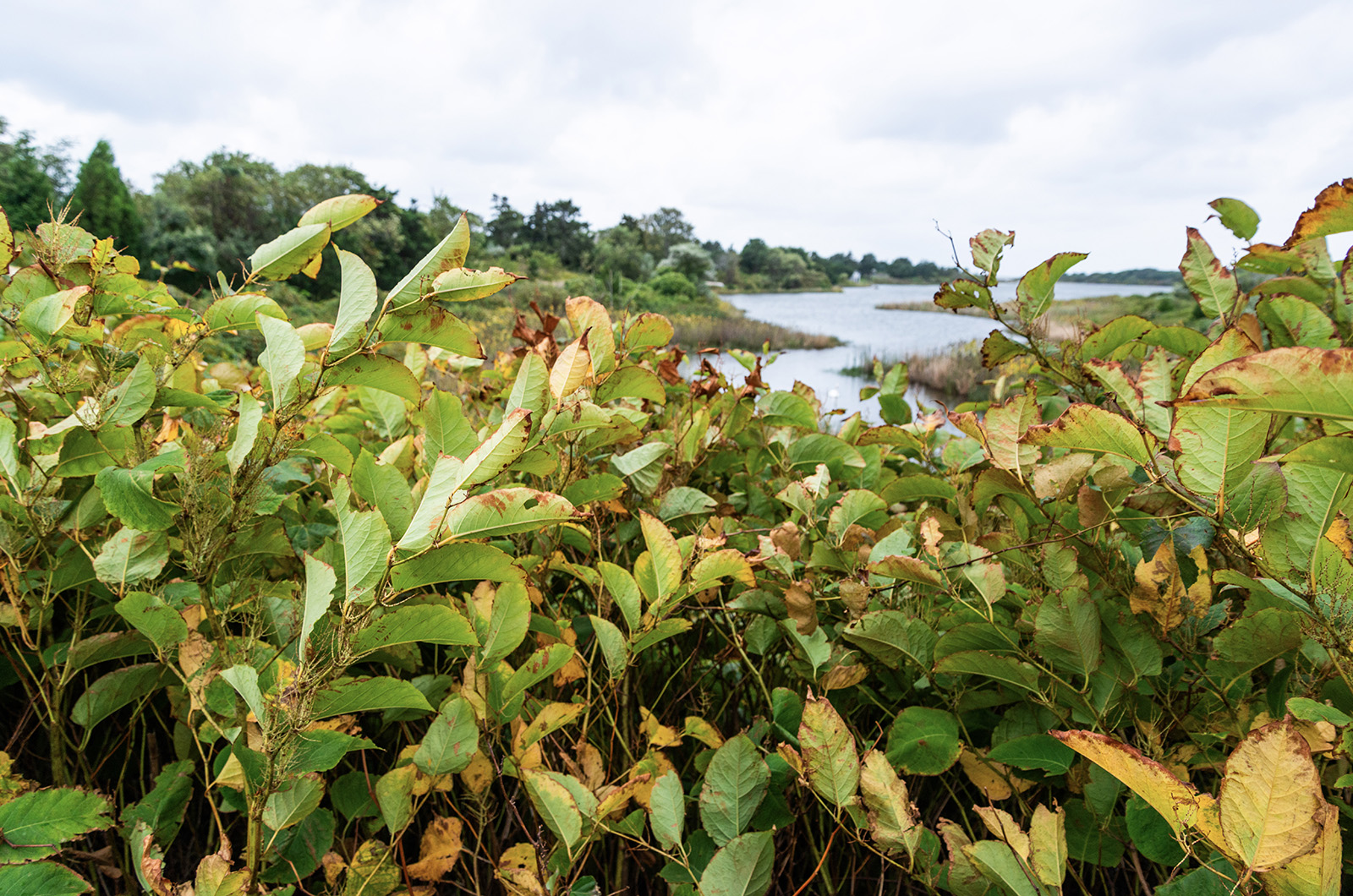
In a recent Aquinnah select board meeting, town officials raised the alarm about an outbreak of Japanese knotweed near a town water tank, hindering access to the tank and even potentially compromising the structure.
It can grow through concrete and reach the length of an anaconda. It is a “controlled substance” in Great Britain. It can take years to kill — and even then, it can still come back.
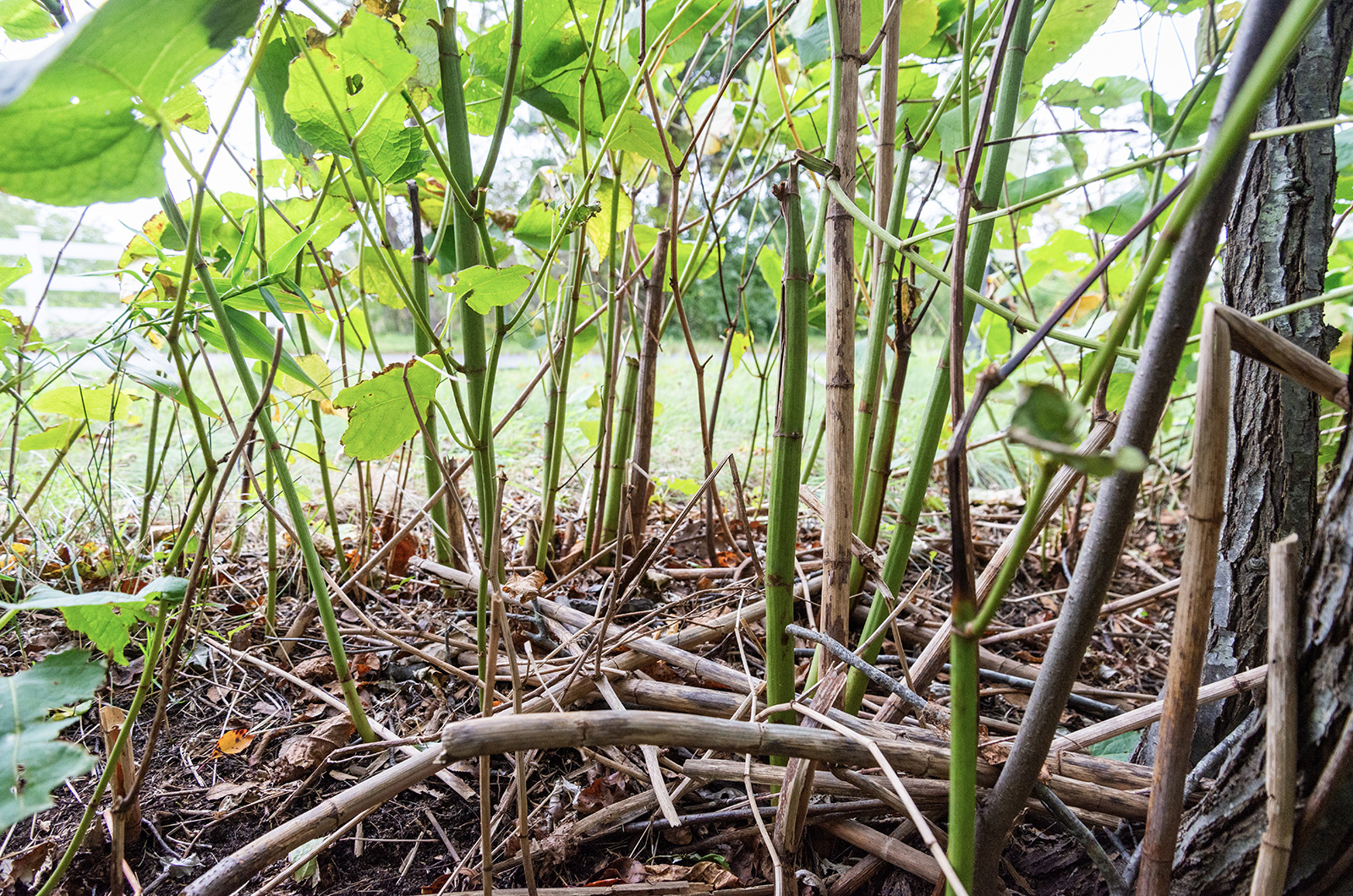
These traits don’t describe a new genetically-engineered bioweapon, but rather the invasive Japanese knotweed (Fallopia japonica), a bamboo-like plant that has become all but ubiquitous on the Island and most of the Northeast.
If left to its own devices, Japanese knotweed, also known as donkey rhubarb, stands to overrun gardens and choke out biodiversity on-Island, even posing threats to house foundations and public works.
In a recent Aquinnah select board meeting, town officials raised the alarm about an outbreak of Japanese knotweed near a town water tank, hindering access to the tank and even potentially compromising the structure. Department of Public Works director Jay Smalley said the department had pulled out a network of Japanese knotweed from a pipe near the tank.
Julie Russell, Martha's Vineyard Land Bank ecologist.
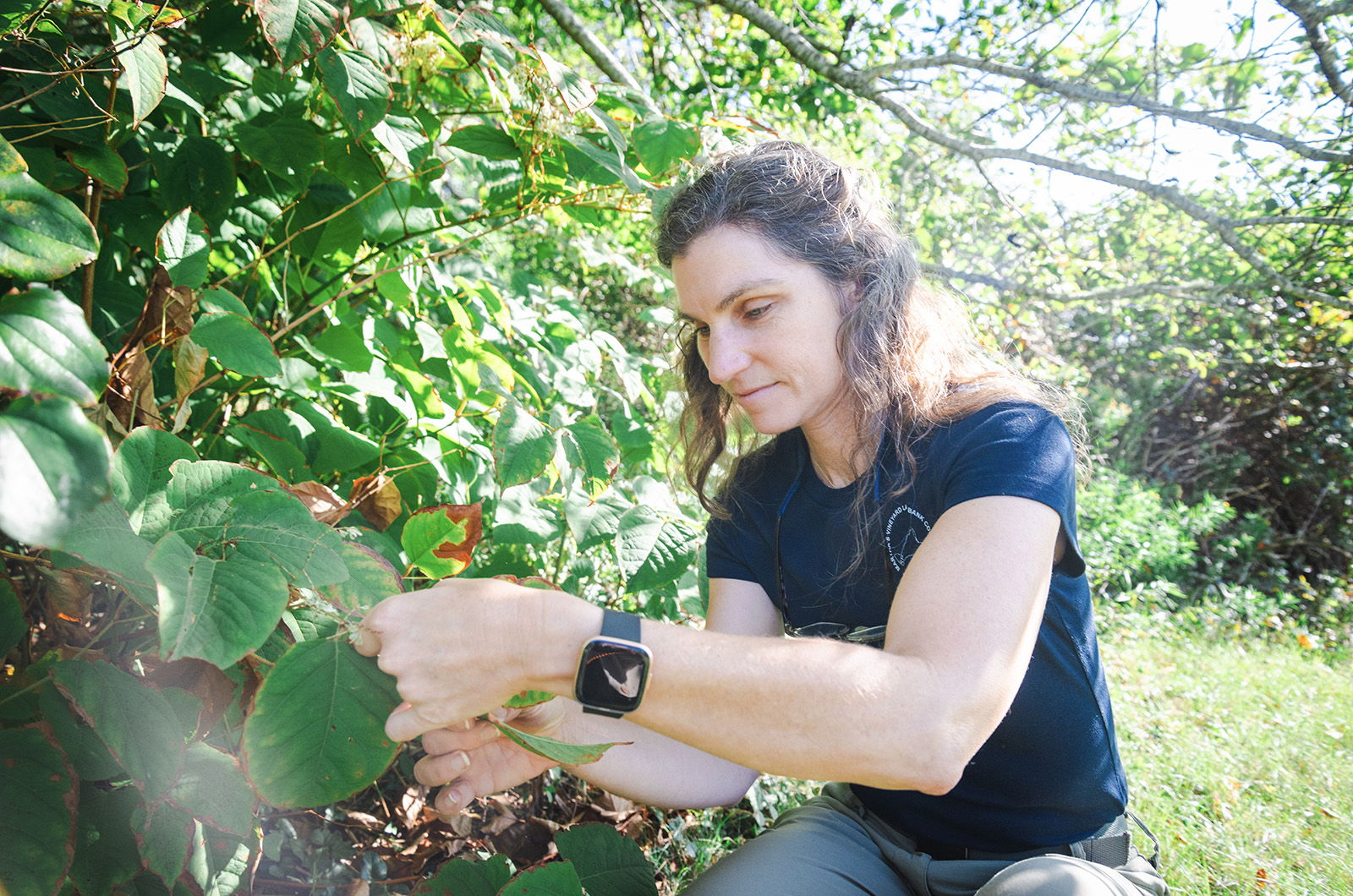
Julie Russell, Martha's Vineyard Land Bank ecologist.
“It was the length of a firetruck,” he said, at roughly 32 feet long.
Although extreme, Aquinnah’s dilemma is hardly new. For decades, gardeners, town officials and ecologists have searched for a viable way to control the plant.
“People get really frustrated,” Martha’s Vineyard Land Bank ecologist Julie Russell told the Gazette. “It’s just one of those plants.”
In her 23 years at the Land Bank, Ms. Russell has encountered Japanese knotweed in every town on the Island, including many Land Bank properties.
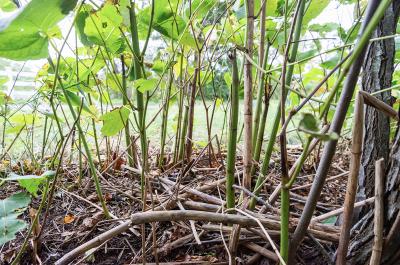
What makes the plant so difficult to kill is its extensive and hardy root system, she said, capable of storing large amounts of energy so even if its shoots are cut back, it can continue to sprout again and again. Japanese knotweed also has a relatively-long growing season and can adapt to nearly any climate or environment, making it particularly challenging to eradicate.
“It’s a really strong plant,” Ms. Russell said. “The idea is to try and starve the plant to exhaust its root storage.”
Since 2013, the Land Bank has employed a herd of goats to help cut back unwanted foliage on its properties. For the past two years, the organization has set its goats on a small patch of knotweed to see if intensive grazing might yield any results. Over that period, the goats have grazed four times, most recently a few weeks ago.
The conservation nonprofit BiodiversityWorks recently started up a volunteer-run Invasive Plants Brigade.
The conservation nonprofit BiodiversityWorks recently started up a volunteer-run Invasive Plants Brigade.
“So far we have not seen a change,” Ms. Russell said.
At the Land Bank’s Farm Pond and Duarte’s Pond properties, the knotweed is mowed annually to keep it in check, but even then it returns, Ms. Russell said.
“I want to be optimistic about it, but it’s difficult,” she said. “It’s all-consuming.”
The only successful removal she has seen was at a private property in Edgartown, where she suspected the property owner excavated the knotweed and disposed of the contaminated soil.
“That’s no small feat, and then what do you do with it?” she said. “It’s like glitter... once it gets out, what are the odds you take a scoop and there’s no glitter in there?”
Polly Hill Arboretum executive director Tim Boland has spent the bulk of his career fostering native species on-Island and, in turn, combatting invasive species that stand to overrun them. He said the only way to dispose of soil containing Japanese knotweed rhizomes is to incinerate it off-Island.
“Even a small segment will cause a new plant to emerge and spread,” Mr. Boland wrote in an email.
The only way to prevent the plant from taking root altogether, he added, is to use exclusively native soil.
“We have never had it here on our property, mainly because we do not import soils and do our own composting and soil mixes,” he said. “Eliminating outside soils has enabled us to avoid many problems with invasives.”
In many areas, however, excavation is not a practical solution. In Aquinnah’s case, the knotweed’s proximity to the town’s water tank precludes intervention with heavy machinery. The next most effective solution in that case is to treat the plant with herbicide, Ms. Russell said.
Herbicide is expensive, however, and requires a licensed contractor to apply it, she added. Plus, in the case of wetland areas, one needs to hand-administer the herbicide into the knotweed’s root system using a syringe to prevent any excess herbicide from running into the environment.
“It’s very time-intensive... and then you run into using more herbicide than necessary, which drives up costs further,” Ms. Russell said.
There are also few experts capable of treating the problem. The only contractor Mr. Boland could name that offers these kinds of services is Wilkinson Ecological Design in Orleans.
“It’s surprising an industry has not developed around invasive plant management and native plant restoration,” he said.
Michael Donaroma, owner of Donoroma’s Nursery, Landscaping and Floral Design, said while his company does occasionally use a licensed technician to administer herbicide, he more often recommends that homeowners mow back their knotweed than try to get to the root of the problem.
When asked how long one must mow their knotweed to exterminate it completely, Mr. Donaroma replied, “Forever.”
“Well, no, in a few years you should notice... it should be gone,” he added.
Some gardeners have started taking matters into their own hands. The conservation nonprofit BiodiversityWorks recently started up a volunteer-run Invasive Plants Brigade aimed at helping homeowners mitigate invasive species in their own backyards.
“Every time you show up to help, you bank a day for the group to come to your house and help with your backyard,” program director Richard Couse said.
While successful so far, the brigade is currently limited to members of its Natural Neighbors program, Mr. Couse said, with no immediate plans to expand. The brigade currently includes around 15 people.
“The Island could use some kind of Invasive Plants Brigade that does [larger-scale] work,” he added. “It’s a business that never ends.”
While Japanese knotweed is a particularly pervasive specimen, environmentalists stressed that invasive species are all too common on the Island, and the average gardener or hiker may not fully understand their ecological threat.
MassAudubon Islands director Suzan Bellincampi said that species such as Japanese knotweed stand to take the place of native plants more suited to the Island and the wildlife it hosts, starving out critical species.
“Everything goes up the food chain,” Ms. Bellincampi said.
To help stave off the spread, both Ms. Russell and Ms. Bellincampi said they have made a habit of monitoring their environment and pulling up invasive species when they see them. They recommend that Islanders do the same.
Early intervention is key, Ms. Bellincampi said.
“Learn your landscape and keep an eye out,” she said. “Do I think the Island will ever be rid of it? Probably not, but I’ll keep doing my part.”
Comments
I am strongly opposed to
Bill Ryan Edgartown/New jerseyI am strongly opposed to using glysophate as there is a strong correlation with cancer. Having said that, it seems to be the only agent that, when used properly, will eradicate Knotweed. Other methods are futile and can often make t worse. Further, the glysophate needs to be applied in a narrow window of time or it won't work; that window is actually right now.
The amount of glyphosate used
Russ Rochester, MAThe amount of glyphosate used to eradicate invasive species is absolutely minuscule in comparison to its agricultural use. Here in Rochester, I live across the street from 100 acres of “roundup ready” corn where 1000’s of gallons are employed annually. Almost all non-organic oatmeal is killed with glyphosate to hasten the harvest, they cleverly call it a “desiccant”. If you follow the instructions (that’s all certified contractors do anyway, it’s not that complicated) you will likely be no worse off than having a bowl of oatmeal or enjoying an ear of corn.
Wouldn't it make sense to (1)
Carol formerly ChilmarkWouldn't it make sense to (1) have crews from the town remove this by hand, and (2) put out a call for volunteers to come & help? I think a lot of residents would prefer to come & dig these up for a day every three months rather than have them sprayed with poison.
I agree with Bill Ryan
Dick AquinnahI agree with Bill Ryan excepting the "strong correlation" with cancer. There is correlation but it appears to be vague or even random. Proper use of glysophate is reasonably safe and very effective. The idea of digging or dredging up wide stands of knotweed and removing the results off island is not just costly, it's ludicrous. And the notion of injecting individual plants with herbicide is plain silly. The application of glysophate, as Ryan explains, in the fall when it is absorbed deep into the tangle of roots on dry, sunny days with temps above 50 degrees, will all but eradicate the plant. Occasionally, a second application is necessary. Are there downsides to the use of herbicides? Sure. But the alternative--native plants and ecologies being permanently over-ridden by invasives--is worth these risks.
I realize it is an invasive
Tim colon Vineyard HavenI realize it is an invasive species but at the same time it is a very important nectar source for honeybees and the many native bees. The honey that comes from this plant is known for its amazing health benefits.
Over the decades that I
Marty Milner TALLAHASSEEOver the decades that I worked the landscape of the island I frequently had to make areas "safe" for children from poison ivy. My solution of choice was to mow the area and install an impervious soil separation barrier of either soil fabric or plastic designed to bear the weight of heavy boulders or pond basins. (Do NOT buy cheap plastic or short time use fabric!)Used intermittently and in different areas these products can last year. Eventually every plant is killed in the darkness. You can the heavily overseed and lime the area with presprouted annual and perennial grass seeds which chokes out anything seeking to reestablish. Mow frequently. This system, if used with the natural seasonal growth periods and weather, works in tune with nature, and takes about 2 years. If you are careful with the fabric it can last years and be used many times in several locations. Contact me on FaceBook it you need specific suggestions on how to work it. Be happy to help.(It works on bamboo!) :-)
Add new comment