


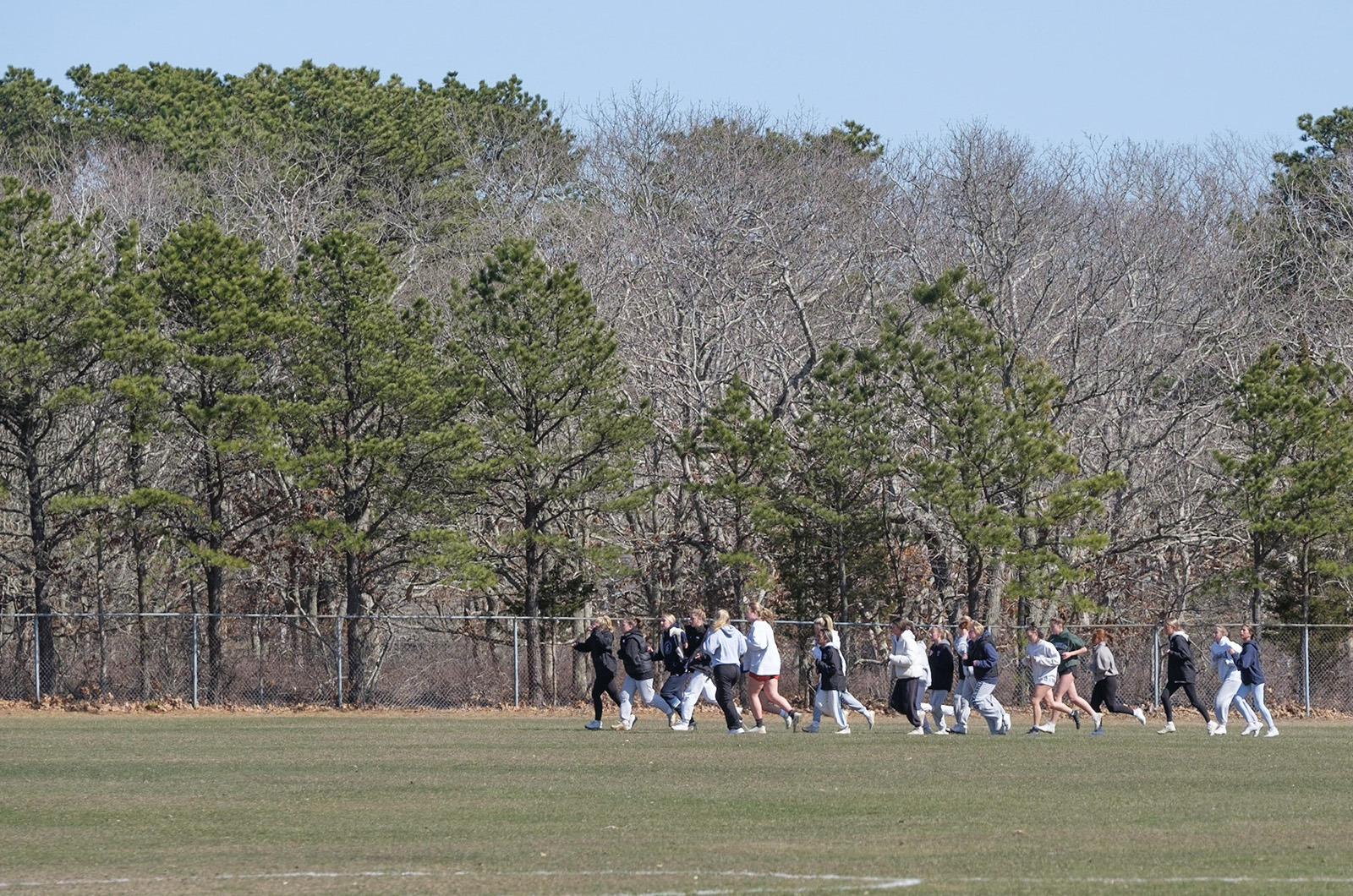
The fate of an artificial turf field at the regional high has been in limbo since the school sued the Oak Bluffs planning board last year.
The long-simmering controversy over a planned turf field at the Martha’s Vineyard Regional High School spilled over into town meetings this year, with West Tisbury voters rejecting the town’s entire share of the school budget in a protest over legal spending.
The project has been in limbo for a year since the school sued the Oak Bluffs planning board in Land Court over its denial of a special permit for the project. Interest in the slow grinding legal battle was rekindled when the school committee voted earlier this month to continue the case to conclusion with no cap on expenses.
Here is an explainer on how the case came to be and what is going on now.
What is the turf project all about?
The regional school district has considered using artificial turf going back to 2016, when MV@Play, a nonprofit group started by Vineyard parents, proposed the idea as part of a revamp of the district’s athletic facilities, which have been in poor condition for years. The project would include putting in a new 400-meter track, a synthetic turf field, a grandstand and renovations to the school’s other grass fields.
The proposal immediately drew opposition from Islanders concerned about the long-term environmental and health impacts of any synthetic materials. A group called the Field Fund offered an alternative plan employing natural grass fields, but negotiations with the school district fell apart. Ultimately, the district decided to move forward on an $11 million plan that included a main turf field and five natural grass fields.
Wasn’t it approved by the Martha’s Vineyard Commission?
Yes. In 2021, the project was referred to the Martha’s Vineyard Commission as a development of regional impact (DRI). After hours of meetings and expert testimony, the MVC approved the plan on a 10-6 vote.
How did the Oak Bluffs planning board get involved?
After the Martha’s Vineyard Commission approved the project in June 2021, it went to the Oak Bluffs planning board for town approval. The board contended that the school needed a special permit because the turf field was planned to be within the town’s water protection overlay district.
The school has claimed it doesn’t need the permit, but applied in a sense of cooperation.
The athletic field plan was bitterly debated for several hearings, with several people concerned about the artificial turf’s potential to harm the area’s water quality with per- and polyfluoroalkyl substances, commonly known as PFAS. PFAS have been linked to increased risk of cancer, liver damage, thyroid disease and other negative health outcomes.
In May 2022, the planning board was split on the special permit application, ending up in a 2-2 tie vote.
Without an affirmative vote, the special permit was rejected.
In its formal permit denial, the board concluded that PFAS chemicals from the turf would leach into the water, posing a hazard to the aquifer.
So what is the basis for the school district’s lawsuit against the planning board?
In June 2022, the school district appealed the planning board’s decision, saying the field should be allowed by right under the town’s zoning bylaws because it is protected by the so-called “Dover Amendment,” a state provision that exempts agricultural, religious and educational uses from certain zoning restrictions.
The school argues that, under the Dover Amendment, the town doesn’t have any right to “regulate, restrict, or prohibit” the school’s educational use of the property through the town’s bylaw.
According to the Massachusetts Municipal Association, the state enacted the Dover Amendment in 1950 in response to local zoning bylaws that prohibited religious schools within a town’s residential neighborhood.
Zoning regulations can’t stop the use of land or structures for educational purposes, though the use of them can be subject to “reasonable regulations” on the size of the buildings, yard sizes, lot areas, setbacks, open space, parking and lot coverage.
In recent court filings, the town contends the field does fall under the “open space” category in the Dover Amendment, and noted that the school has applied in the past for town open space funds in order to restore the track, a part of the athletic complex revamp that includes the turf field.
“The District cannot have it both ways,” the town attorney wrote.
Where does the lawsuit stand now?
The district sued the Oak Bluffs planning board in Land Court last year, and since then, the two sides have filed motions back and forth arguing the merits of the case ahead of a potential trial.
The judge, the Hon. Kevin Smith is currently considering a motion by the school district for partial summary judgment.
The planning board contends the school district is reading the Dover amendment too broadly and claims the board wasn’t denying the district’s proposed use of the field, just the artificial turf that the school wanted to use.
The town has responded that a judgment before a trial is not the “proper vehicle to resolve this dispute between public bodies.”
How does the West Tisbury vote factor into all this?
The school’s legal budget, the fund used to pay for the lawsuit, is wrapped into its overall budget that is voted on annually at town meetings across the Island.
Earlier this month, the regional school committee, in a split vote, decided to continue funding the lawsuit after it spent the initial $30,000 in legal fees that it had set aside for the case.
In protest of the continued spending, West Tisbury voters at town meeting last week denied the school’s budget, a move that could send the school back to the drawing board if two more towns also reject the budget.
If the school can’t get four of the six Island towns to pass the budget, the school committee will have to go back into the budget. If West Tisbury is in the minority, it would be the town’s responsibility to convene a special town meeting to approve its share of the budget, schools superintendent Richard Smith said.
Edgartown and Oak Bluffs already voted in the school budget; Tisbury and Chilmark have their town meetings next week and Aquinnah is in May.
School officials have noted that the additional legal spending, while going over the initial limit set by the school, hasn’t come close to exhausting the high school’s legal budget line.
What happens next?
The land court will rule on the school’s motion for summary judgment in the case. A hearing has not yet been scheduled. The high school school committee has called an executive session on Monday to talk about the lawsuit and “to consider settlement proposals to offer” to Oak Bluffs.
Comments
Ethan thank you for this. But
Tom Engley West TisburyEthan thank you for this. But it’s still nonsense.
Most of this is correct
Islander61 OBMost of this is correct except for the planning board piece. Initially the planning board brought forward a vote to reject the project. That vote lost 3-1 against rejecting the project. Thus actually approving the field. The planning board chair then proposed the need of a Special Permit, that got denied with a 2-2 vote. Then, IMO, the planning board chair went to the building inspector and convinced him that a special permit was needed. That is how the need for a special permit came to be. When it was motioned that a special permit was to be approved it got denied with the 2-2 vote. A technicality got the permit denied because a 2/3 vote in favor was needed. Just setting the record straight.
Correct. After all of the
Bob OBCorrect. After all of the time and funds invested by many in order to present this project in the proper fashion, and through the proper channels, with ample opportunity for public discussion and the presentation of substantiating evidence - the process was subverted on a technicality by one person. That is why I support this litigation. This is not beating a dead horse, and these funds are not being wasted - we all need to be assured that this sort of abuse of authority will not be allowed to recur. This isn't about a field anymore.
If there is actual proof that
James Klingensmith West TisburyIf there is actual proof that an artificial field could possibly even if the evidence is thin, why would the school want to put the children and island community at risk of contaminating our water supply.
Any risk of contaminating the water whether it is legal or not should be avoided.
Jim
Terry Donahue EdgartownJim
Weston & Sampson testing done for the MVC 2/1/21, attached below.
Based on our review and the current regulatory standards for PFAS in Massachusetts, there are no significant risks associated with the discharge of PFAS from the synthetic turf field into groundwater.
Thank you Mr Donahue. Indeed
George Stein OBThank you Mr Donahue. Indeed this is way beyond just a field long ago. Tragedy is an appropriate evaluation no matter how it pans out.
James, I’ll ask you one
Sportsman OBJames, I’ll ask you one question. With thousands of these fields in place all over the world, wouldn’t you think that if they were harmful to ground water there would be dozens of studies done that show that by now? I played on one of the original turfs in the ‘80s so they’ve been around a while and not one study that has shown that they affect ground water. Glenn Field is correct, our kids deserve a quality field. This project has been well vetted and approved by the MVC, there was no reason to deny the field by OB. Not one shred of evidence presented said it was harmful.
While this article is all
Glen Field Oak BluffsWhile this article is all about legal issues, local government bureaucracy, financial issues, environmental concerns, and politics, the bottom line is that hundreds and hundreds of MVRHS student-athletes have been forced to compete on sub standard playing fields for a very long time and it looks like it will remain that way into the foreseeable future. The vast majority of student-athletes across the Commonwealth have been competing on high quality artificial turf fields for nearly two decades.
I can vividly recall many conversations with coaches and parents twenty years ago about this very topic. At that time, it was clear that the MVRHS athletic fields needed to be a priority moving forward. Now here we are 20 years later and situation remains the same. Artificial turf fields are everywhere. Why can’t the student-athletes of MVRHS have what nearly all of their off island peers have? They certainly deserve it.
Ethan, great article! I do
Ted EdgartownEthan, great article! I do wish folks were more concerned about more important issues.
The economy, inflation to name a couple. My God I am lucky I am 85 years young.
I have never seen anything like it.
Look there has been no
Carlos Degotta VineyardLook there has been no responsible presentation of harms caused by a synthetic field but many about sport injuries due to poor natural field conditions. What makes me crazy is the same people that go wild over the MAGA group and say the group doesn’t believe in facts are themselves showing the same belligerent behavior in their unwillingness to accept the science. Shame on all of you who are willing to waste taxpayer money for a feeling not what the science says. Boo boo boo
In full transparency, I
William Oak BluffsIn full transparency, I support this project. It is long overdue. I also support the school committee's challenge to the town. The town is attempting to change established law. If the Town wins, the bar becomes significantly higher for any MA school to change anything, but that's an entirely separate issue. It's interested that so much pressure is being put on the school board to settle. I know there is tremendous support for this project, so why isn't equal pressure being put on the town to settle? There is significant reference to the money being spent on the lawsuit, but the town is spending a great deal of money as well. Both groups are spending tax payer funds, no?
The arguments in MV are not
SE HintonThe arguments in MV are not unique across the country, e.g. they are the same on the west coast where I live, and neither is the gaslighting/greenwashing. Our (United States) toxics and industrial regulation takes place in hindsight. The EPA relies on 'reports,' mostly by industry, before it acts. Recall the number of years we argued about various pesticides or about tobacco or coal dust before the Federal Government stepped in. Many people died waiting for help. (Compare with state of Washington proactive model, "Addressing priority toxic chemicals".) As for terms like "substandard playing field," these are terms used industry-wide by plastic grass advocates. The non profit Beyond Pesticides has a Parks for a Sustainable Future program that uses organic growing methods to make high-traffic, lower water using, very low to no pesticide/herbicide fields beloved by those fortunate enough to have them. In the long run these fields are also lower cost.
Add new comment