

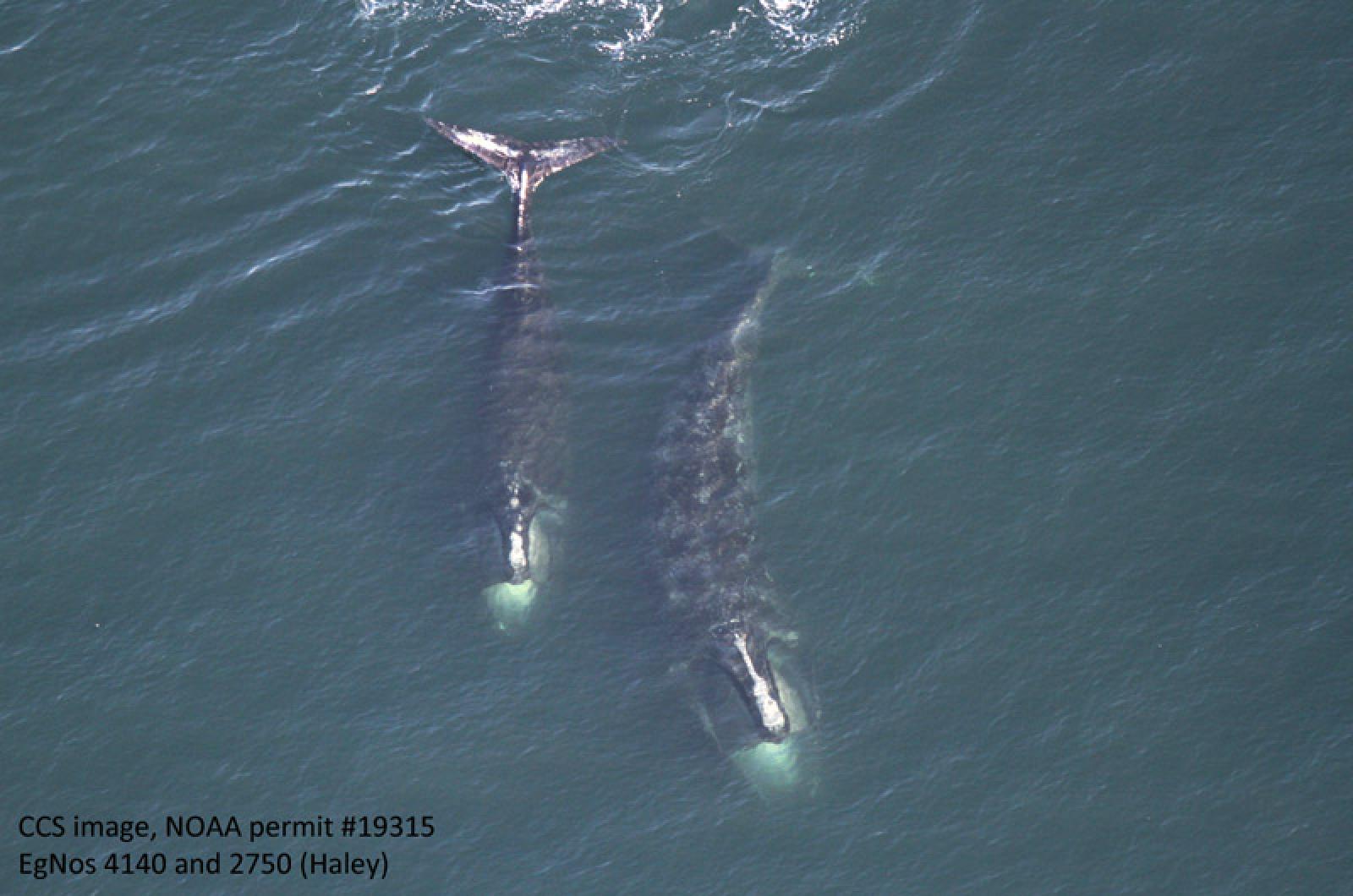
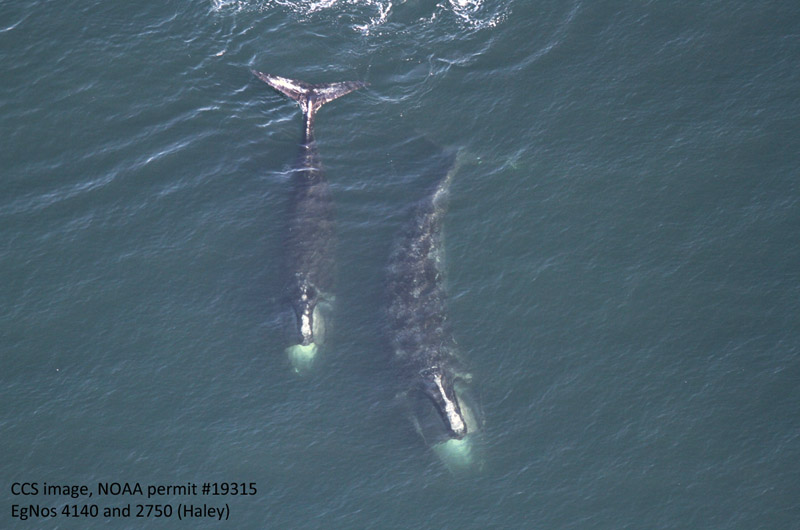
Under pressure to reduce the environmental impacts of its wind farm located 15 miles off the Vineyard coast, Vineyard Wind has turned to artificial intelligence in a bid to protect the endangered right whale population.
Under pressure to reduce the environmental impacts of its wind farm located 15 miles off the Vineyard coast, Vineyard Wind has turned to artificial intelligence in a bid to protect the endangered right whale population that frequently travels in the area.
Right whales are one of the world’s most threatened species, with estimates pegging the remaining population at fewer than 350. Ship strikes and entanglements in fishing gear are the leading causes of death, and scientists are worried that increased ship traffic during wind farm construction will cause more fatalities.
To alleviate risk, Vineyard Wind plans to use an artificial intelligence system called Awarion that is designed to spot whales on the water’s surface in time to prevent ships from colliding with them.
The system was created by research and development firm Charles River Analytics and uses infrared video technology to identify the whales. It is currently being tested by project leaders to determine how well the system works, the distance at which it can detect whales and the best weather conditions for detection.
“We go out there, the system takes a million pictures and we go back to the office to sift through boring images of water until we find the exciting moments when the whales show up,” said Ross Eaton, principal scientist and director of marine systems at Charles River Analytics.
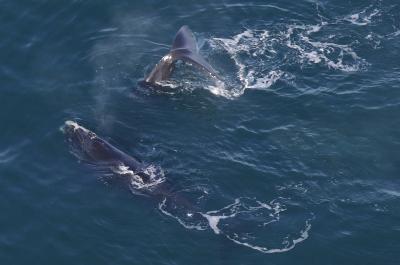
Artificial intelligence will aid humans in trying to cut down ship strikes, which are a leading cause of death for right whales.

Artificial intelligence will aid humans in trying to cut down ship strikes, which are a leading cause of death for right whales.
Elaine Coleman, vice president of commercialization at Charles River Analytics, explained that when training an AI detector, it is important to take as many photos as possible to secure the highest probability of detecting whales in real time. She sees Awarion as a way to augment human performance, helping Vineyard Wind know when to take a closer look.
AI systems are increasingly popular in the maritime and commercial fishing industries. Some, like Awarion, are employed on ships and signal captains to slow down when a marine animal is spotted on camera. Others run on buoys to deter ships from traveling in areas where underwater animal sounds have been heard.
“It’s the quintessential ‘AI for good’ project,” Ms. Coleman said. “We’re in it to save these whales and our earth. I’m not moving to Mars.”
Local scientists, however, are cautiously skeptical and would like to know more.
“New technologies are really exciting and great, but we also strongly need to focus on the critical review of these systems,” said Jessica Redfern, associate vice president of ocean conservation science at the New England Aquarium’s Anderson Cabot Center for Ocean Life. “Do they actually reduce risk to whales and by how much?”
Charles “Stormy” Mayo, director of the right whale ecology program at the Center for Coastal Studies in Provincetown, warned that despite their size, right whales can be exceptionally difficult to detect. They can dive for up to 15 minutes while hunting, he said, and a whale could potentially collide with the bottom of a ship before ever being noticed by humans or detection systems, no matter how intelligent.
“AI is neat because once you have all of the data on all of the different variables like zooplankton levels, wind conditions, feeding behavior, et cetera, you could potentially plug it into the system,” he said. “The problem is knowing all of the variables.”
Ms. Redfern also expressed wariness about the ability to react quickly enough to avoid collisions.
“I do think that AI is a cool idea, but being able to respond to a detected whale is very tricky,” she said. “You need to be able to detect it with enough time to change course or slow down. For large ships that’s not an instantaneous thing. It’s complex.”
How Vineyard Wind vessels respond will depend on the ship’s size, speed and the type of job being done on the boat, said Elizabeth Marsjanik, manager of environmental affairs at Vineyard Wind. She said the captains are confident that they can act quickly, notify other vessels around them and avoid disturbing any whales.
Both Ms. Redfern and Mr. Mayo ultimately agreed that any type of increased protection and surveillance for right whales is a step in the right direction — especially if it is to aid renewable energy development.
“The future of right whales and these ecosystems is dependent on climate change,” said Mr. Mayo. “We have to change our use of fossil fuels and from what I know the only solution that has the economic power to actually work at the scale of the problem is offshore wind.”
For leaders at Vineyard Wind and Charles River Analytics, being a part of the country’s clean energy transition and marine species preservation is career-defining.
“I’ve been working on computer vision challenges for 20 years now and before when people asked me about my job, no one was super jazzed,” said Mr. Eaton. “Now when I tell people about my work protecting whales and supporting alternative energy, they light up and so do I.”
Comments
Is this a joke? Want to
Mark EdgartownIs this a joke? Want to protect the whales? Then don’t build giant monolithic towers in the middle of their habitat…
Once the 60 plus VW towers
PointRip Cape CodOnce the 60 plus VW towers are built, there is nothing that can then be done to protect them. It will be far too late. Then what?
As an opponent of the wind
Andrew Middle roadAs an opponent of the wind project I see this issue as the tip of the iceberg.
We are going to see more and more of these environmental issues come up as they move forward with this absurd offensive attack o no our natural environment.
In any project private or public there must be two fundamental elements they are Risk and Reward. In this project there is way more risk than reward. The returns to the public are few with little or return.
Sadly, we have uninformed who believe this industrial massive mega turbine structure is actually to save the environment!
Wake up islanders!
Mark-- it's no more of a joke
don keller Vineyard HavenMark-- it's no more of a joke than allowing 1/4 mile long cargo ships and thousands of miles of fishing gear into the middle of their habitat.
The fact that Right Whales
frank brunelle Vineyard HavenThe fact that Right Whales are at risk is in itself disturbing as are all of the impacts from Offshore Wind. While it is good to produce energy without fossil fuels the idea that we will, as a planet, be able to be carbon neutral has been cited as now impossible by the major scientific researchers and organizations. Indeed, anything we can do to mitigate harm is crucial and this sounds like it could work. That being said, I for one would like to see an article investigating all aspects of Vineyard Wind impacts on Martha's Vineyard. For example, our electrical rates are now out of sight and everyone is complaining. Will rates go up as a result of the recent news that Vineyard Wind requested to withdraw from the project because of costs. They are obviously proceeding. So does this mean a substantial increase in our rates to cover the expenses? I have a lot of questions about this project but if that one inquiry could be addressed it would be appreciated. Thank you.
This wind farm is insanity,
Ralph Jameson EDGThis wind farm is insanity, why are we ok with destroying our oceans for this, why can't these turbines go on land, or we invest more in solar, this is a cash grab by various companies under the guise of green energy. Right whales are dying in unprecedented numbers right now, washing up all over the east coast and it's in direct correlation to all this new wind farm activity. Shame on any politician who is in support of destroying our oceans and putting further pressure on these beautiful creatures.
At least they are admitting
Rational Person Oak BluffsAt least they are admitting that the increased boat traffic for these industrial electric plants will probably harm the whales.
Say no to the wind farms,
Frank East ChopSay no to the wind farms, huge waist of time and money. The wind turbines will never, ever, produce the power it takes to build them, place them, and maintain them. Its a money grab disguised as an eco friendly solution, but it is far from a solution.
I don't think the wind
Bob Long IslandI don't think the wind turbines are the issue as there have been a handful working off Block Island for some time now and you didnt' see the whale deaths you're currently seeing of late. What I think is threatening them, among fishing gear and ship strikes is the seismic testing they're currently conducting while they scan for areas for future sites closer to my home and off NJ. I would wonder once they find these sites and begin to blast bottom to lay cable down, more whales will be harmed. All that said, IMO they should immediately seize seismic testing and determine if whale deaths stop or decrease to truly determine its impacts on these giants. Or put them on federal or state land, eliminating the problem once and for all.
So, there's a similar article
Jason Gale Vineyard HavenSo, there's a similar article in the other island paper, that I commented on, they won't post my comment.
NOAA has issued incidental take permits to these offshore wind companies that allow for the taking of certain species under the Marine protected mammals act.
One of which is the North American Right whale.
People either aren't aware of this, choose to ignore it or don't want others to know about.
It's all on NOAAs website
Add new comment