


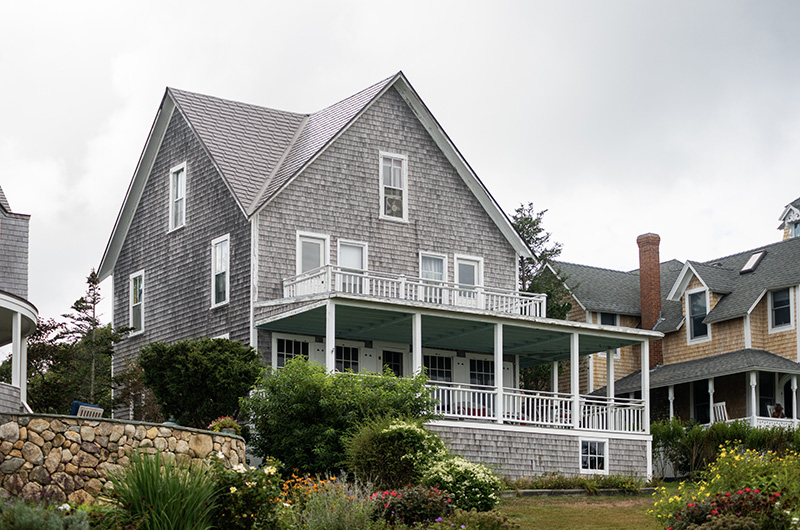
With requests for demolitions and teardowns at an all-time high on the Vineyard, the Martha’s Vineyard Commission is in the throes of redrafting its policy for reviewing demolition projects.
With requests for demolitions and teardowns at an all-time high on the Vineyard, the Martha’s Vineyard Commission is in the throes of redrafting its policy for reviewing demolition projects.
In a report at the regular commission meeting last Thursday, an MVC subcommittee that’s been working on the policy set the stage for a new approach.
“We thought we should change the name from demolition policy to the policy for preserving historic structures — because really our interest in this is to try and do what we can to preserve historic structures on the Island,” said commissioner Fred Hancock, who gave the report.
Any home that is more than 100 years old or listed in MACRIS, the state database of historic buildings in Massachusetts, is required to come before the MVC before it can be torn down.
In the last six months alone, about a half-dozen demolition requests have come before the commission for a review with varying outcomes, and another will be taken up by the MVC early next month.
On Thursday night Mr. Hancock said a commission inventory of historic buildings on the Island found that only 40 per cent of them (930 buildings) lie within designated historic districts, while 60 per cent lie outside a designated district (1,460 buildings).
“Obviously those are the ones that are of major concern,” Mr. Hancock said. He continued:
“What we want to do it prioritize saving structures and actions that preserve structures instead of actions that just cause the demolitions . . . so we are trying to come forward in a more positive way. Instead of asking, why do you want to demolish this building . . . we are thinking of asking, why can’t you save this building. Isn’t there something you can do in what you propose that saves more of the building instead of just knocking it down.”
Mr. Hancock said the committee is working on a list of alternative strategies to demolition, including rehabilitation, restoration and relocation. “The idea is that any of these could be combined, so it doesn’t have to be all, one or the other,” he said.
The complete policy is expected to be unveiled, discussed and voted on at an upcoming commission meeting.
“We’re introducing the concept to you before we hammer out the nuts and bolts of it,” Mr. Hancock said, “because it is a pretty substanstial change from what we have been doing in the past.”
Most commisisoners expressed support for the draft policy, although Brian Smith questioned whether it would broaden the MVC’s scope of review.
“Are we creating an Islandwide historic district?” he asked.
“No,” Mr. Hancock replied, explaining that it is simply a reworked policy for required reviews.
Commission chairman Joan Malkin concurred. “Our jurisdiction hasn’t changed . . . it’s really about how we approach requested demolitions,” she told Mr. Smith.
Commissioner Jeff Agnoli said there may be reason in the future to expand the development of regional impact (DRI) checklist to include houses less than 100 years old.
“It might be a way of keeping a certain type of stock in our housing inventory . . . to include some of the wonderful homes that are being torn down for size issues,” he said.
Longtime commissioner Linda Sibley praised the draft policy.
“I think the shift in emphasis is incredibly important,” she said. “We want people to understand we are trying to preserve the character of the Island as it’s reflected in older housing.” She added: “The group should look at the question of how we communicate this.”
Mr. Hancock said that subject had been discussed. “We’re talking about doing information sessions with real estate agents, architects and builders so people who are directly affected by this understand that something has changed,” he said.
Commisisoner Michael Kim, who is an architect, had offered to lead that effort, Mr. Hancock said.
Mr. Kim said time is of the essence, noting that at its next meeting the commission will take up another demolition application.
“We need this policy and it may not be in time [for the next application],” Mr. Kim said. “It’s taking shape nicely . . . there’s an awful lot of good things in it . . . and we have to get something out because what we have isn’t enough.”
Comments
The MVC was created to
here we go again edgThe MVC was created to prevent overdevelopment. They have overstepped their bounds with this wide net they cast upon individual pre-existing dwellings. The local zoning boards, planning boards, and historic commissions are very competent to determine what is appropriate in THEIR town. Just because something is 'old' does not make it historic, worthy of preservation.
Wonderful news!!
Johanna HynesWonderful news!!
The history of Martha’s
John Sands Oak Bluffs MassThe history of Martha’s Vineyard and its Architecture go hand in hand. What has made Martha’s Vineyard special is that the island has made it a priority to preserve the history and architecture of the island when you disregard history and it’s architecture by piecemeal demolition here and there it becomes like a termite infestation and before you know the historic structure of the island just collapses !! and we become just like every other beach side community Just Imagine if no restraints were put on the campground cottages OceanParks cottages the sea captains houses of Edgartown and the other areas of the island I’m not against expanding one’s house But. It needs to be in the same character of the existing structure and have a maximum percentage of expansion to the existing structure and its relation to its property size I’m reminded of the saying You can never make. NEW. Old friends !! I think this also applies to the old houses of Martha’s Vineyard !!!
Add new comment