



James Jette, superintendent of public schools in Milton, spoke about education, lifting expectations for all students and the importance of voters' rights during the Martin Luther King, Jr. Day luncheon for the NAACP of Martha’s Vineyard.
When James Jette was a senior at Martha’s Vineyard Regional High School in the 1980s, the guidance counselor wouldn’t write him a college recommendation.
“Told me I should go to the military, that was my trajectory,” said Mr. Jette, now the superintendent of public schools in Milton, during his keynote speech at Monday’s Martin Luther King, Jr., Day virtual luncheon and membership drive for the NAACP of Martha’s Vineyard.
“It’s not a knock — it’s the reality,” added Mr. Jette, who moved to the Island as an adolescent to live with relatives after experiencing homelessness in Boston.
“This is a story that I was often embarrassed to talk about,” he told more than 100 listeners who signed in for the online gathering. “I share it because it doesn’t matter where you start, it’s where you land, and where I landed I feel very proud of.”
Mr. Jette, who played on the high school’s 1986 Cape & Island League champion basketball team, didn’t accept his guidance counselor’s low expectations of him. He went to college and then graduate school on his way to a career in public school administration.
“When somebody tells me I can’t do something, I’m going to try to prove them wrong,” he said.
Educators should never write off their students, Mr. Jette told his listeners.
Over 100 people attended the virtual talk which was also a membership drive for the NAACP of Martha's Vineyard.
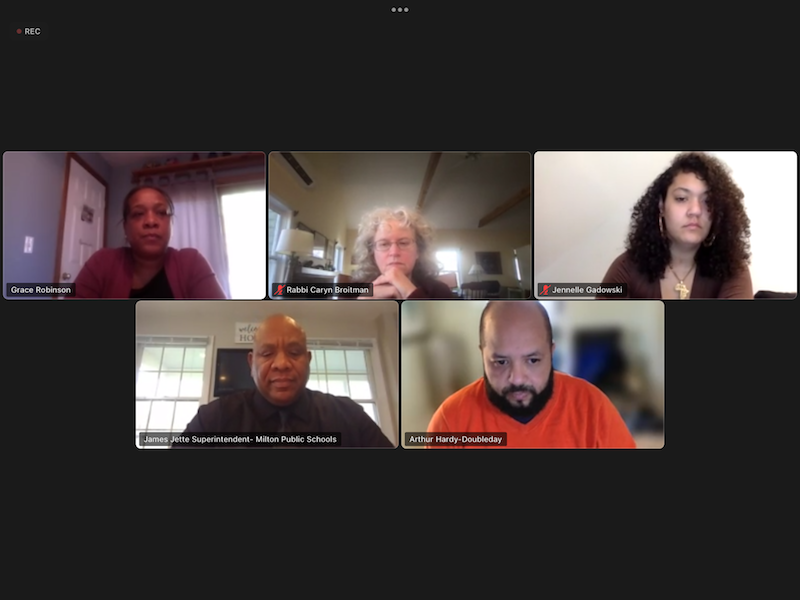
Over 100 people attended the virtual talk which was also a membership drive for the NAACP of Martha's Vineyard.
“Once you give up on them, they know,” he said, advocating for a perspective in which students are viewed not for their shortcomings, but for what they are capable of achieving.
“We need strength-based thinking,” he said. “We need to make sure our young folks, particularly black and brown, believe in themselves.”
After working for 12 years as a high school and middle school principal in Milton, Mr. Jette became the district’s top administrator a year and a half ago and has been using his pulpit to advocate for change, he said.
“I’ve been talking about diversity, equity and inclusion in all aspects, not only in education but in the workforce, in politics and so forth,” he said.
Mr. Jette has met some community resistance to his initiatives, he told the group.
“There are some people who try to steal that narrative and talk about critical race theory,” he said. “It’s not critical race theory — it’s culturally responsive teaching, implemented into an individual teacher’s craft. And what that means is acknowledging the students, their cultural identity, their identity as a whole. Their language. Their interests … It’s not a set curriculum. It’s just understanding and knowing who is before you.”
Equity, in particular, is a frequently misunderstood concept that should not be confused with equality, Mr. Jette said.
“Equality means I give everybody in this room a pair of sneakers,” he said. “Equity means I am giving everybody a pair of sneakers that fit them.”
Equity in education means providing access that allows students with different abilities to participate in the same activities, Mr. Jette said, using as comparisons the frequently-seen ramps for wheelchairs and the widely diverse finishing times among marathon runners.
“You don’t change the expectations,” he said. “You have high expectations for everybody.”
Mr. Jette also discussed the importance of voting in local, regional and national elections, and of encouraging students to think about civic issues and politics before they hit voting age at 18. In his own youth, he was completely disengaged from politics, he said.
“I was ignorant, I was passive and it was very difficult to engage me in a political discourse,” he recalled.
“I didn’t think I had an impact on it as a person of color, African American Native American man,” continued Mr. Jette, whose family is enrolled with the Chappaquiddick tribe of Wampanoags.
Now, he sees voting under threat from repressive laws being passed in multiple states.
“We can’t take …the voting right for granted,” Mr. Jette said. “Your vote does count, [and] those who are responsible for educating the children need to plant that seed in their head.”
Following his formal remarks, Mr. Jette answered a stream of audience questions read by event chair Grace Robinson, who is also his sister. Asked about the effect on public school teachers of the high cost of living on Martha’s Vineyard, Mr. Jette advised collective action.
“That is a conversation worth having with town officials [and] with your school committees,” said Mr. Jette, suggesting a potential raise or housing stipend for Island teachers. “It is a huge challenge, especially if you have to rent.”
“This is a time for educators to stand together,” Mr. Jette added. “In isolation, you’re fragile. In concert, you’re a giant.”
Before Mr. Jette spoke, Monday’s virtual luncheon guests heard from a current student at the regional high school, Beth Jennings, who read Martin Luther King, Jr.’s 1957 speech Give Us the Ballot. The 15th Amendment was passed in 1870, stating that voting rights could not be denied by race or color, and yet African Americans were subject to numerous voting barriers at the state level until the Voting Rights Act of 1965 was passed, Mr. Jette noted during his talk.
“That’s not that long ago, folks,” he said.
Comments
I was lucky enough to be a
Emily Sharon MAI was lucky enough to be a Milton Public Schools student during Mr. Jette's tenure at the middle school in the early 2000s - had no idea about the Vineyard connection! As an alum I've enjoyed following along with his promotions, all well deserved. He is a gifted educator and I will always remember him.
Thank you NAACP Martha’s
T E Hopkins Oak Bluffs, MA.Thank you NAACP Martha’s Vineyard Branch, for inviting Superintendent Jette to share his story.
Unfortunately, this ugliness is not just historical; it’s an ongoing experience for Black, Indigenous and Children of Color (BIPOC) in our local public school system.
T. Ewell Hopkins Jr.
Shame on his counselor. It so
Moreis RayShame on his counselor. It so easy to give up on a person of color, and yes it happens often, still. Maybe someday this world will change, not actually preach it but, change. I so admire this young man for believing in himself
So glad to see an MVRHS
Ray Czwakiel Continental U.S.So glad to see an MVRHS graduate invited back to share his experience and professional journey, particularly one as distinguished as Superintendent James Jette!
Jimmy, as I knew him when he
Islander61 OBJimmy, as I knew him when he was playing hoop at Niantic Park, has a strong message. His success is due to his hard work and determination. His message is a strong one and one I hope resinates with our youth of color and all our youth. Get involved. Run for political office and make a change. Hold seats on boards as a community official. Hold seats on board of directors of businesses. Teach, be a school administrator, be a role model for our youth. VOTE!!! Jimmy was an outstanding athlete. He used those talents and branched out to become a school leader. It didn't happen overnight, it took time. In this instant gratification society, I hope kids learn, it will not happen overnight, the longest journey begins with the first step. I hope Jimmy's message helps, even one student, to take that first step. Job well done Mr. Jette.
Thank you Mr.Jette. So nice
Elizabeth' Thomas Milton High School parentThank you Mr.Jette. So nice to learn more about what helped shape you into the distinguished leader that you are today.
I am a retired Milton teacher
Joseph O'Neill Milton MAI am a retired Milton teacher who was fortunate to have worked with James Jette. Over the years we have communicated many times. Mr Jette makes it clear that all involved in the education of our youth must understand that all kids want to learn. And the job of the educator is to figure out what works with each student so the student can reach his or her potential. Milton is fortunate to have a leader who understands youth and learning.
Add new comment