


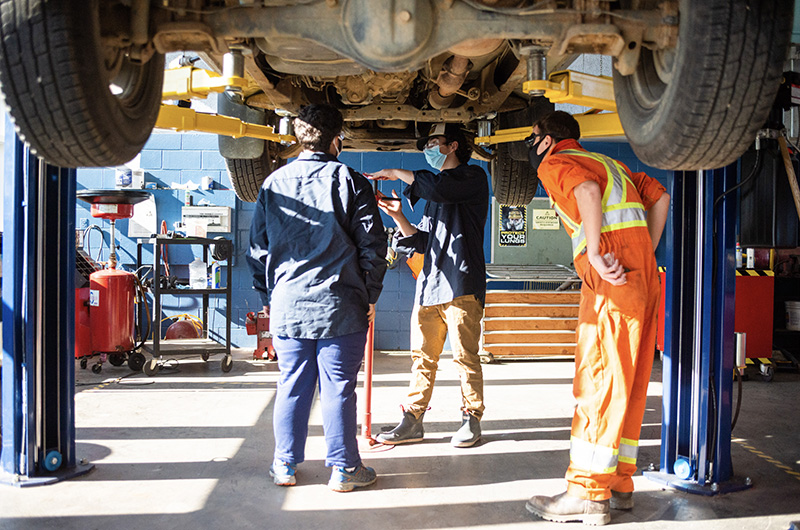
English language learners in the Martha’s Vineyard public schools have increased almost sixfold over the past decade and now make up more than 19 per cent of the total student body.
English language learners in the Martha’s Vineyard public schools have increased almost sixfold over the past decade and now make up more than 19 per cent of the total student body, providing a partial but vivid illustration of the rapidly changing demographics across the Island.
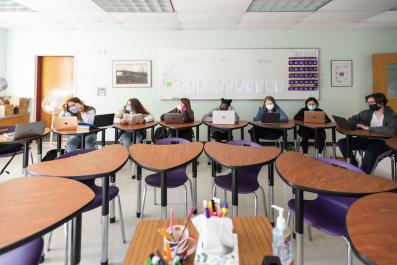
Enrollment at the regional high school is sharply up for a second straight year.
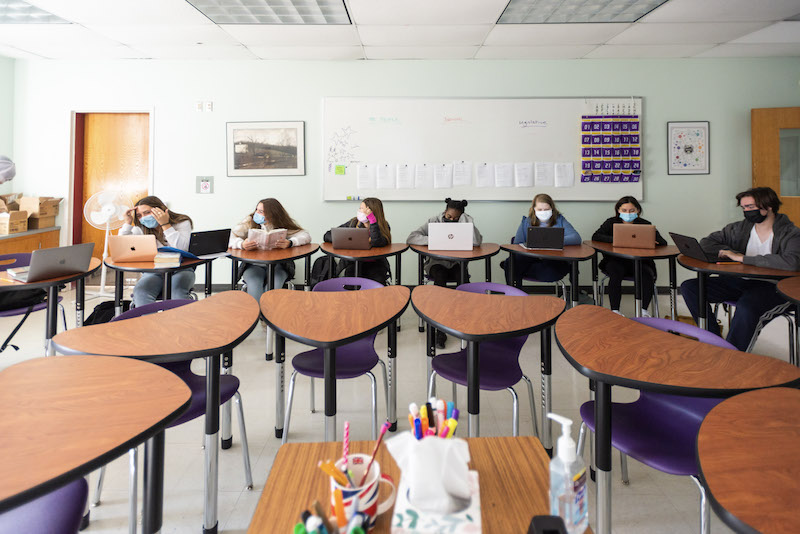
Enrollment at the regional high school is sharply up for a second straight year.
In an interview with the Gazette this week Leah Palmer, who coordinates the ELL programs in all the Island public schools, said the numbers have been changing almost daily since the start of the school year in September.
“Right now, we are at 427 English learners on the Island,” Ms. Palmer said. Last year, 347 students in the system were English language learners, she said. “To put that in context, when I started in 2011, we had 72 English learners,” she added.
The Islandwide fall student census, done annually on Oct. 1, reports a total enrollment of 2,191 in the public schools. But Ms. Palmer said an influx of new students is ongoing.
“We’re enrolling students every day right now,” she said. “I foresee that we’ll probably be at a 100-student increase in our ELL program.”
These numbers, and the children and families they represent, make it clear that the Island’s student demographics are changing rapidly, Ms. Palmer said. “Our ELL program is becoming more and more an essential service,” she said.
Across the board, enrollment is up only slightly at Vineyard schools — except for the regional high school, which has seen a sharp increase of 49 new students this fall after growing by 41 students over the whole 2020-2021 school year.

Brooke Hardman Ditchfield with her theatre students.
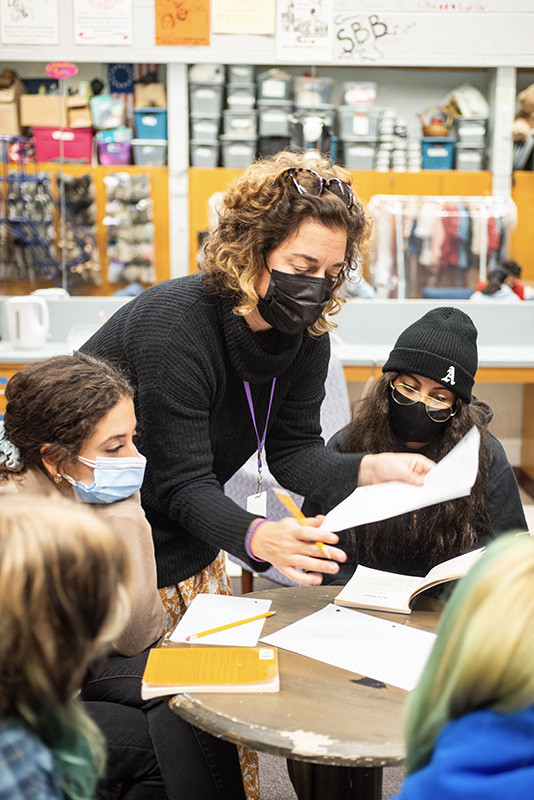
Brooke Hardman Ditchfield with her theatre students.
And the numbers are still rising, with about two-thirds of the new students speaking languages other than English, said principal Sara Dingledy, who recently received permission from the school committee to spend up to $200,000 to hire a new ESL (English as a second language) teacher and teaching assistant.
Backing up Ms. Dingledy’s request to the board, ESL teacher Jonah Kaplan-Woolner described what it has been like in his class, which teaches newcomers to English.
“Today . . . there were more kids than there were chairs,” he told the regional high school district committee at its Oct. 6 meeting.
“We had kids sitting at the teacher’s desk. We had kids standing up,” he continued. “Ordinarily the more the merrier, but these kids are . . . true beginners. These are kids [for] some of whom, their English language abilities begin and end with ‘hello’.”
In addition to the new teacher approved that night, who has already been hired, the school is looking for a Portuguese-speaking assistant for the ESL staff, Ms. Dingledy told the Gazette.
Brazilian Portuguese continues to be the predominant native language among English learners, Ms. Palmer said, with preliminary data indicating that 344 of the 427 students learning English are Brazilian.
The second largest group among the remaining 20 per cent is Spanish speakers, who account for 15 students in the preliminary data, she said.
Children speaking Chinese, Italian, Bulgarian, Romanian, Jamaican patwa, Tibetan and Bhutanese are also enrolled, Ms. Palmer said.
While young children have the ability to pick up second and even third languages with relative ease while learning other elementary subjects, Ms. Dingledy said high school students arriving without English have a double handicap: They’ve moved beyond the natural language-acquisition phase of their development, but they need English in order to learn anything else.
“When a student is 16, 17, 18, it is a different ball game than when they’re five, six, seven, eight,” the principal said.
To accommodate teens with little to no English — and in some cases, with limited facility in their native tongues — the high school starts them out in newcomer ESL classes, which Ms. Dingledy described as “a landing pad for students who need English.”
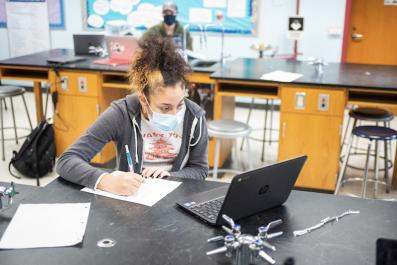
Studying in Anna Cotton's earth science class.
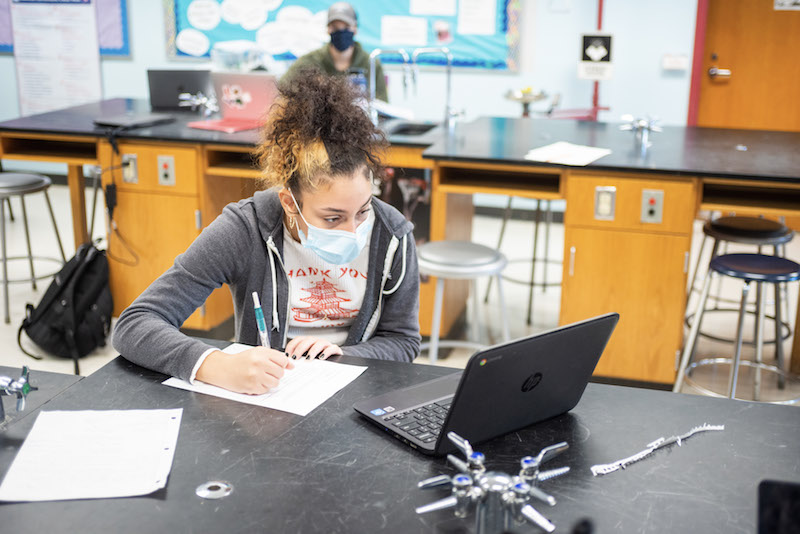
Studying in Anna Cotton's earth science class.
The ESL classes initially focus on English language acquisition over subject matter, gradually phasing in more regular course work as students gain fluency over their school careers, the principal said.
“What has changed this year is that the preponderance of them are ESL 1 [entry-level] students, which require a significantly larger population of ESL teachers than math teachers or science teachers,” Ms. Dingledy said.
“It requires a different level of support from our ESL department.”
The changing makeup of the Island’s student body is adding to the already vexing problem of staffing district schools. With teachers at all levels in short supply, finding ESL teachers and assistants from diverse backgrounds is an extra-tall order for Vineyard schools.
“As we see across the board with education, our staff does not represent our demographic,” Ms. Palmer said. “We’re really looking for ways to bring in more bilingual [and] multicultural staff.”
The district is engaged in a mentorship initiative with La Salle University for students of color who are interested in education careers, Ms. Palmer said, with the goal of increasing linguistic, cultural and ethnic diversity on school staffs.
“Brazil is so diverse,” she said. Outside the classroom, the school district is partnering with other Island organizations such as the Island Wide Youth Collaborative to make newcomers welcome on the Vineyard, and recently hosted a health access fair that drew about 20 non-English-speaking families who signed up for services, Ms. Palmer said. “Some really great conversations are happening with this,” she said. “We’re going to keep on pushing for language access and opportunity.”
Comments
All for educating people.
Abby Normal The RockAll for educating people. Also believe in legal immigration. But, many believe that does not matter. Once here, you are "entitled" to receive all the benefits.
Is that fair? Is it sustainable?
Will this make it into the comment section because of questioning their immigration status?
We have people, legal residents, either born, or went through the process to become citizens that need help.
How many people can the island support?
Abby:
Tom West TisburyAbby:
How do you know how many of these students are here with or without the proper documentation? If you have factual information, you should present it. I know several Brazilians and they are either citizens or have green cards. There are a variety of reasons why a child may come to this country legally but without speaking perfect English. I've known two who were Chinese, three Vietnamese, and one Jamaican.
I think a melting pot of many
Anne EdgartownI think a melting pot of many ethnicities is great. However, I think the responsibility and expense of learning the language of the country you have immigrated to, in this case the U.S.A, lies solely with that person or the child’s parent or guardian. I have visited many countries and they certainly do not pay for me to learn their language.
Key here being that you
Rebecca OBKey here being that you “visited” and not moved to and called your permanent residence
You have to hand it to these
Molly West TisburyYou have to hand it to these teachers and students, tackling the language barrier while also wearing masks. I can't even imagine.
Language at all levels is
Linguist MvLanguage at all levels is developed, not “acquired”. The high school students are no different than the young ones, the difference lies in their chance of speaking without an accent and we should all know highly intelligent people still have accents. There is no connection other than the age at which they learned (in) the language.
There is so much misunderstanding and false beliefs with regards to language learning. A truly educated approach to this immigrant opportunity would be to bring bilingual education to the pre-school and elementary levels. We spend so much on unlearning instead of learning both (languages). Of course they need more teachers for this influx but let’s think bigger and better for our children and community.
The Supreme Court of the
Josiane Vineyard HavenThe Supreme Court of the United States decided in the 1970's that all children have a right to public education and that immigration status is irrelevant. School systems are not allowed to ask for a student's immigration status. Massachusetts laws require accommodations for students who arrive speaking a language other than English. The two commenters above are not correct to assume that teaching of English is the family's responsibility. It is the school system's. Some of the expenses are reimbursed by the state. No school system can pick and choose which student deserves an education. All children deserve the best a school. district can offer for each of them to realize their potential.
Add new comment