


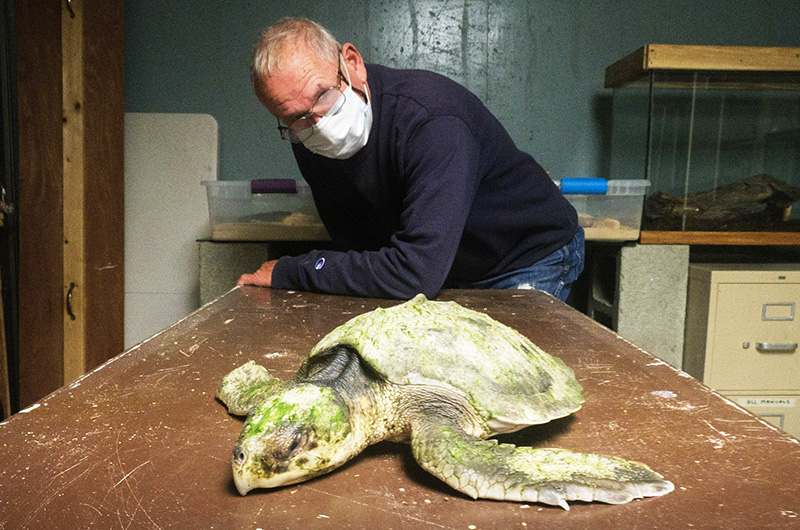
A juvenile, cold-stunned Kemp’s ridley sea turtle is on the road to recovery Friday after washing up on the Chappaquiddick side of Norton Point Beach Thursday morning.
A juvenile, cold-stunned Kemp’s ridley sea turtle is on the road to recovery Friday after washing up on the Chappaquiddick side of Norton Point Beach Thursday morning.
Will Geresy, a beach ranger for the Trustees of Reservations, found the juvenile turtle Thursday and called Island naturalist Gus Ben David to take a look at it. When Mr. Ben David arrived, he said the turtle “was just solid. But I watched it, saw one little movement and knew we had a live turtle.”
Kemp’s ridley sea turtles are among the smallest species of sea turtles, reaching about two feet in shell length and weighing up to 100 pounds. They are also one of the most endangered species of sea turtle, found primarily in the Gulf of Mexico but also as far north as Nova Scotia. For the turtles that do venture north, the southern migration can be perilous if they leave too late and get caught in rapidly cooling water.
Mr. Ben David said Cape Cod Bay can be particularly difficult for the turtles to navigate.
“They stay up here too long, get caught in the elbow of the Cape trying to head south, can’t come back around and the water temperatures drop quickly. Once it drops, they become immobile,” he said.
Mr. Ben David said the warming process for a cold-stunned sea turtle has to be done carefully and thoughtfully. Warming them up too quickly is “the worst thing you can do...You basically warm them up in stages.”
Mr. Ben David started the turtle in a room at 54 degrees Fahrenheit. He said the turtle’s body temperature had reached 52 degrees Fahrenheit by mid afternoon. Later in the evening, he moved the turtle into a warmer room, 63 degrees Fahrenheit to be precise, before carefully securing the turtle in a box for a ride on the M/V Martha’s Vineyard ferry Friday morning.
On the Woods Hole side, a volunteer from the Wellfleet Bay Wildlife Sanctuary picked up the turtle and drove it to their rehabilitation center.
After a stop in Wellfleet, Mr. Ben David said the turtle will eventually be taken to the New England Aquarium in Boston. The marine biologists in Boston will then monitor the turtle’s body weight and determine the right time to fly them to South Carolina where they will be released.
Kemp’s ridley sea turtles washing ashore on the Vineyard is not a highly uncommon occurrence, Mr. Ben David said. He added that anyone who finds a sea turtle, even it appears to be dead, should contact him immediately and not disturb the animal.
Mr. Ben David can be reached at 508-627-5634, or call the Wellfleet Bay Wildlife Sanctuary at 508-349-2614.
Comments
Kemp’s ridley cold stunnings
Charles W. Caillouet, Jr., PhD Montgomery, TexasKemp’s ridley cold stunnings are historically recurring natural phenomena, They have increased over decades with increase in numbers of hatchlings from beaches along the western coast of the Gulf of Mexico, predominantly those along Tamaulipas, Mexico. Kemp’s ridley approached extinction in 1985, despite decades of conservation interventions by agencies in Mexico and the US that protected it on nesting beaches and at sea. This species was on track toward recovery in 2009, but it experienced a nesting setback in 2010 from which it has not rebounded. Cause of the setback has not been determined with certainty.
The following scientific papers discuss Kemp’s ridley population status and rescue, resuscitation, rehabilitation and release of those found stranded alive:
Here are the two research
Charles W, Caillouet, Jr., PhD Montgomery, TexasHere are the two research papers I mentioned in my previous comments;
Excessive Annual Numbers of Neritic Immature Kemp’s Ridleys May Prevent Population Recovery
http://www.seaturtle.org/mtn/archives/mtn158/mtn158-1.shtml
A Call for Evaluation of the Contribution made by Rescue, Resuscitation, Rehabilitation, and Release Translocations to Kemp’s Ridley Population Recovery
http://www.herpconbio.org/Volume_11/Issue_3/Caillouet_etal_2016.pdf
I saved the previous input thinking I could add to it, but instead it was submitted.
Thank you, Gus.
Pia Webster EdgartownThank you, Gus.
Thank you, Gus for another
Betsy Houle West Tisbury/ConnecticutThank you, Gus for another job well done.
Thank you, Gus Ben David.
Carol formerly ChilmarkThank you, Gus Ben David.
Add new comment