

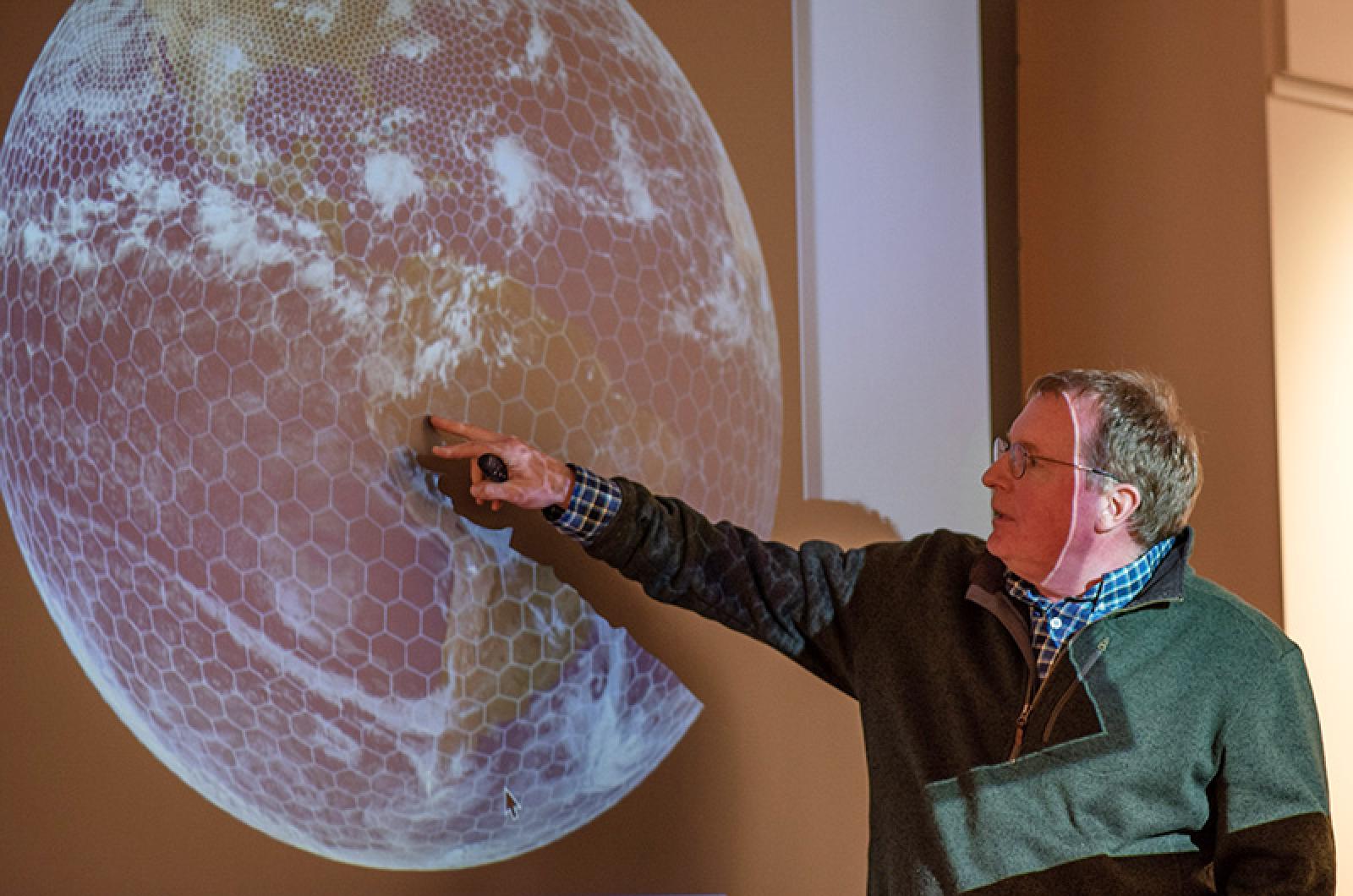
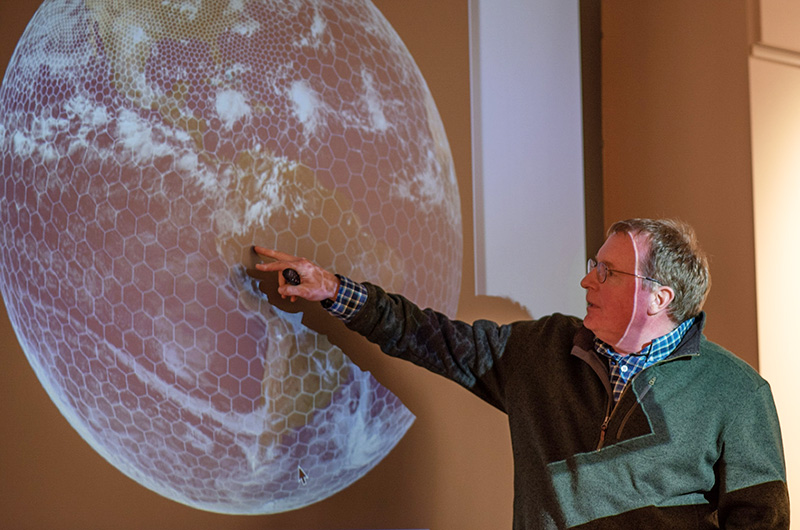
On Monday night at the West Tisbury Library, Dr. Peter Neilley spoke about our changing climate, its impact on our Island and how modern weather and climate forecasts are made.
Are weather predictions always wrong?
In short, no, they’re not. But according to Dr. Peter Neilley, the director of global forecasting sciences and technologies for The Weather Company, relying on current weather predictions to tell us where our climate is heading does not tell the whole story.
On Monday night at the West Tisbury Library, Dr. Neilley spoke about our changing climate, its impact on our Island and how modern weather and climate forecasts are made. The world of weather has evolved with today’s technology, he said. Forecasts are driven by supercomputers and satellites that continuously collect troves of data and spit out unsolvable equations that are approximated into weather and climate forecasts.
But when it comes to climate forecasting, several variables play a large role in determining the outlook. According to Dr. Neilley, boundary conditions, like the amount of solar radiation reaching the earth and how much greenhouse gases are in the air, are the main factors driving the forecasts of climate change today.
The charts tell the tale.
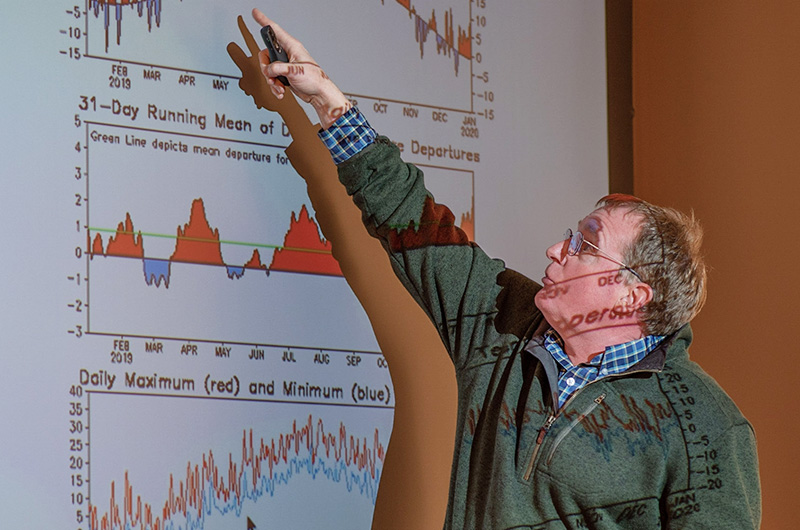
The charts tell the tale.
In his presentation he used the analogy of a car road trip to describe how weather and climate change are related. The exact details of the trip, like where you will sleep and where you will refuel, are an analogy for the weather while the big picture projection of the trip on Google Maps is an analogy for climate.
“You don’t need to understand the details to get the climate right, however, the climate does impact the details,” he said.
And the details can be quite scary.
Close to home, based on Dr. Neilley’s projections, he calculated that by 2100 the tide will submerge the Menemsha docks every 13.5 hours. Tides will also submerge Basin Road at Menemsha Creek every 1.4 years, Basin Road at Menemsha Texaco every 3.7 years and State Road at Hariph’s Creek and Stonewall Beach every 27.4 years.
And worldwide, according to Dr. Neilley’s best and worst-case scenarios, global temperatures will rise between four and nine degrees by 2100, and global precipitation will increase by three to eight per cent. There will also be more frequent droughts and hurricanes will become stronger. There won’t necessarily be more hurricanes, he said, but they will be more severe.
“As the temperatures go up, precipitation becomes more concentrated and episodic,” he said. “So, we’ll get more precipitation but the period of time between each rain will be longer.”
On average the seas could rise 19 inches above today’s levels, give or take another six inches, Dr. Neilley added.
“These climate models are right,” he concluded. “Trust them. The issue is not the science or the models, but how much carbon we are adding to the atmosphere in the coming century.”
Comments
Right up until he said to
Bob EdgartownRight up until he said to trust the climate models and that they are correct, I was liking this guy. We will see but mostly any kind of models are at best half right. On a local level when they rebuilt the high school the models said we would have 1,000 high school students by now. In fact we have close to 50 less students so there is good reason to not trust models.
"Mostly any kind of models
Bill Chaisson Wilmot, N.H."Mostly any kind of models are at best half right" is not a particularly scientific statement and paints with too broad a brush. Climate models depend on a grasp of earth systems that is continually getting better and on a data base that is continually getting larger. Climate is much more determined by a finite number of factors; where people decide to move is not.
In the case of climate models
Ann Marie Reardon Chilmark and Tenafly, NJIn the case of climate models, they have thus far proved to be far more conservative than was originally thought. The models gave a range of possible outcomes and the reality has already surpassed the most extreme of the model predictions since they were first implemented. So, we do well to take heed.
Add new comment