


In the face of a global environmental crisis, last Friday the Martha’s Vineyard Commission adopted emergency climate resolutions after Phil Duffy, executive director of the Woods Hole Research Center, delivered a stark warning on global change and human suffering.
In the face of a global environmental crisis, last Friday the Martha’s Vineyard Commission adopted emergency climate resolutions after Phil Duffy, executive director of the Woods Hole Research Center, delivered a stark warning on global change and human suffering.
The emergency is clear. The globe is warming, glaciers are melting, seas are encroaching, and storms, droughts, and floods are intensifying. As species extinctions loom, desperate peoples are fleeing their homelands, human health worsens, our national leader stands in denial, and yet, we continue to abuse the earth.
Now is the time for each of us to act — in our own backyards and through local, state and national policy. The greatest first step that we can take is to keep our landscapes intact so that nature can continue to support human life as it has forever. Engineering, technology, and reduced consumption are essential, but the green infrastructure of forests, wetlands, grasslands, and farmland is resilient and has unparalleled capacity to strip greenhouse gases from the atmosphere, cleanse pollutants from our waters, and lend health and serenity to our lives. Protecting and restoring the earth keep this infrastructure intact to serve humans and nature indefinitely.
Scientists recognize that one third of the solution to climate change lies in halting the destruction of the world’s forests. Their principal focus is on the tropical centers of biodiversity, such as the Brazilian Amazon where rampant deforestation has shocked the world.
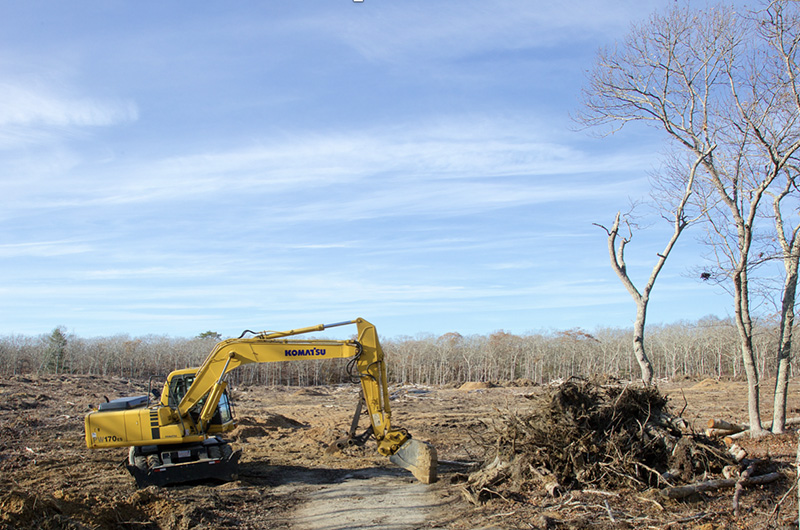
But what of our own backyard on the Vineyard? Here, the scenes are equally dramatic. Forests never cleared in 10,000 years are being clearcut, bulldozed, and replaced with houses, solar arrays, and roads. Farm fields that yield habitat, environmental benefits and food are treated no better. Recent proposals are frightening: solar panels on water source areas and critical habitat in Oak Bluffs; expansion of trash and airport facilities adjacent to the state forest, 54 acres of woodland eyed for 28 4,800 square-foot houses in Edgartown, and clearing for a 10,000 square-foot gaming facility in Aquinnah.
A new study by Brian Hall at Harvard University shows that 400 acres of natural and farm landscape has been lost to development in the last four years since we compiled the data for A Meeting of Land and Sea. This represents 280 acres of forest, 75 acres of grassland and heathland and 45 acres of hay and cropland.
The Island and the globe are finite and both are conveying stark warnings. Pollution closes our ponds to swimming and shellfish harvests, our roads flood with every major storm, and each year sets a record for warmth. The lesson is clear: we need to establish limits and support nature to keep our environment livable.
This emergency will require much of the MVC and each of us. But the first step should be a policy of no net loss of forest or farmland. We need to support the health of our communities and ourselves by keeping the Island and the globe intact.
David Foster is director of the Harvard Forest at Harvard University and author of A Meeting of Land and Sea. The Nature and Future of Martha’s Vineyard
Comments
Now is the time to meet with
Ewell Hopkins Oak BluffsNow is the time to meet with your local Planning Board. As we approach the 2020 Town Meeting season, know the deadlines for the submission of warrant articles.
A very sad unintended
Sheila Terranova Beasley Oak BluffsA very sad unintended consequence of the title five septic law is the destruction of our tree canopy resulting in greater water use for irrigation and thousands of years of soil build up destroyed, doing away with insects as well. We need a better system than the one we have that plows down trees, shade, destroys soil, kills the insects, and requires enormous irrigation and fertilizer just to grow grass.
A very sad unintended
Sheila Terranova Beasley Oak BluffsA very sad unintended consequence of the title five septic law is the destruction of our tree canopy resulting in greater water use for irrigation and thousands of years of soil build up destroyed, doing away with insects as well. We need a better system than the one we have that plows down trees, shade, destroys soil, kills the insects, and requires enormous irrigation and fertilizer just to grow grass.
I’m all for stopping
Greg mVI’m all for stopping development on MV. However this island has been clear cut several times. There are no 10,000 year old forests on this island.
In addition we need to stop the spread of ticks. Open ground, short grass and sunlight are currently the best way to control them..
Finally there is no cost effective option to septic systems. Sewer systems are prohibitively expensive for most of the island and we have to control damage to the ponds.
Add new comment