

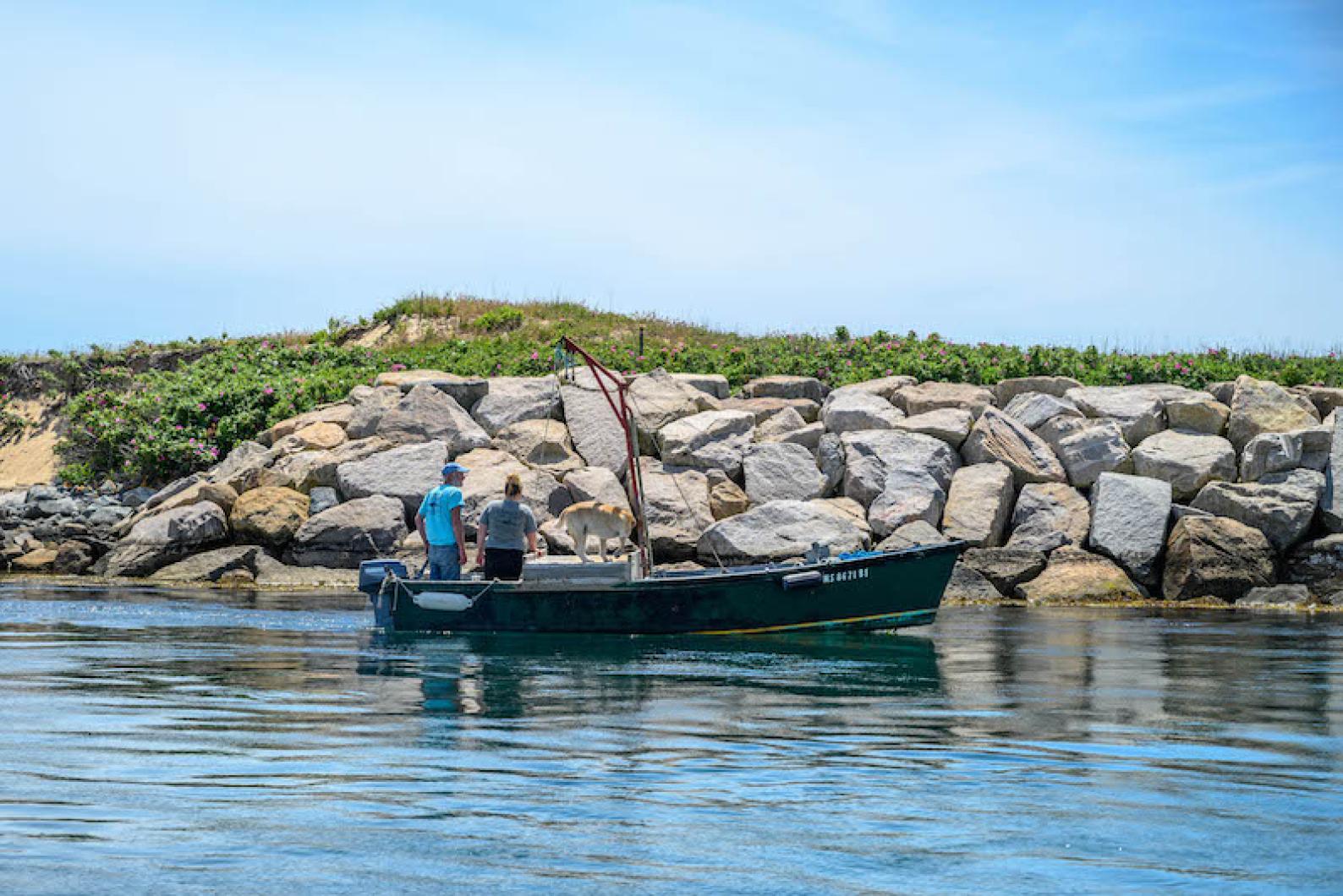
<p>With their school now empty, educational leaders on Cuttyhunk plan to host visiting middle school student groups who will learn about the island ecology and environment.</p>
With the graduation of the final eighth grade student from Cuttyhunk Elementary School last week, educational leaders on the tiny island are plotting a new course for the one-room schoolhouse.
The school plans to host visiting middle school student groups who will spend a week on the island that lies at the tip of the Elizabeth islands chain, learning about its ecology and environment.
“It’s vital that we keep the schoolhouse open to continue that vibrancy on-island when everyone else leaves,” said Michelle Carvalho, who is the teacher and principal at the Cuttyhunk school. “And my hope and goal is to engage the community with STEAM Academy programming.”
The island has a declining year-round population that numbered 12 last winter.
Superintendent of schools Dr. Margaret Frieswyk said Cuttyhunk’s long-range planning committee had identified the school as a priority for vitalization.
“Michelle Carvalho and I came together and talked about how could we bring energy and exposure to the island in an academic way,” Ms. Frieswyk said. She added that if a school-aged child does move to the Island, the regular school would reopen to serve the need.
STEAM stands for Science, Technology, Engineering, Art, and Math. The Cuttyhunk curriculum will focus on the environment of the island with an emphasis on the ocean. Lessons include exploring the effects of ocean acidification, identifying uses for seaweed, learning about aquaculture and assessing water quality.
The STEAM Academy project was piloted this spring with 10 eighth grade students from Falmouth. It has received ample support from island residents, including some $80,000 in donations from 50 donors, Ms. Frieswyk said. Housing for Ms. Carvalho has also been donated. For the pilot program, a local family hosted and cooked meals for visiting students.
Ms. Carvalho said she envisions a curriculum that involves the participation of Cuttyhunkers. During the pilot program this spring, one islander gave a historical tour of the island, a diver gave a presentation about shipwrecks, an artist donated lobster buoys for an art project and another islander gave a tour of his aquaculture program.
“The students had an opportunity to taste some fresh oysters from the pond,” Ms. Carvalho said.
Ms. Frieswyk said the capacity will be about 20 students, with an all-inclusive cost of $500 per student. Students will stay in island lodging and rentals.
The Cuttyhunk school has stayed open almost continuously since it was founded in 1857. Ms. Carvalho has taught there for four years, spending winters on Cuttyhunk and returning home to New Hampshire in the summers.
Ms. Frieswyk said the new STEAM academy will operate with a $70,000 budget supplemented with donations. So far no groups have enrolled for next year.
“We just think the island is a space that is very conducive to learning,” she said. “So the outcome for the visitors would be that they would have a pretty incredible weeklong oceanographic biological STEAM experience.”
Ms. Carvalho said while she looks forward to the new program, bidding farewell to school’s final full-time student last week was not easy.
“It’s certainly bittersweet. I think the town has supported a schoolhouse here on island since it was constructed,” she said. “I don’t envision anyone moving on island who has a small family.”
Comments
Wonderful idea
Mike WTWonderful idea
I hope that the program is a huge success
Islanders could donate time teaching what boooks don't.
-'Experience'-
It will be fascinating for the informed and uninformed.
Great plans and wonderful
Nancy NYGreat plans and wonderful opportunities await!
A great model for this
Lorna VAA great model for this approach, if you haven't already checked it out, is Islandwood on Bainbridge Island, WA, just across the Sound from Seattle. Middle school students go as part of the public school curriculum.
Perhaps an exchange program
Peter Becker, Port Angeles, WAPerhaps an exchange program between the two would be useful. As a professional of 35 years in the Shellfish Aquaculture business in Washington and past Islander who drove tours of the Vineyard for Westley. House and cruised the Elizabeth Islands, they present a different perspective and Cuttyhunk and Vineyard Shellfish groups are well worth experiencing.
The breadth of understanding out here is lacking and a week in New England for the shellfish aquaculture alone would help students and their adult guides better understand the history of shellfish aquaculture through a bigger lens.
After all, it started just across the way at WoodsHole when Spencer F. Baird started the US program in Aquaculture in 1870. (but not called that until 1930!)
Another partner might be Friday Harbor Lab on SanJuan Island which owed it’s early existence to a joint partnership with landlocked Whitman College and Ohio State Universities. Friday Harbor too would benefit from exposure to the East Coast successes in aquaculture.
Add new comment