

<p>The Vineyard has had its second confirmed sighting of a live Eastern coyote — the first sighting in at least three years — Island wildlife biologist Gus Ben David 2nd said Wednesday.</p>
The Vineyard has had its second confirmed sighting of a live Eastern coyote — the first sighting in at least three years — Island wildlife biologist Gus Ben David 2nd said Wednesday.
Unlike the Island’s previous live sighting and five earlier dead coyote sightings, this one did not occur on the Island’s north shore.
Although Mr. Ben David would not disclose the location of the animal to protect the confidentiality of the property owners, he confirmed the coyote was photographed and filmed on a camcorder at approximately midnight Tuesday.
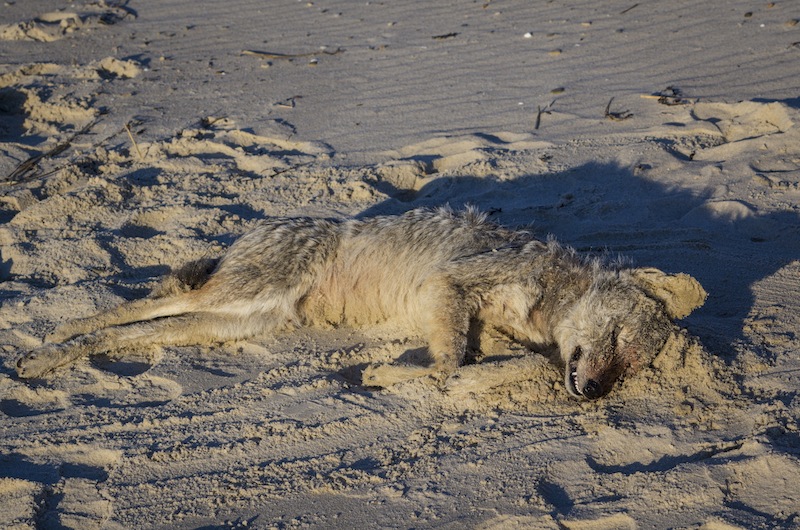
“No doubt about it,” Mr. Ben David told the Gazette on Wednesday. He said the coyote was a fully grown adult of average size. “Looked like 40 pounds. It wasn’t an exceptionally big one, but definitely an adult,” Mr. Ben David said.
Coyotes are found on the Elizabeth islands and Cape Cod, but there are none on the Vineyard beyond an isolated sighting of a single animal three years ago and a handful of carcasses found washed up on the shoreline over the years.
Mr. Ben David believes the animal came from Naushon, the largest of the Elizabeth islands which has had an established Eastern coyote population for decades. He said environmental factors can force the notoriously territorial animals to seek new terrain. Occasionally that means by water.
“They swim, they are known to do that,” Mr. Ben David said. “They do it when they are expanding their range in their particular area, or if the prime habitat is taken over by alpha animals. They can get pushed out of their territory, and then they would swim across.”
Because Naushon is only four miles northwest of Martha’s Vineyard, all the previous coyote sightings have occurred on or near the Island’s north shore, where passage is possible although difficult in strong currents. But this animal was spotted elsewhere, Mr. Ben David said, prompting further questions surrounding its whereabouts.
“This animal most likely came from Naushon,” Mr. Ben David said. “That means it has already traversed part of the Island, which they do. They are tremendous travelers until they set up their territory and find a den site. This animal could be in Edgartown tonight and West Tisbury tomorrow.”
Eastern coyotes evolved from their smaller Western counterparts, moving across the continent and cross-breeding with wolves along the way.
Mr. Ben David said there is no chance that the wild coyote was brought to the Island by a human. “No, no way. Coyotes, even if you raise one from a little pup, they’re vicious. No way that animal was brought to this Island. That animal basically got here on its own volition,” he said.
Mr. Ben David said he has contacted a state environmental official to report the coyote sighting. While coyotes, which look like “racy dogs,” according to Mr. Ben David, can vary widely in coloring, he said this one was fairly average in both weight and appearance.
“It wasn’t anything exceptional color-wise,” Mr. Ben David said. “The typical grayish with the black. Normal.”
Although Mr. Ben David said the previous live coyote was never spotted again and likely killed by hunters, he believes that having a breeding population of coyotes on the Island, where there are no natural predators for the animals, would have serious ecological ramifications. For example, Naushon used to have about 150 domestic and 300 wild sheep, Mr. Ben David said. Now there are 12 domestic sheep. And they have to be kept inside at night.
With its recent resurgence of small farming, the Vineyard has large populations of sheep, goats and free-range chickens. The Island also has a large domestic pet population.
“If they get established here, you’re going to have human-animal conflicts,” Mr. Ben David said. “They’re a predator, they affect everything. They would cause a lot of problems, especially for people with livestock,” he added.
“There’s an abundance of prey here,” he continued. “Rabbit carcass. Whale carcass. Seal carcass. Berries, seeds, nuts, mice, snakes, anything. They’ll basically consume just about anything.”
While Mr. Ben David said some environmentalists would suggest leaving the animal alone because it most likely arrived on the Island by natural means, he said it’s widely accepted in the hunting and outdoorsmen community to shoot coyotes if they’re spotted, especially considering the threat they pose to farmers.
Mr. Ben David said now that the one coyote has been spotted, he and other Island biologists will take steps to ascertain if there are more. He said if someone is certain they’ve spotted a coyote, they should call him.
“I haven’t had a coyote call in I would dare say at least two years, and it’s the second time we’ve had a live one. We’ll see what happens,” Mr. Ben David said. “They’re amazing creatures. They’re the most adaptable. Wily, wily coyote — that’s apropos.”
Comments
I was heading over the bridge
RT WTI was heading over the bridge to OB maybe 4 years ago, and absolutely without question saw one pass right in front of me and made its way over towards the lagoon. I saw an OB cop - he said thanks - stopped into the OB police station - no one was there.
Why the immediate rush to the
Jim NYCWhy the immediate rush to the negatives — is it legal for hunters to kill these animals?
Are there any positives to this ? Lowering rodent population, deer herd, canadian geese occupation, lowering mice and lyme rate?
Just because they have arrived doesn’t mean they need to immediately die.
There is a hunting season in
EditorThere is a hunting season in Massachusetts for coyotes. Here is a link to the state website: https://www.mass.gov/service-details/coyote-hunting-regulations
For me all the anecdotal
Big Picture View EdgartownFor me all the anecdotal evidence of coyote attacks unrelated to hunting for food became real when a pack took my 20 lb dog out of my yard in a suburban neighborhood! I was unaware of coyotes in our town. NowI know they breed like the proverbial rabbit analogy and during the winter they will stalk and kill dogs and cats, not to eat but out of territorial aggression. If coyotes are allowed to colonize here that choice would be choosing these predators over every other living creature on the island. They are not native and are as big a threat to the environment as any non native species.
Agreed. They will go for the
Mr. B ChilmarkAgreed. They will go for the low-hanging fruit, and there is plenty on MV; they will expand their numbers rapidly and become increasingly aggressive.
If coyotes prey on deer, they
Geoffrey L West TisburyIf coyotes prey on deer, they could have a very positive effect on Vineyard plant ecology by limiting pressure from deer browsing. I'm not minimizing the risk that coyotes pose, but I am pointing out there are most definitely two sides to the issue.
Newton's healthy coyote
Vick Danberg Newton CentreNewton's healthy coyote population thrives on rabbits, domestic cats let outside and small dogs let out in backyards after dark. Telephone poles here are filled with "lost dog, lost cat" posters. There is no such thing anymore in Newton as an "outdoor cat".
If coyotes take hold on the vineyard, life as we know it will change, as it has in Newton. The wild turkeys can fly away when one of them gets caught. Not so with cats and dogs, which seem to be their easiest prey.
Yes, all true. They take
Carol formerly ChilmarkYes, all true. They take outdoor cats & small dogs first - easiest prey. When coyotes are killed here in Calif. and an autopsy is done, stomach contents always feature domestic (though could be feral) cats and small dogs. The way you know the coyotes have moved into your neighborhood is the proliferation of Lost Dog and Lost Cat posters - all true. Sorry folks, they won't be going after the white footed mice (too small) or the deer (too large, though fawns are a possibility). It'll be cats, dogs, then smaller livestock, especially sheep.
Agree, the presence would be
Jim H TisburyAgree, the presence would be a huge plus. A natural predator to deer, skunks, turkey, mice, and seals on the beach, is essential to maintaining balance of the Island’s ecosystem. Really, if they did not find a way to colonize the Island soon we would have to consider introducing a few ... but happy to have a “population” started without interference.
As a homeowner with pets, I
Pat W. West TisburyAs a homeowner with pets, I wonder if Mr. Ben David has any cautions or suggestions for keeping our pets and livestock safe. Need we be concerned about the coyote's presence and take special protective measures at this point? Also hope that any future sightings will be reported, and it would help to know at least general location.
It's a darn shame they don't
WashAbhorred EdgartownIt's a darn shame they don't take on deer...might help with the tick problem.
It's the mice not the deer
Mike WTIt's the mice not the deer
Problem is any ground nesting bird becomes prey
Aooooooooooooooeeeewwwww
Coy Under draw bridgeAooooooooooooooeeeewwwww-hhhhhhhh
I see the presence of coyotes
Chicken Owner West TisburyI see the presence of coyotes as positive. Even as a former chicken owner, I approve of a coyote population here. In addition to preying on tick-carrying mice, they might make a dent in the skunk and raccoon population--and raccoons are horrible poachers of chickens. I'd rather have a reclusive coyote here and there than hundreds of raccoons. A question I'd have is about coyotes mingling with dogs... I don't know if this would be a problem. But a predatory coyote population may actually help keep the rampant pest population in check.
here in falmouth, coyotes are
oceanna falmouthhere in falmouth, coyotes are quite a problem. they are around night and day. meaning if you have small pets, cats or dogs or keep rabbits, chickens, etc. you will need to keep them indoors or protected somehow or you will lose them.
They probably wouldn't do
Hunter west tisburyThey probably wouldn't do much with the raccoon population. You for sure would see less skunks. Raccoons are very tough animals that a coyote learns pretty quickly he doesn't want to mess with especially when theres an abundance of easier meals. A coyote or group of coyotes will kill and eat a dog if given the opputunity. Average weight of an adult coyote is about 30 pounds. Small but very powerful animals
Coyotes will kill deer
charlie callahan so boston/edgartownCoyotes will kill deer
Bring in the Road Runner !
Looney Tunes EdgartownBring in the Road Runner !
Looney Tunes, best comment
Lorraine EdgartownLooney Tunes, best comment yet. Or, at least, if not available, how about a Real Roadrunner Hemi?
Has anyone contacted the Acme
Bulkington EdgartownHas anyone contacted the Acme Anvil Company? They know about controlling coyotes, even intelligent, wiley coyotes.
Bulkington and Looney Tunes,
Lorraine EdgartownBulkington and Looney Tunes, you have absolutely made my day. Roadrunner is THE cartoon...
I cared for coyotes
Katryn Hines Tucson, AZI cared for coyotes rountinely at a wildlife center and did not find them to be "viscous." They were guarded and curious and it was easy to see why in Native American lore they were the trickster. It is my understanding that one cannot go shooting coyotes willy-nilly in MA and that there is hunting season or if they are a threat which seems vague and is likely to be manipulated. While the prescence of a growing population of coyotes on MV would alter ecological relationships why interfere as half the species in the world are on the move including ospey? The world has a terrifying history when certain populations are allowed to be extinguished. Should we kill off the increasing population of Great White sharks or summer tourists wearing blue hats? Let it be.
you do realize that martha's
oceanna falmouthyou do realize that martha's vineyard is an island. once they're here, they are not likely to "move on". also, i believe that eastern coyotes are a lot different than western coyotes. eastern coyotes are larger, a mixture of coyote, wold and dog. so naturally people are concerned. there are no natural predators for coyotes on the island as there would be in parts of the mainland.
I am a former resident and
Kathryn Hines Tucson, AZ /Sunnyvale, CAI am a former resident and lived on another island, as well. Thanks. Of course there will be effects, everything does, including the tourists that descend on the island. The question is do you interfere with a natural process or manipulate it to your advantage? They have been anticipated for some time. Address fears by learning more about coyotes, ask for a tour at the Cape Wildlife Center, perform tasks that do not attract them to your yard, learn how other isolated communities are managing and continue with MA hunting season. Their population will inherently level out and possibly become a sub-species like some other species populations on the island.
Is it safe to fish at night??
Bob West TisburyIs it safe to fish at night??,are they dangerous to humans,?will they attack,someone out there please let us know
They have confronted small
Big Picture View EdgartownThey have confronted small dog owners with their dogs on leash in cities across the country including Chicago. If one pack is allowed to establish there will soon be dozens. No dog or cat or animal will be safe outdoors. With no natural predators they will over populate and start competing for scarce resources, which make them a danger to small children. You will always have the live and let live group...which can lead to people having to change their behavior so much to protect themselves and their animals that it is like living in a cage.
I think people fish at night
Steve FalmouthI think people fish at night in Cape Cod all the time and are just fine, Bob
Looks like the Summer People
PB East ChopLooks like the Summer People have arrived early this year.
Here's a link to an excellent
Steve Allen Purcellville VA and EdgartownHere's a link to an excellent article we published a few years ago in the newsletter of our local wildlife conservancy in Northern Virginia. Contains a lot of good information about coyote life-cycle and how to get along with and manage them in your neighborhood. Author is a wildlife biologist with the Humane Society.
https://loudounwildlife.org/2015/10/coyotes-loudouns-ghost-dogs/
Let's just leave the coyote
Paulli D EdgartownLet's just leave the coyote alone and let him/her get some of the rabbits, deer, skunks, and turkeys taking over the island. We need some balance on the island, and a pair of coyotes would be better.
I see the presence of coyotes
JBM OBI see the presence of coyotes as positive.
So many people with so many
Michael OBSo many people with so many opinions.
Is anyone correct?
problem is you don't just
PeterW edgartownproblem is you don't just have two, they breed and with so many food opportunities the population would likely expand. And they do attack humans, especially small children
https://www.ocregister.com/2018/11/20/what-you-need-to-know-about-coyot…
https://losangeles.cbslocal.com/2018/11/19/coyote-attack-placentia-park/
Farmers around here use
Denise Leary Hume VaFarmers around here use donkeys to keep their cows and sheep safe. Just a thought from one who loves the Island.
If they go after skunks it’s
Edtown resident EdgartownIf they go after skunks it’s a positive!
Add new comment