


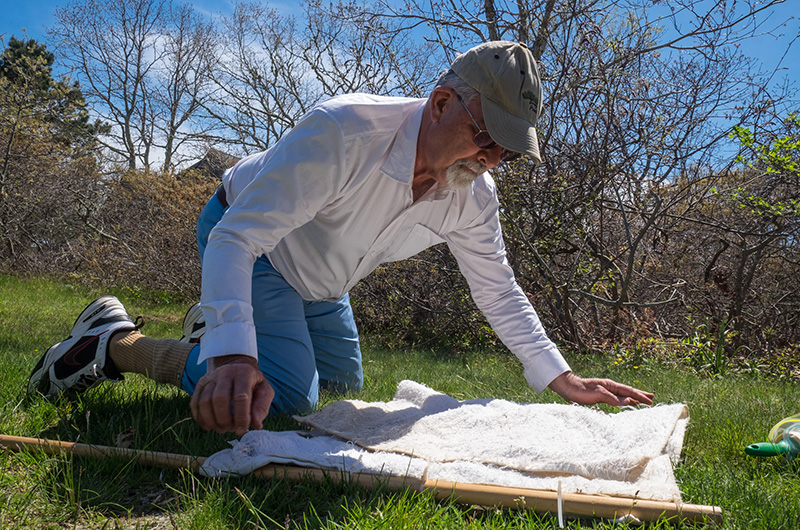
Lone star tick nymphs and adults are spreading and increasing in numbers, data from the MV Tick Programs 2018 yard surveys shows.
Data from the MV Tick Programs 2018 yard surveys clearly document the spread and increase in numbers of lone star tick nymphs and adults. In addition, I have been receiving a disturbing number of reports about people who have encountered lone star larvae, primarily from Chappaquiddick and up-Island.
Female lone star ticks can lay as many as 5,000 eggs. Unlike deer ticks, when the lone star larvae hatch they do not disperse but tend to stay in clusters on vegetation. When an unlucky person (or other animal) brushes against this cluster, hundreds of tiny ticks move onto the person. In my experience, the larval clusters seem to occur about shin height, so they tend to end up between the ankle and the knee. Although the larvae are tiny, they move very quickly and tend to bite as soon as they encounter bare skin.
If the unlucky person has not taken proper precautions they can end up with hundreds of tick bites in a matter of minutes. The silver lining is that since the larvae have not fed yet, most do not carry any illnesses that can be transferred to humans. However, recent research indicates that a small percentage of may carry disease organisms transferred directly from the mother to the larvae, so we need to monitor this situation closely.
The bad news is that the bites itch terribly for a long time, as much as six weeks in some reports. Because of the number of bites and the fierce itching, many people believe they have gotten into chiggers, however as far as I know there are no chiggers on the Vineyard.
We have not had enough experience with lone star larvae on the Vineyard to know precisely when they are active. But it is clear that they are present in August and September and possibly well into October. We are also still learning about their habitat, but I have encountered larvae in tall grass and brush and lone star ticks seem to be partial to cedars, pitch pines and possibly other conifers.
The best way to avoid lone star larval bites is to wear long pants, tucked into your socks, both treated with permethrin. You can buy clothing pretreated with permethrin or purchase the spray and do your own clothes.
I like the Insect Shield brand of clothing, which can be purchased online or at outdoor stores. The treated socks are available on-Island at Basics in Oak Bluffs and Brickman’s in Vineyard Haven. If it is still shorts season, the next best thing is to spray your legs, feet and footwear with a good repellent; traditionally products that contain 25 per cent deet have been considered the most effective. Recently several plant-based products have been developed that seem to offer promise, including BioUD, Nookatone and a combination of essential oils.
For more information about these plant-based repellents, see the Center for Disease Control website at cdc.gov/lyme/prev/natural-repellents.html.
Richard Johnson is an Island biologist who leads the Martha's Vineyard tick-borne illness reduction program.
Comments
I got my first lone star tick
Brad Chagnon MashpeeI got my first lone star tick bites on Naushon Island three years ago
Oh, Joy.
EmilyOh, Joy.
Can’t some smart humans figure out a way to decimate the tick population? We on the Numbskull Planet have a bigger brain. Surely we can figure this out. Is there any beneficial purpose to their existence?
We have been plagued by
Going Crazy ChilmarkWe have been plagued by dozens of lone star tick larvae bites, driving us completely nuts. Our Doctor has prescribed a 5% permethrin ointment that has to remain on our bodies for 14 hours before scrubbing it off. Thankfully this treatment seems to be working although we are only 3 days out!
The biting has been going on since mid-August. We thought the bites were from no-see-ums or bed bugs. We inspected beds and furniture finding no trace or evidence of any bugs. We did endless loads of laundry, washing sheets and towels and clothing. We vacuumed and mopped but the itching did not stop. We showered many times a day all to no avail. The bites occur in clusters or straight lines along the edges of clothing and underwear. Dick, Do we have tens of thousands of larvae clusters in our yard? Can you detect the larvae with your white cloth method of picking up adult ticks? Does the larvae die after biting a host? Does the larvae live in clothing or furniture or bedding? We have found them in the center of the bite and in magnification, they have 6 legs. We have also pulled off the nymphs. What is the white pustule that forms during or after a larvae bite? I will email you directly with these questions. Thank you for your work on mapping the tick population. If all these larvae survive then there will be a gazillion adult lone star ticks on our property. A frightening image to say the least.
I have heartland virus and
Glen Meyer Lincoln mo. Central mo.I have heartland virus and alpha gal from lonestar tick
Use colloidal Silver and stevia. Folks it works.
Add new comment