

<p>The return of grasshopper sparrows at Katama this summer has been heralded by Island conservationists as a hopeful sign of ecological health.</p>
The return of grasshopper sparrows at Katama this summer has been heralded by Island conservationists as a hopeful sign of ecological health.
The Trustees of Reservations documented the rare grassland-nesting sparrows at the Farm Institute during an ecology assessment this summer.
“Actually, first we heard them. Then we saw them perching,” ecology assistant Caitlin Borck told the Gazette.
Native to the grassy Great Plains of Katama, the grasshopper sparrow once flourished in many spots on the Island and the Cape. As late as the 1980s, birders documented at least 10 breeding pairs at the Katama Airfield. But by the early 2000s the sparrows had virtually disappeared from the Island due to a combination of factors, including habitat loss, the introduction of skunks and other predatory ground mammals and a regional population decline.
The three males Ms. Borck and her associates located this summer mark the first grasshopper sparrows seen at Katama since 2005, and the first ever found on the Farm Institute property — 186 acres of conservation farmland owned by the town and managed by the Trustees.

Tiny sparrow has a light song and muted colors, making it hard to detect.
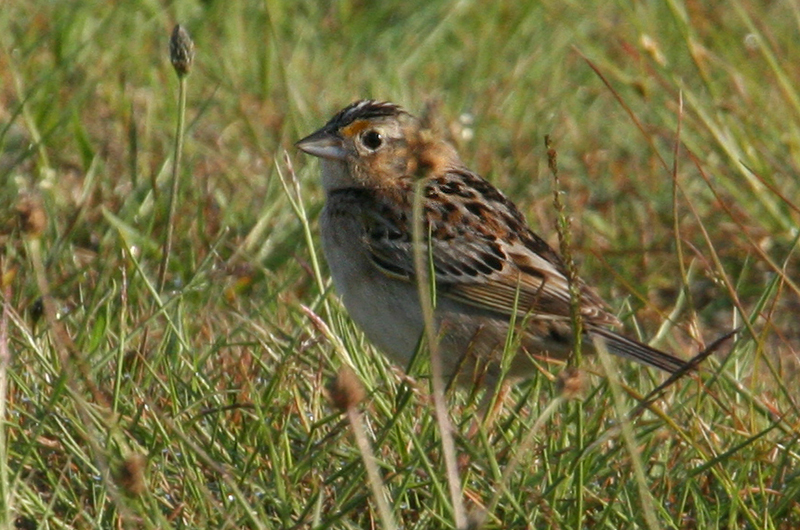
Tiny sparrow has a light song and muted colors, making it hard to detect.
“It’s a big deal,” said Rob Culbert, the Gazette bird columnist. “If they’re back, that would be great news. Even though they’re state protected, the birds are very rare in Massachusetts.” Mr. Culbert said he currently knows of only one other spot on the Island with grasshopper sparrow sightings.
Tom Chase, Island wildlife conservation expert for The Nature Conservancy, which has played an active role in conservation management at Katama, said he was pleasantly surprised to learn the news.
“The Katama Airfield used to be one of the last strongholds of the bird on the Vineyard,” Mr. Chase said, “but as the regional population has declined, the local population started to blink out in small areas, and the Katama population did blink out. I’ve never known them to be on the Farm Institute side, so that may have to do with improved management practices there,” he added.
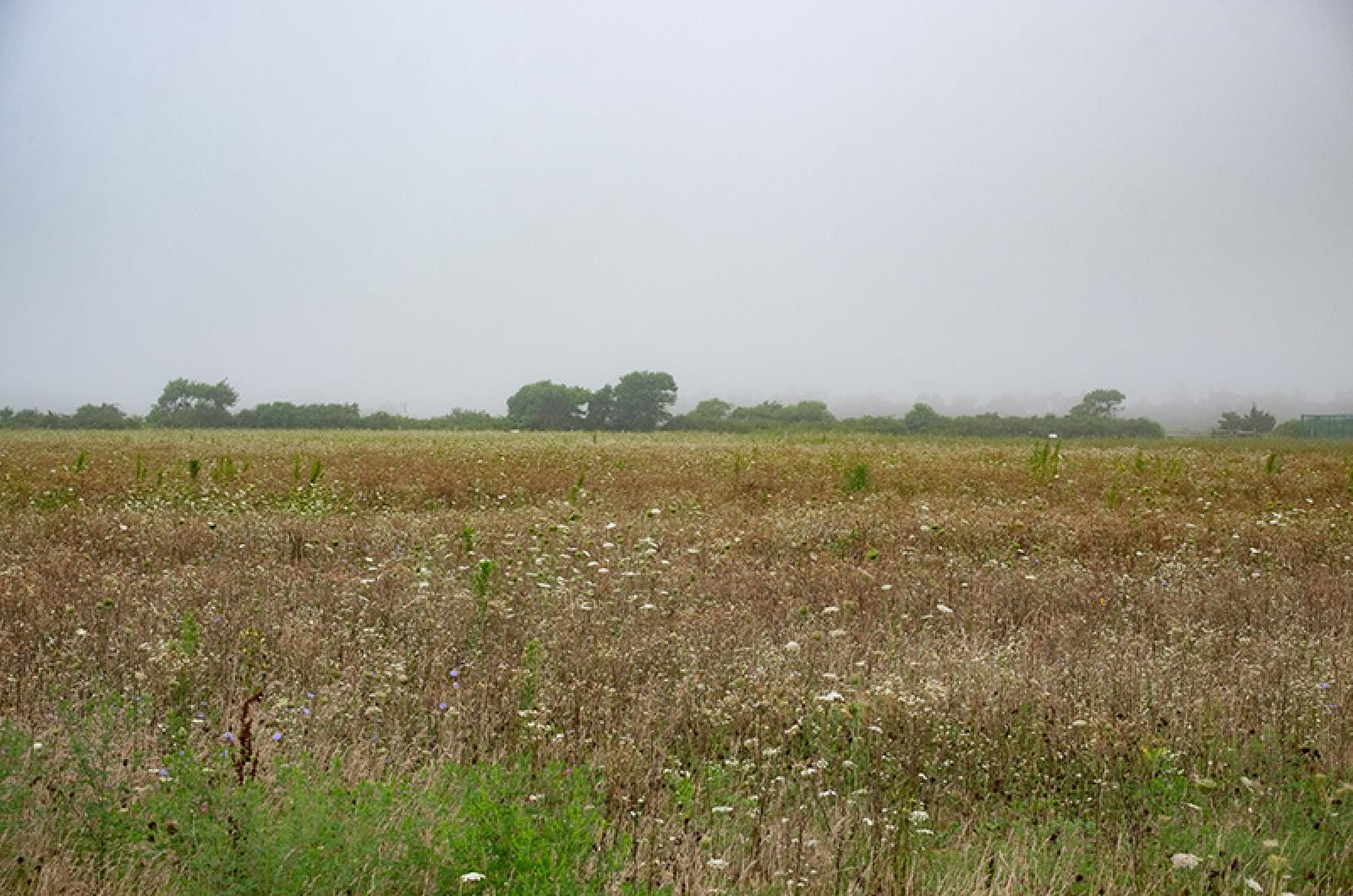
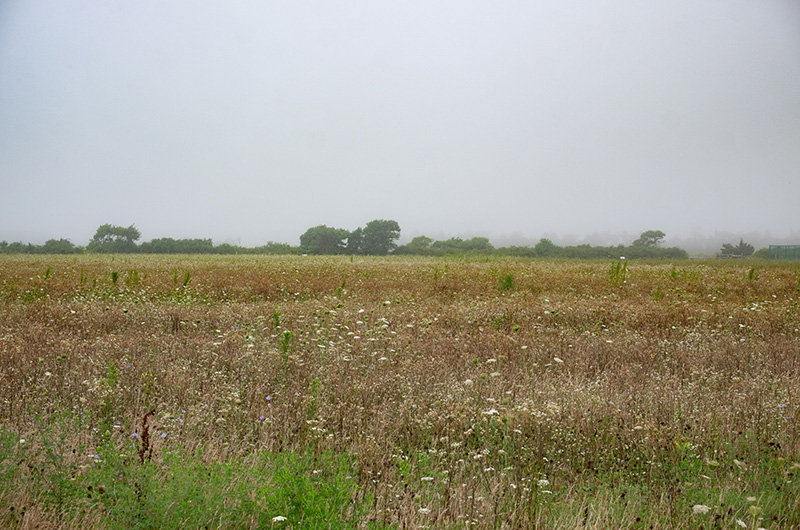
The small sparrows like to nest in sparse grasslands with patches of bare ground. At the Farm Institute, a nonprofit educational working farm taken over by the Trustees three years ago, over grazing by cattle, sheep and other animals had made the land uninhabitable for the birds, Ms. Borck said. Sustainable prescribed grazing was begun with an eye toward reestablishing the sandplain grassland habitat.
“We’re hoping that’s what has allowed the birds to come back,” said Ms. Borck. “Our goal is to create habitat for target species. We reduced our herd size dramatically — by 55 per cent — which would be better for grassland habitat.” She also said the Farm Institute now grazes animals on a rotating schedule that reduces pressure on vegetation.
Although Ms. Borck does not know whether the birds are breeding pairs, she said the existence of more than one suggests that the three petite males probably weren’t migrants. Mr. Culbert agreed.
“It could be a migrant. It could have nested there. It will certainly provoke more searching next nesting season,” Mr. Culbert said. “But a sighting now suggests that the birds are probably nesting there.”
The grasshopper sparrow is a seed-eating bird relatively small in size for a sparrow. It has a light song, generally only audible within 100 yards of its location. Combined with the bird’s brown, or drab, coloring, it is difficult to detect.
“It is adapted to a particular, unique grassland niche,” Mr. Culbert said. “It has been here. We aren’t sure whether it was here historically when the Europeans came, but it was certainly here in fairly large populations when the Vineyard was one huge sheep farm.”
He said he would not want to rule out pure chance as one of the factors that could lead to the reemergence of the bird.
“There is a population that nests on the Cape, and occasionally birds disperse from that and they will reestablish elsewhere. It could be a random chance that the birds discover Katama grasslands and move in,” Mr. Culbert said. “But it seems like the work at the Farm Institute has made a difference.”
Other grassland-dependent avian species include the bobolink, the upland sandpiper, Eastern king birds and Eastern bluebirds. According to Mr. Culbert, the presence of any one of those birds indicates environmental quality from a natural history perspective.
“It’s exciting to hear of birds being spotted at the Farm Institute,” Mr. Chase said. Although he fears that the birds could have stopped over during their migratory path south from the Cape, he agreed that their existence alone bodes well for the future of Katama grasslands.
“The more of them out there, the stronger the habitat,” Mr. Chase said. “We’ll know more next year.”
Comments
As the former ED of The FARM
Jon Previant WTAs the former ED of The FARM Institute I read with interest the article about the Grasshopper Sparrows. Unfortunately it contained inaccurate and unwarranted conclusions and statements. .Let’s look at some facts: the birds have not been there when the cattle count was quite low — when I started in 2010, there were 12 cows at Katama Farm. But, no birds. When I left we might have had 80 or more cows and yearlings and calfs. No birds I guess. Now that the herd has been cut in half, but still more than 2010, the birds are back. Am I really to believe that the number of cows is the cause? In addition both Mr Chase and Ms Borck think ‘management’ is the reason. Well, In 2015 to help us improve an already good system, with the aid of the Permanent Endowment, we brought to the Island a national expert on pasture management, Dr Rachel Gilker. We walked the pastures, dug the dirt, sent soil samples off and held an well-attended evening seminar at the Ag Hall. She brought with her over a dozen ‘pasture sticks’ - a simple device to help formulate pasture rotations using body weight, forage density, etc. We put together a comprehensive plan, which we were using right up to when I left a little over a year ago. In addition The FARM institute was the subject of a story in OnPasture - the webbased journal that Dr Gilker started and edits, and one of the most respected ag journals. What TTOR has done since I left, other than reduce animal counts, I don’t know.
You may be wondering why we had so many laying hens, sheep, and cattle, and raised hertiage breed turkeys. The complex mission of TFI back then was that we were committed to both education and raising food for the island - making the most productive use possible of the amazing property that Islanders had saved from development. On an island with serious food issues, to choose to not produce is not understandable to me.
Thanks Jon always 2 sides of
Bob EdgartownThanks Jon always 2 sides of a story and nice to read yours. I wish the food grown/raised here could be more affordable and I would support it more. Only the rich can afford buying local and the locals are not rich.
They look like common House
Rick Wandmaker South DartmouthThey look like common House Sparrows which are not indigenous and a nuisance. Where's the difference?
Add new comment