

<p>Edgartown selectmen backed off an idea to send a letter of concern to Eversource after the conservation agent shared information about plans to use herbicides under power lines.</p>
Edgartown selectmen this week backed off an idea to send a letter of concern to Eversource after the town conservation agent shared more information about the utility company’s plans to use herbicides under power lines on the Vineyard.
Earlier this month a state board voted not to issue a one-year moratorium on spraying in the region amid strong opposition to herbicide use on the Cape and Vineyard.
On Monday selectman Arthur Smadbeck asked if the board should sent a letter to Eversource asking for a meeting, noting widespread community concern. “I’d like to know if there isn’t another mechanism that this could be done, certainly they haven’t been spraying herbicides forever and ever,” he said, adding: “I’d like to send them a very respectful letter asking them to engage with us in a discussion before they start spraying herbicides that many people in this community don’t want to see happen.”
Town conservation agent Jane Varkonda said she had researched concerns about the herbicide and the Eversource project, and said she was okay with selective applications to control plant growth under power lines.
Utility companies are required by federal law to make sure trees do not interfere with the transmission of electricity, Mrs. Varkonda said.
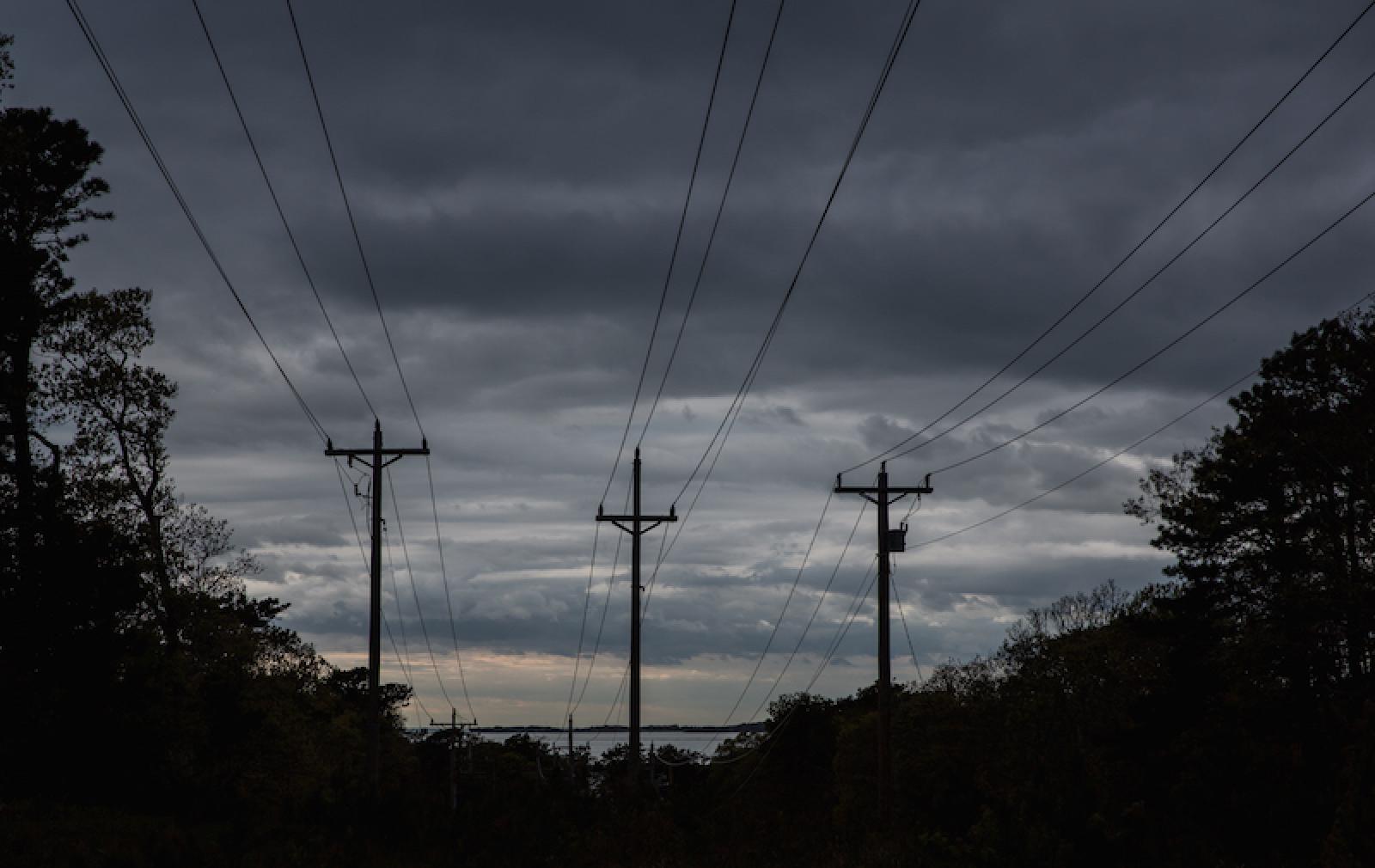
She said that on the Vineyard, herbicide spraying would take place under the main transmission line, which goes through Vineyard Haven and Oak Bluffs and a fire lane in the state forest, ending at a parking lot in Edgartown, on the Edgartown-West Tisbury Road. The fire lane used to be mowed mechanically by the Department of Conservation and Recreation until Eversource took over the company from NStar, Mrs. Varkonda said.
Eversource uses Rodeo, an herbicide with the active ingredient glyphosate, which is used to kill plants. Ms. Varkonda said the utility company would treat trees over 15 feet tall, and invasive species would be targeted with low-pressure backpack pumps. She said the company plans to treat areas every three to five years.
She said a European Union report that said glyphosate was considered a carcinogen was followed by another report that concluded the product was unlikely to have a carcinogenic effect. “There’s been a lot of research done on this,” she said. “They’re pretty much sure it interferes with amino acids in plants so it cannot photosynthesis and dies . . . it doesn’t bind to the soil, it doesn’t seem to leach out.”
The project was reviewed by the state National Heritage program and the Department of Environmental Protection, she said, adding that she understood the concerns.
“I just know, particularly on the Cape and Islands, there’s just a sensitivity to any kind of chemical,” she said.
Selectmen said they felt reassured. “If they stick to that . . . it’s a contact killer,” said Michael Donaroma, a landscaper.
“I just wanted to bring it up as a possible issue,” Mr. Smadbeck said.
In other business, selectmen approved requests from 19 Raw Oyster Bar and Rosewater Wine and Spirits to change business hours, and a request from Alchemy to close between Jan. 1 and Feb. 1 for maintenance and repairs.
Comments
I'm glad Ms Varkonda has no
Salt EdgartownI'm glad Ms Varkonda has no problem with the spraying of pesticides but what if the tax payers do?
In case you missed it: the
Kathryn MuirIn case you missed it: the international scientific community sent us two very loud wake-up calls last month. First, the UN World Health Organization’s prestigious International Agency for Research on Cancer released a consensus report that glyphosate, the active ingredient in RoundUp, is a “probable carcinogen.” A few days later, a team of international scientists based in New Zealand reported that widely available commercial formulations of RoundUp, 2,4-D and dicamba can lead to the development of antibiotic resistance in common disease-causing bacteria.
In addition to these findings, there's a growing body of evidence on health impacts associated with exposure to glyphosate or RoundUp, such as endocrine disruption, organ damage and birth defects.
How many more reasons do you need to NOT use this poison? It goes in the ground water, the sea and in your bodies. Find another way to control weeds.
Absolutely they should send a
Gail Gardner EdgartownAbsolutely they should send a letter. With all due respect, the opinions and concerns of the people In the community should be addressed by OUR representatives. You are supposed to represent us, Edgartown Selectmen. Shame on you for letting your constituents down.
Laura Kelley from POCCA
Marie Meyer-Barton Vineyard HavenLaura Kelley from POCCA (protect our Cape Cod Aquifer) will be at Living Local Fest this Saturday at the Ag Hall. You will find her at We Stand Together's Environment and Climate table. Come with your questions.
Senator Cyr and Representative Dylan Fernandez will hold office hours 2-4 pm this Sunday at the West Tisbury Library. Bring your concerns.
On March 25, 2015, the cancer
elaine AquinnahOn March 25, 2015, the cancer research arm of the World Health Organization announced they had classified glyphosate, the active ingredient in Monsanto’s Roundup, as “probably carcinogenic to humans.” Monsanto backlash and demands for retraction were immediate. While some countries, such as the Netherlands, had already restricted the sale and use of glyphosate-containing products for years, others such as Sri Lanka, Columbia, and Bermuda quickly followed suit with glyphosate bans after the WHO announcement.
For the last 6 months or more Eversource has been cutting trees around the Island. Why can't they use the mulch from said trees and branches instead of poisons substances produced by Monsanto.
I consider that a sin. Not only does this poison affect the nerves and blood health but also impacts insects and bees. To blatantly ignore their customers and go forward with the spraying is adding insult to injury.
Totally in favor of spraying
John Mort Atwood CircleTotally in favor of spraying herbicides - maybe it'll also kill all the moths that the state board of ridiculousness has protected and impacted property owners ability to remove dead trees for fear of eliminating their habitat.
And monarchs, which are
Gail gardner EsgartownAnd monarchs, which are incredibly threatened because of this stupid chemical. This is dispicable. You can't just kill everything. To quote John Muir ""When we try to pick out anything by itself, we find it hitched to everything else in the Universe." This refusal to send a letter is an egregious error and n the part of the Edgartown Selectmen. They have let the town and the island down.
Eversource uses 5 different
Laura Kelley Cape codEversource uses 5 different herbicides to maintain vegetation along ROW power lines. They can not spray anything over 12 feet. They can not spray within 50 feet of a private well. This is the fifth year in a row herbicide use was approved by the state MDAR. Mowing was used ever 7 years prior. New updated science proves these herbicides are more harmful than we realize. Cape cod & MV rely on an aquifer below us for drinkable water. We are doing all we can to educate them and homeowners there are other successful ways to keep our electricity on. Please get involved, join the mission, learn more at: www.poccacapecod.org
"The world’s most widely used
Claire B Goodbody Vineyard Haven"The world’s most widely used insecticides would be banned from all fields across Europe under draft regulations from the European commission, seen by the Guardian.
The documents are the first indication that the powerful commission wants a complete ban and cite “high acute risks to bees”. A ban could be in place this year if the proposals are approved by a majority of EU member states.
Bees and other pollinators are vital for many food crops but have been declining for decades due to habitat loss, disease and pesticide use. The insecticides, called neonicotinoids, have been in use for over 20 years and have been linked to serious harm in bees."
This is what the evolved members of this planet are doing. Eversource are not 'good neighbors.' Court action is necessary to stop this destructive and insidious poisoning.
https://www.theguardian.com/environment/2017/mar/23/europe-poised-for-t…
Roundup never leaves the eco
Douglas Finn West Tisbury, MARoundup never leaves the eco-system. And, according to this National Institute of Health study, Roudnup is linked to far more than cancer:
https://www.ncbi.nlm.nih.gov/pmc/articles/PMC3945755/
Stop spraying!
Add new comment