

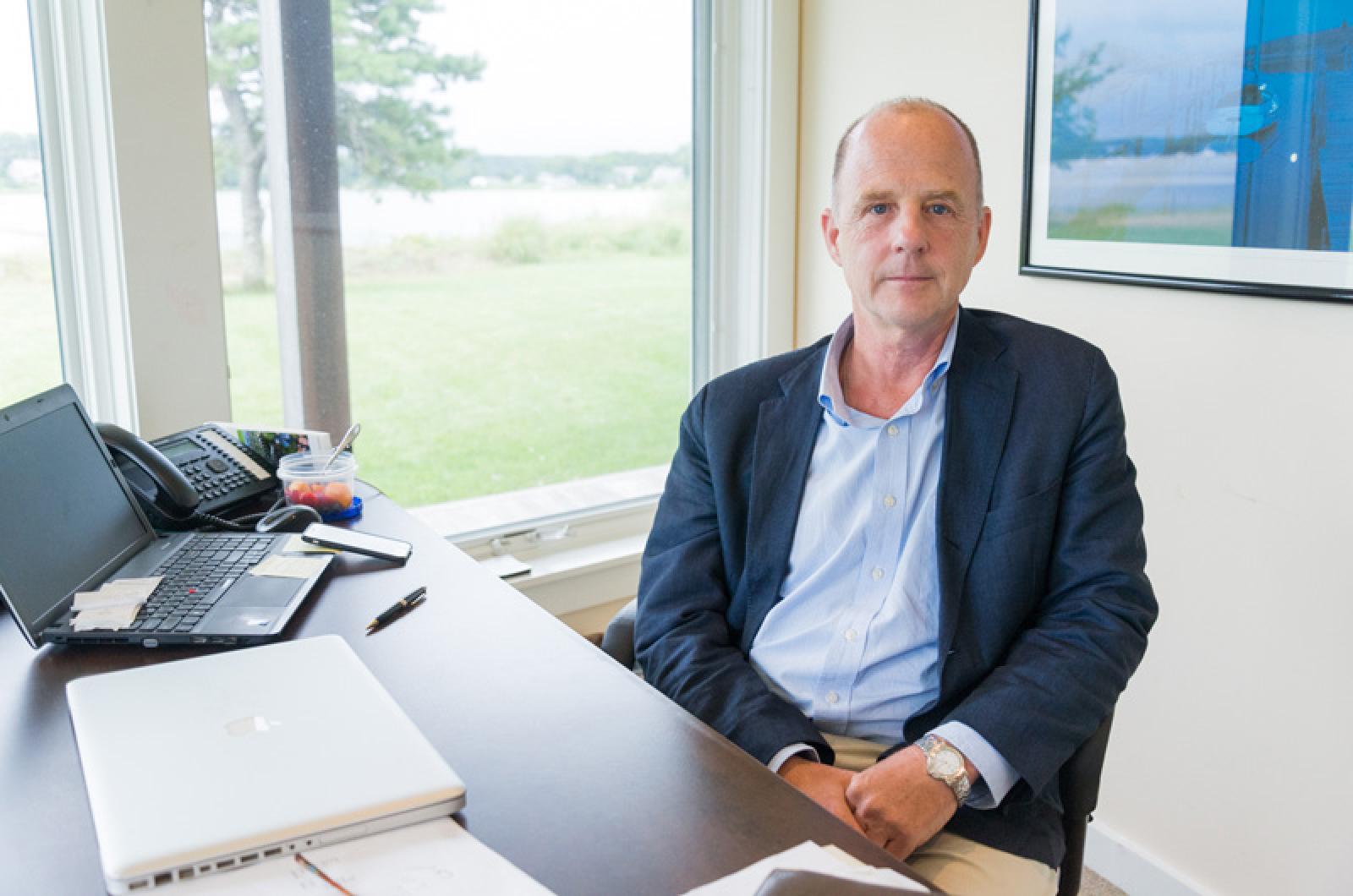
<p>With funding pressures greater than ever, leaders at Hospice of Martha’s Vineyard say their annual Summer Soiree takes on added importance. The event is Monday at Farm Neck.
During his first year as executive director of Hospice of Martha’s Vineyard, Tom Hallahan got a call from an Island resident with an unusual request. The man’s septic system had backed up and he wanted to know if Hospice could help.
“I said, I don’t know, but could I put you on hold?” Mr. Hallahan recalled in a conversation with the Gazette this week. A staff member called a repair company on the Island. “We call, and we say it’s one of our patients, here’s what’s going on, this is the last thing he needs,” Mr. Hallahan said. “And they took care of it that morning.”
On another occasion, a disabled patient was left in a bind when staff members for another agency that had been providing care went off-Island and a crisis ensued. Hospice nurses paid a house visit that same night and handled the situation.
“That happens over and over and over again,” Mr. Hallahan said.
In the past 36 years, Hospice of Martha’s Vineyard has become known as the Island’s primary source for end-of-life care and bereavement counseling. It is one of just a handful of staffed hospice programs around the country that operate unfettered by insurance. An alternative fundraising model allows the Island Hospice program to offer more services to more people — and at no cost to patients and families.
But a rapidly aging population, along with an increase in deaths associated with drug overdoses in recent years, have strained the program like never before, making fundraising all the more critical.
The biggest portion of fundraising happens during Hospice’s annual Summer Soiree, which will be held this year on Monday at the Farm Neck Golf Club.
The event usually brings in about $110,000. But Mr. Hallahan said that figure will now fall short of the need. “It used to be a quarter of our budget, but now the way things are changing it’s probably a fifth of our budget,” he said. “We have to increase the net.”
The bereavement program in particular, which provides counseling for families and loved ones dealing with loss, has seen a sharp spike in demand, with the number of patients more than doubling, from 95 in 2013 to 195 last year. Hospice patients themselves nearly doubled from 56 to 100 in the same period.
Bereavement patients are increasingly those whose loved ones did not go through the Hospice program, said Mr. Hallahan, who took the helm at Hospice in March 2016. “But we feel obliged, because we’ve done it for 30 some years, to continue to see anybody who needs support for grief and loss,” he said. “We are known for what we do, and if we change that, I think it would be a real shock to the Vineyard community.”
HopeHealth, a Cape Cod provider that offers hospice care on the Island, follows a more conventional model, including Medicare reimbursements. “We were instrumental in getting them to come down here,” Mr. Hallahan said, “and we need them to come down to help us manage this growing population.”
Dukes County as a whole is aging faster than both the state and national averages, increasing the pressure on many Island services. According to recent projections, by 2035 people over 65 will make up about a third of the Island population.
“We knew baby boomers were coming,” Mr. Hallahan said, noting an increase in deaths on the Island from about 90 in 2013 to 170 last year. He said Hospice usually sees between 35 and 40 per cent of those cases. “Right now we are looking at how can we sustain this?” he said. “And it’s really tied to finances.”
He added that the opioid crisis has added pressure to the bereavement program, with people who have lost loved ones from an overdose needing help.
Donations, grants and bequests covered about half the Hospice program’s $665,000 annual budget last year, with the rest covered by an endowment set up in 2001. The program appears to remain on steady footing, with the endowment and restricted funds growing by $1.1 million last year. And a new fund started by James and Margaret Chirgwin aims to support what Mr. Hallahan said were badly needed respite services on the Island.
He said last year was a turning point, and sustaining a version of Hospice that people have come to expect on the Island will require a new level of community support.
Other fundraisers throughout the year include a Memorial Day road race, a tennis tournament in June, a golf tournament in September, and a Christmastime event in Edgartown. By way of illustrating the challenge, Mr. Hallahan said the tennis tournament alone covers only about one week of payroll, which has grown to about $10,000.
Changes in staffing include an increase from three to five nurses last year, and the elimination of a bereavement counselor to cover those costs. “Right now we have two therapists,” Mr. Hallahan said of the bereavement program. “We desperately need a third one.”
In addition to two full-time and eight part-time staff members, Hospice relies heavily on patient care and fundraising volunteers. Last year’s annual report also lists 136 in-kind vendors and several dozen Island sponsors.
Island residents have long supported the program through volunteer efforts and acts of generosity throughout the year. Mr. Hallahan noted that almost everything needed for the soiree, including a meal for 325 guests, will be provided for little or no cost. In the off-season, he said, people often deliver free meals to Hospice staff at their headquarters in the Tisbury Marketplace. That space was made possible by a donation from former Washington Post publisher and longtime Island resident Katharine Graham, who also seeded the Hospice endowment fund.
With a long background in public health education, including as a professor at Boston University, Mr. Hallahan said his first year at Hospice has not necessarily changed his views on death, although it has reaffirmed his faith in community.
“What has changed my mind is the level of compassion, of humanity,” he said, “— of the nurses and the counselors, and our front desk people and the volunteers. That has given me hope of the level of compassion that’s out there.”
Looking ahead, he laid out a simple vision where Hospice can continue doing what it has always done, while meeting the growing demand. “I just don’t know if we are ready for this huge influx of the aging population,” he said of Island services in general. “It’s at a point in the whole country where something’s got to be figured out pretty soon.”
Comments
We are very happy to have
Rev. Roberta L. Williams, The United Methodist Church of Martha's Vineyard 40 Trinity Park, Oak Bluffs ~ next to the TabernacleWe are very happy to have hosted the Christmas Concert fundraiser. We look forward to doing it again.
"It is one of just a handful
former Hospice Exec Edgartown"It is one of just a handful of staffed hospice programs around the country that operate unfettered by insurance." The question is Why? Why has this hospice resisted becoming Medicare certified and meeting the standards of care? There are more than 4000 hospices in the US. Medicare certification would allow the hospice, and its patients, to have hospice services reimbursed not only by Medicare and Medicaid, but private insurance as well. I've had several family and friends cared for by Hope Hospice and MV Hospice. Unfortunately, we don't have access to the best hospice care here on MV. Most, if not all, Hope Hospice staff don't live on the Island and are not readily accessible. They don't have an adequate number of home health aides or volunteers. MV Hospice is hampered by not being certified - it provides excellent supportive care but not the full array of hospice services that are provided elsewhere in the US. And, it is heavily reliant on donations- donations that could be used elsewhere by non-profits that do not have access to reimbursement from Medicare and other insurances. I strongly believe in hospice and the need to ensure excellent end-of-life care - I just hope that when my time comes that I don't have to go off-Island to get the hospice care my family and I need.
Many of the needs of the
Chris Cowan KatamaMany of the needs of the aging are not the job of hospice care, but fall into a much broader category. Sandie Corr-Dolby and Beth Toomey run Horizons Geriatric Care and they provide many of these services and did so for both of my parents until they passed over the last 18 months. Coordinating caregivers, handling insurance matters, making sure the physical therapists, occupational therapists, and everyone else surrounding the household were there when they were supposed to be. If you choose to live out your days in your own home, the logistics are incredible. And speaking of incredible, that's just what Beth and Sandie are. They go well beyond their charter and show genuine care and compassion in all they do. We couldn't have managed the past few years without their capability and friendship.
The last two "comments are
Retired Volunteer TisburyThe last two "comments are appalling. First of all, the "former Hospice executive" has no idea what he is talking about, as far as knowledge of the organization, or its goals and accomplishments. MVH is NOT hampered by not being certified...which is NOT true. It provides wonderful, PERSONAL care by ONE professional nurse to the WHOLE family, and if this "former Hospice executive" really believes that ALL hospices in the US are better equipped, I say, he really knows nothing. As for the "love letter" from Chris Cowan, obviously this is more about friendship and PR, rather than knowing anything about our wonderful and unique Hospice on the Vineyard. Care may have been given wonderfully and the attention supportive, but to compare MVH to a "geriatric" organization is wrong. MVH does ALL the caring and personal matters that is mentioned. What's more, it's non-political, independent, and led by a seasoned professional. I would shutter to think this is more about the two women with "Vineyard names" and connections, than the care that was given at Cowans tragic time.
Add new comment