

This is not the time to focus on self-interest. But President Trump’s climate policy is clearly a bad deal for Martha’s Vineyard.
While we share our environmental problems with all the people of the world, our industrial might, which has made us the leader among nations in terms of material well-being, also gives us the responsibility of dealing with environmental problems first among the nations. We can be proud that our solutions and our performance will become the measure for others climbing the ladder of aspirations and difficulties; we can set our sights on a standard that will lift their expectations of what man can do.
In 1972, President Richard Nixon made his historic visit to China, an acknowledgement that in the modern world, all nations — even rivals and adversaries — are economically interconnected. That year he also wrote the above passage, noting that environmental problems are also shared across borders, placing environmental stewardship among the ideals that the United States should seek to promote through leadership on the global stage.
Last week, 45 years after Nixon argued that the environment was something we had a duty to take responsibility for, President Donald Trump, in withdrawing from the Paris climate accord characterized the agreement as more than anything else, a bad deal for America:
“This agreement is less about the climate and more about other countries gaining a financial advantage over the United States. The rest of the world applauded when we signed the Paris Agreement. They went wild. They were so happy.”
If we take his argument at face value, it raises the question of which of these Presidents’ starkly contrasting views of the world, and America’s role in it, is more appropriate for the leader of the most powerful country on earth.
In Mr. Trump’s zero-sum world, when someone wins, someone else loses. If the Paris agreement is good for the rest of the planet, it is by definition bad for the United States. That is why “they went wild” — not because of the potential to mitigate the worst impacts of climate change, but because “they” got one over on the USA.
Unfortunately, the impacts of climate change will, to use one of the President’s favorite words, make a loser out of us too. Running full-speed ahead on carbon emissions, just because we have the ability to adapt to rising seas better than poor island nations, to change our agricultural practices more easily than southeast Asia, and to absorb rising health care costs due to extreme heat better than Latin America, leads only to the sort of relative victory for which no one should be proud.
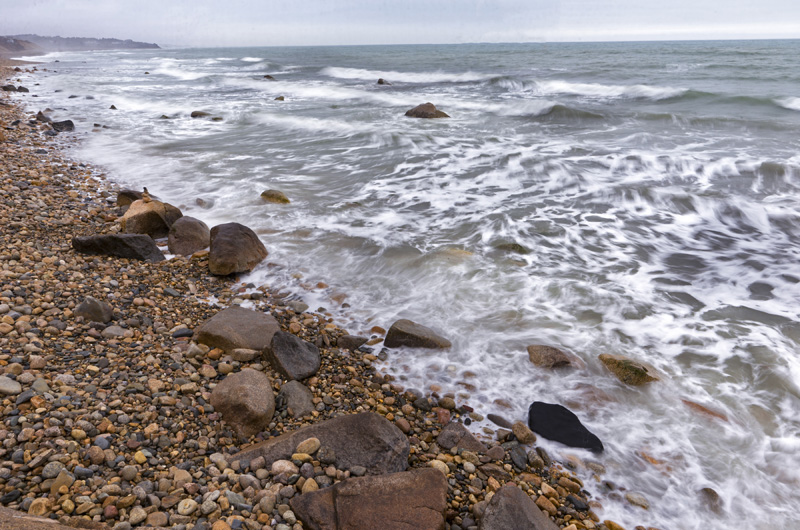
This is not the time to focus on self-interest. But writing for the Vineyard Conservation Society, it would be a sort of malpractice not to note that President Trump’s climate policy is clearly a bad deal for Martha’s Vineyard. This is an Island, after all. Sea level rise poses an outsized threat, compounding the natural erosion of our beaches. We draw our drinking water from a sole-source aquifer threatened by saltwater intrusion. Our economy is driven by tourism, with visitors drawn by the perception of a pristine natural environment. And the prospect of more frequent and powerful coastal storms needs no comment. On the flip side of the issue, we don’t have coal mining or heavy industry here, but we do have a small but growing green-energy economy.
Despite all this, now is not the time for despair. Though sometimes buried under incorrect facts and hyperbole, President Trump’s speech held a kernel of truth, which he articulated surprisingly well: this agreement had no legal force.
Countries chose their own targets for emissions reductions, and they remain free to revise them downward at any time if they have trouble meeting their goal. Further, the only consequence of failing to meet the target is the potential for public shaming, something to which the Trump administration appears to be immune.
To a certain degree, it is fair to describe the Paris climate deal as a symbolic gesture. However, the decision to pull out of the agreement, accompanied by great fanfare, was entirely symbolic. The President’s actions to date, and stated intent going forward, had already made clear that the federal government was going to do everything legally possible to reverse recent efforts to curtail greenhouse gas emissions, along with any other environmental regulations. If we aren’t going to abide by the agreement anyway, why formally reject it, ceding global leadership while lowering the bar for everyone else?
The answer is that symbolic gestures matter a lot to President Trump. Last week’s gesture was at once a show of respect and gratitude to the base that elected him and a defiant thumb in the eye of the rest of the world. Both are embodied in the Pittsburgh, not Paris slogan quickly embraced by his supporters. It articulates well the us-against-them world view where protection of the global environment through shared effort just doesn’t make sense.
Unfortunately, symbolism also matters in the effort to combat climate change. Reducing global greenhouse gas emissions will require international cooperation, trust, and a shared sense of duty. Commentators are missing the forest for the trees when they correctly point out that the direct effects of leaving the Paris agreement on emissions will be minimal. The real harm is indirect, through the manner in which we left, and the lack of any sensible reason for the decision.
This calls to mind one more quote, from another strangely-hued long-running television star: “I can’t promise I’ll try, but I’ll try to try.”
Bart Simpson’s weaselly level of commitment here still amounts to something: an acknowledgement that to try would be right. Last week, America instead told the world that to try would be to yield advantage; further, that only self-destructive fools believe there is any such thing as right.
Even though we haven’t always lived up to the ideal Nixon articulated about a shared responsibility for the global environment, up until now the rest of the world could at least count on America to try to try. But now that the world’s most powerful nation, and greatest historical emitter of greenhouse gases, demonstrates a lower standard of leadership than Bart Simpson on a bad day, who are we to ask the world to follow? This answer, not some particular carbon emissions number, is what we gave away last week.
Jeremy Houser is communications coordinator for the Vineyard Conservation Society.
Comments
you need to do your research.
steven oak bluffsyou need to do your research... first of all , the paris accord was signed by Obama as voluntary because it would not have passed congress. There have been studies done , that do not get any press due to the agenda of the left and Al gore , who is making MILLIONS of dollars flying in a jet that each time he flies, causes as much pollution as driving a car for a year. scientist do agree there is a slight warming trend... although many do not agree it is the cause of humans. there were charts , HARD EVIDENCE presented in a congressional hearing showing a warming and then cooling trend throughout history. Also , the arctic has lost some of its polar caps... but Antarctica has gained ... It is a HUGE money grab with billions at stake ..the is a new clean coal technology that has capability to capture carbon and store it.. it is no worse than the new light bulbs that last many hours but needs to be disposed of properly..
I do not understand the views
Tom Imrey SfI do not understand the views of republicans. If a doctor said you had cancer you would believe it. Somehow you do not believe climate and atmospherical science. These are ideological ideas and not based on facts. Science is based on facts.
I recall first learning about
Rob Burnside Kingston, PAI recall first learning about the greenhouse affect in a 1970 college Environmental Science course, but it took the rest of the world nearly 50 years to arrive at a level of awareness demonstrated by the Paris agreement. Our new Chief Blue Meanie has now essentially said, "It's okay to be dumb again." He's wrong,it isn't okay, and willful ignorance always has unfortunate consequences. Ask not for whom the ostrich squawks and get thy cheeks to higher ground.
Add new comment