

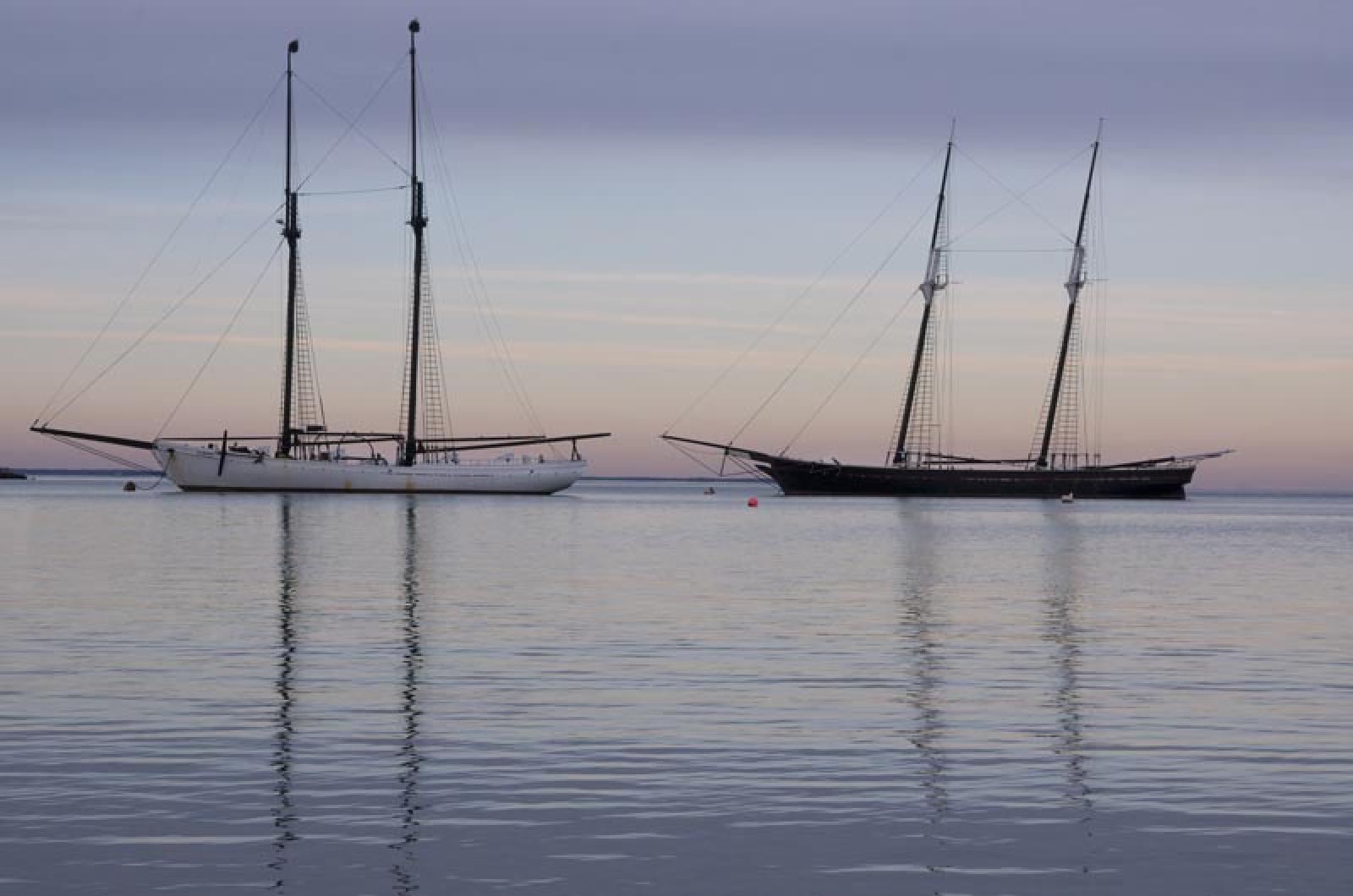
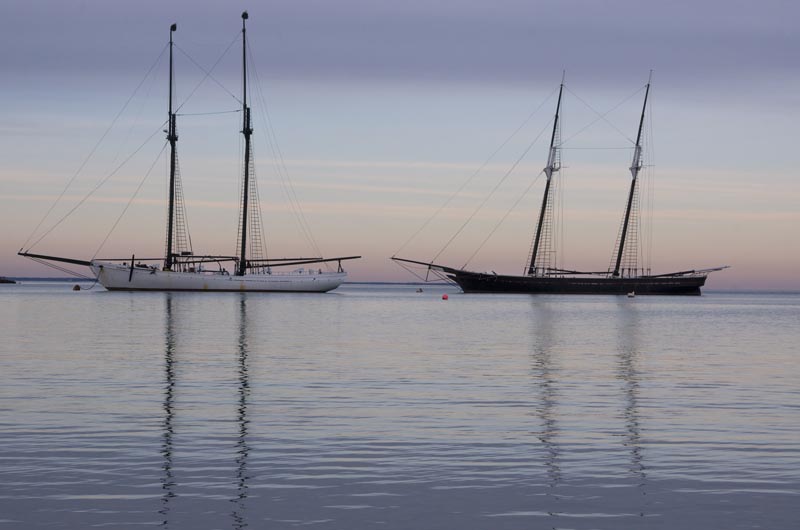
The Shenandoah and Alabama were anchored just south of Harthaven one recent muggy, overcast morning and it struck me how innocent these famously-named schooners looked.
The Shenandoah and Alabama were anchored just south of Harthaven one recent muggy, overcast morning and it struck me how innocent they looked, filled with Island school children aboard an overnight ocean-going camp. The peaceful scene of the two schooners lying at rest with sails furled belied the history of two different schooners with the same names. During the American Civil War, those dreaded boats were a whaler’s nightmare.
The Alabama sloop of war and extreme clipper Shenandoah were built in secrecy by the British for the Confederacy specifically to destroy the whaleships of the North to hurt its economy. At 220 feet in length, the Alabama had eight cannons and two 300-horsepower steam engines along with its sails, and could travel at 13 knots. The Shenandoah, 230 feet long, also had eight cannons, and with a single 200-horsepower steam engine could attain a speed of eight knots, twice that with its massive array of sails. By contrast, unarmed, hulking whaleships could barely travel at seven knots. The state-of-the-art warships would catch up to the heavily-laden whaleships and burn them to the water line — not a difficult task given the pitch used to treat the ship’s wood to prevent water from getting in, and the highly-flammable whale oil cargo.
In a brief four-day raid in the Bering Straits in 1865, the Shenandoah singlehandedly destroyed 25 whalers and converted four others into Confederate transports — almost the entire Pacific fleet. An officer aboard on that voyage wrote in his journal, describing his delight at the sight of an oil-soaked vessel set on fire: “One day we overhauled a New Bedford whaler attached to a whale. It was the case of the big fish eating up the little one, and we were the largest in the pond just then. So the whaling barque Edward . . . went up in flame and smoke.”
The slightly smaller Alabama was described by author Elmo Paul Hohman as a “lithe and graceful panther of the seas” that destroyed more than a dozen whalers in the Atlantic. Indeed, the Alabama was accused of setting fires to whalers in order to lure others for the same fate.
These two raiders were the South’s most effective weapons of the Civil War. Together destroying more than 100 whale and merchant ships, they wreaked havoc on the North and its whaling industry — reportedly without casualty or the taking of lives at sea.
But the Battle of Hampton Roads became the best-known naval battle of the Civil War and was a portend for the end of wooden ships in warfare. This was the clash of the first ironclads, the North’s Monitor and the South’s Merrimack. The engagement occurred at the mouth of the James River, a relatively protected harbor entrance as compared with the deadly North Atlantic and Pacific oceans. Ironically, in the inconclusive three-hour battle of March 1862 neither ship was able to inflict a measurable amount of damage on the other. After the Confederate retreat from Norfolk on May 9, 1862, the Merrimack was demolished by its crew. The Monitor was lost during in a storm near Cape Hatteras, N.C., on Dec. 31, 1862.
Meanwhile, with the issue of slavery hanging in the balance, whaling had presented an opportunity for black seafarers to obtain merit-based work and promotion before and during the Civil War. According to most evidence, 30 to 40 per cent of all who went whaling were black. More than 60 black whale captains have been identified. Possibly less well known is the fact that one black man, John Mashow (1805 to 1893) was a ship designer and builder. His Dartmouth-based company Mathew, Mashow & Co. built about 60 ships between 1830 and 1860. One was named after him (the John Mashow was a merchant vessel) and 14 were whaleships. It was often the practice that ship builders retained part ownership of ships as payment and it is believed Mashow held shares in seven ships. For 30 years it was said his were among the best on the water.
Five of the Mashow-designed ships were owned and/or sailed by black whaling captains, and one, the Morning Star, had four black captains at various times.
The Shenandoah and Alabama burned three of the whaleships built by Mashow. The first to be burned in the war was Mashow’s Benjamin Tucker, destroyed by the Alabama in 1862.
Three black whaling captains had sailed from Edgartown: Jasper M. Ears, John T. Gonsalves and William A. Martin. Captain Martin was one of three who were born and lived on Martha’s Vineyard. His first trip as a whaler in 1846 began the day before he turned 19 aboard the doomed Benjamin Tucker. The Nimrod and the Jireh Swift were both burned by the Shenandoah in 1865. Capt. Raphael Semmes had no compunction about burning Union ships even after he knew his Confederates had lost the war.
The aging and war-torn Alabama, launched in July 1862, met its fate at the hands of an American warship in France in 1864. The Shenandoah — having sunk another 10 ships after the war had officially ended — was launched in August 1863 and surrendered in England in November 1865.
In a scant two-year period the notorious Shenandoah and Alabama had helped decimate a whaling industry that had used 2,700 ships over a 250-year history. Whaling went downhill and the price of oil never recovered.
In a serendipitous twist today, the graceful Alabama and Shenandoah, Vineyard Haven schooners owned by the Douglas family, are used partly as teaching vessels, carrying Island kids to learn the ways of the sea. With topsails billowing in the wind, they are a sight for us to wake up to on the way to work. Words written by the late Dorothy West about my brother’s shipboard marriage seem to evoke a far better Vineyard legacy:
“A cannon sounded from the Shenandoah, balloons of every color rose from the deck to lend beauty to the sky . . .”
Skip Finley writes the Oak Bluffs column for the Gazette and is writing a book about black whaling captains. He will speak at the Martha’s Vineyard Museum on August 22.
Comments
Fascinating!
Kharmaisis Oak BluffsFascinating!
Thanks for sharing this
Scott Guild Wellelsey, MAThanks for sharing this history of the namesake ships. I knew the Alabama history, but was not aware of the Shenandoah history. Keep the history coming!
Excellent, Skip!
Dean Rosenthal EdgartownExcellent, Skip!
Interesting history and
Carolyn Coverdale Vermont / Oak BluffsInteresting history and synergy between the Shenandoah and the Alabama. Enjoyed reading.
Interesting, and informative
Chris Rowan New Canaan, CTInteresting, and informative - well done ! Maybe that noise you hear from the Oak Grove Cemetery late at night is that of the 19th century Luce and Peakes whaling captains from Vineyard Haven buried there, who must be spinning in their graves to know that their nemeses' names live on, while their own are long-forgotten ?
Capt. Thomas Manchester Peakes (1823 - 1901) had captained the "Virginia", as had his uncle Capt. Richard G. Luce (1803 - 1885) who had named the ship after his wife, Virginia Manchester. On her 8th whaling voyage, the "Virginia" was sunk by the "Alabama" off the Azores on September 17th, 1862. Capt Peakes had also been a captain of the "Euphrates", later burned and sunk by the "Shenandoah" in the Bering Sea on June 22nd, 1865.
Thomas Manchester Peakes had a brother Capt. Charles Henry Peakes (1824 - 1906) who also sailed on an early voyage of the "Virginia", and another brother William Robinson Peakes (1838 - 1917) who was on that final, doomed voyage of the "Virginia".
Are the boats reproductions
Steve FalmouthAre the boats reproductions of the originals? Did the crews of the burned whalers drown or taken prisoner?
I don't know if they are
Skip OBI don't know if they are reproductions--if so they would be scale models; each of the modern versions are only half as long as the originals. No, they let everyone live-they "bonded" captured ships to return prisoners to shore.
Add new comment