

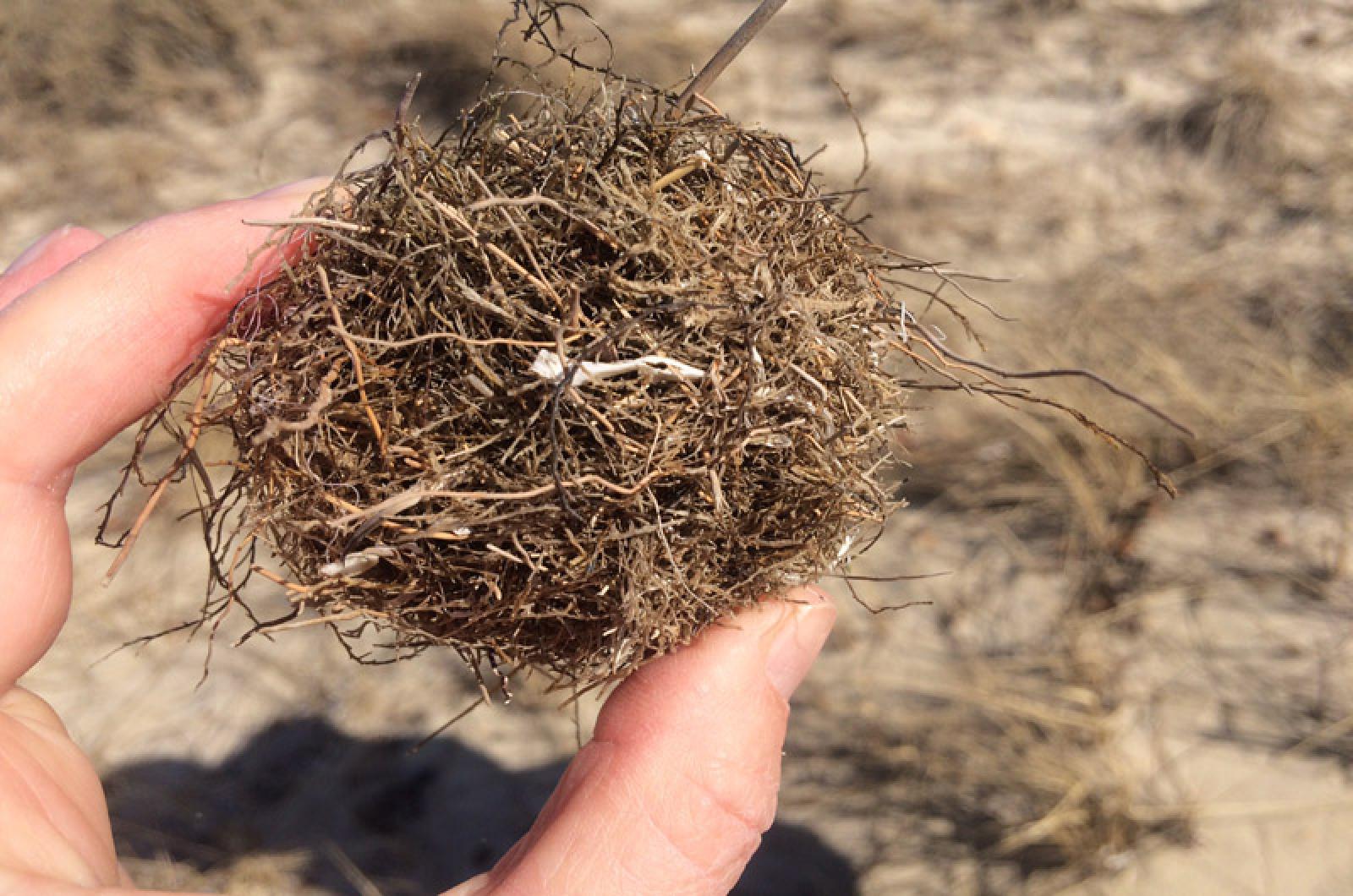
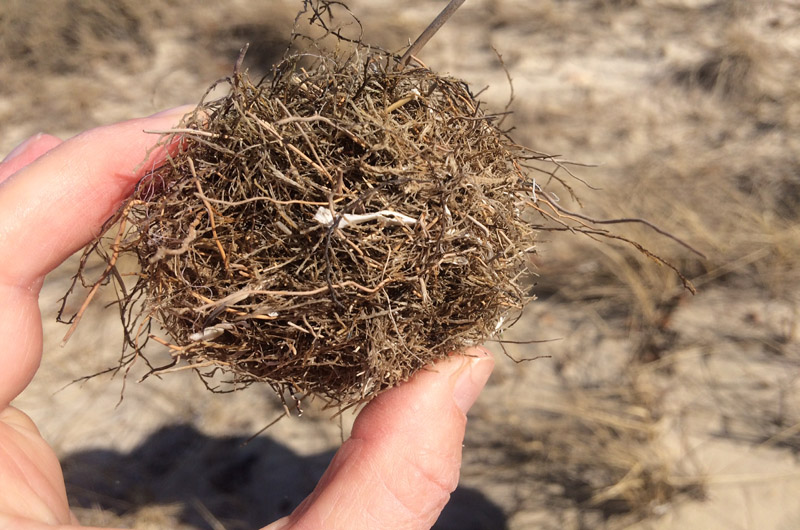
<p>Sea balls are orbs of vegetative (and sometimes synthetic) matter that appear on beaches. Reports of these spectacles are few and far between.</p>
Nancy Weaver had a ball at Cedar Tree Neck last week.
On a walk along the rocky shoreline, she observed sea balls, a unique and very special beach find. Sea balls are orbs of vegetative (and sometimes synthetic) matter that periodically appear on beaches. Reports of these sphere-shaped spectacles are few and far between.
Sea balls have also been called whale burps, though have nothing to do with the digestive system of that marine mammal. And in fact, they are present in both saltwater and freshwater, having also been found on inland ponds and lake shores.
Ranging in size from a few inches to a more than a foot, sea balls form from a variety of materials and under a certain set of conditions. What gets the ball rolling? They can be natural or not, since the genesis of the balls might be organic or human-made.
In some cases, it is just plant and algae that make up sea balls. In others, however, their heart or center is made up of trash, plastic or other artificial materials. With wind, waves and currents, the balls go round and round and become larger. Their final form can be oval in addition to the more common round variety.
Turns out this is a worldwide phenomenon, with different regions boasting their own varieties of balls.
In our country, variations of balls have been found from coast to coast and along the shores of the Great Lakes. Californians find their balls on lake and marsh shores. These so-called Ruppia balls are made from ditch grass from the genus Ruppia, and can be as big as a watermelon. In Minnesota, surf or beach balls have been found that have included plastics, feathers, fishing line and shell fragments.
In Japan, fuzzy green balls, called marimo, occur. Marimo are made of algae from the genus Cladophora, and are considered a natural treasure. Their image is even found on postage stamps, and a three-day festival celebrates the glorious green globes. Marimo is unique in that the alga is living. To engage in photosynthesis, these bottom-dwelling balls float to the top of the water, with the help of trapped air bubbles, then return to the bottom. Truly a clever adaptation to celebrate.
On Mediterranean shorelines, Neptune balls are the norm. Sea grass from the genus Posidonia are the raw materials and, also, explains the name. These balls have a long history, having been mentioned by Aristotle and Theophrastus, and have been used by Greeks to caulk ships and by Venetians as packing material for their glassware.
And those Neptune balls have not lost their usefulness in modern times. Since they are slow to decay, mold resistant and non-flammable, they have been used for insulation and construction under the trade name NeptuThern.
Down under, in Australia, fibre balls are the local variety and result from tapeweed, a vascular plant found offshore in seagrass beds. And up north in Iceland, ball muck may be found.
While it may be distressing to think that on our own shores balls may be forming around discarded refuse, many are still organic marine marvels, as Nancy Weaver’s find shows. It’s wonderful to consider how Mother Nature provides for free everything we need to enjoy a day at the beach, including the beach balls.
Suzan Bellincampi is director of the Felix Neck Wildlife Sanctuary in Edgartown, and author of Martha’s Vineyard: A Field Guide to Island Nature.
Comments
In the old lodge at remote
Dick AquinnahIn the old lodge at remote Big Lyford Pond, Maine, there is a wonderful collection of these items. At their different centers, their hearts, I've found bits of freshwater clam shell, the snelled hook of a Parmachene Belle and in one, the penis bone of a fisher. Everyone of these balls are a mystery, wrapped in what..an enigma? I've wandered at least 40 other bodies of water in this area, great and small, and have found no others. But I am so glad to hear that others exist and to now know something about them.
Dick, Found a few dozen at
Rachel Bellenoit Parker River National Wildlife RefugeDick, Found a few dozen at Parker River National Wildlife Refuge yesterday. Thanks for the detailed info. I guess it's time to crack a few open to see what's in the center!
We went to a local coastal
Susan Orford Tasmania AustraliaWe went to a local coastal area today near Triabunna and found quite a number of these sea balls. They are very light weight and very dense and almost perfectly round. I was very happy to find out that they are found world wide.
Found many at of the north
Rachel Bellenoit Parker River National Wildlife RefugeFound many at of the north shore beaches at the Refuge in Newbury yesterday. Glad to find this explanation here of what they are. Wish I could post a photo.
Thanks for this article. I
Jean Bell Moose Jaw Sk. CanadaThanks for this article. I found an abundance on the edge of a slough south of town.They were surrounded by a variety of empty washed snail shells.They will be used in an artwork where the shells will make a nest for the egg shaped balls of plant material.
I had no idea what they were. Thank you!
Add new comment