

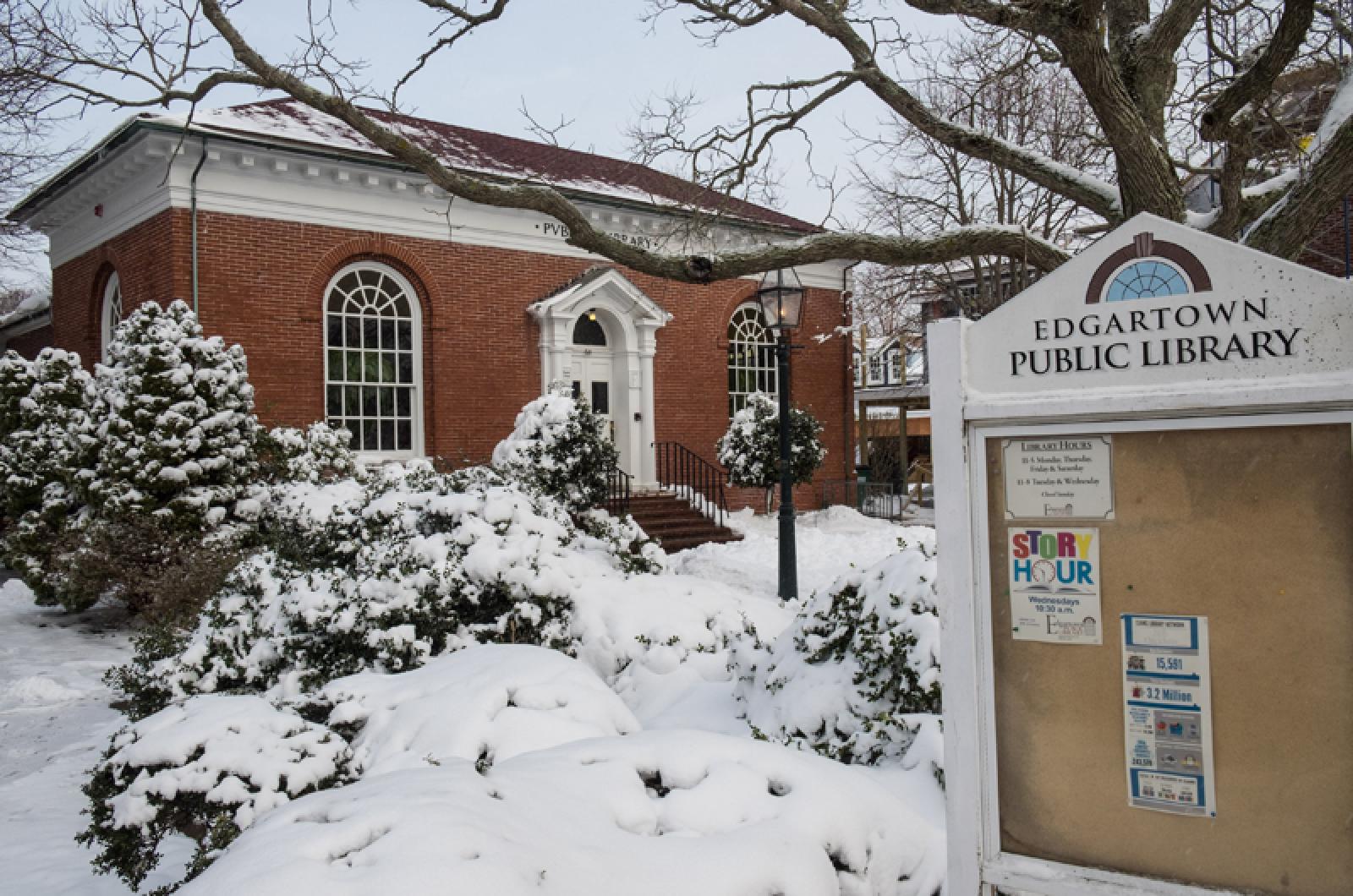
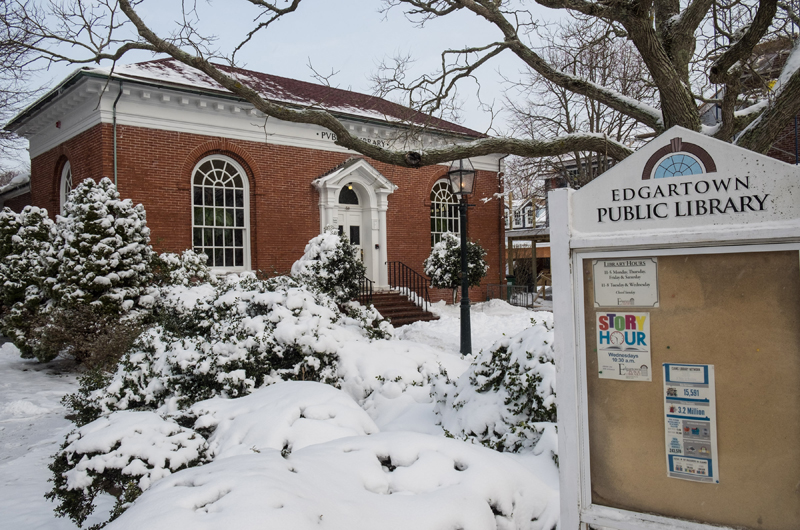
<p>The new Edgartown Library is finished and the shelves have arrived. But what of the historic Carnegie building that will be left behind?
It is really going to happen. The new Edgartown Library is finished and the shelves have arrived. There is a real elevator for those who have trouble on stairs, a large, bright and mildew free children’s room, a community meeting room, separate study areas, plenty of power points and parking. In a very short time, people will wonder what we ever did without this new and improved library. It fits our life today and will surely prove its worth in the future.

Edgartown library may be the smallest of the Carnegie libraries in the world.
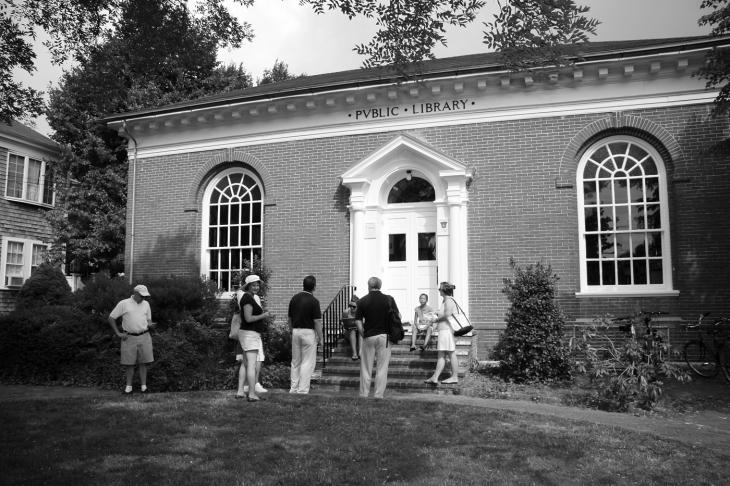
Edgartown library may be the smallest of the Carnegie libraries in the world.
But what of the Carnegie building that will be left behind? I think that it will finally get its due as one of Edgartown’s architectural treasures. With the Martha’s Vineyard Preservation Trust on board, I am sure that will happen.
Why is it so important? I am shocked (I am also easily shocked, as regular readers know) at how little most people know about this building. Even the descendants of the architect who designed the building did not know its history. It has survived unsympathetic renovations, hurricanes, furnace blowbacks and lighting strikes. Even Margaret Henderson Floyd, the author of Architecture After Richardson, the only book on the history of Longfellow, Alden and Harlow, came to Edgartown for research and did not discover this gem, designed by Edgartown’s native son, Frank Alden who was born here in 1858 and died here in 1908. It was Frank who designed the building in 1904 and who was the one who probably persuaded Andrew Carnegie to provide the funds. (By this time, Carnegie had farmed out most of the library construction decisions to staff members.)
It may be the smallest of all the Carnegie Libraries in the world. And I mention this, because it was the firm of Longfellow, Alden and Harlow who also designed the largest of the Carnegie libraries: The Carnegie Institute of Pittsburgh. It was in Pittsburgh and the surrounding areas that Alden’s firm (later Alden and Harlow, when Longfellow left the firm to be a sole practitioner in Boston) designed the majority of the Carnegie Libraries. There are dozens of his extant buildings in Pittsburgh and Sewickley that are recognized by the Pittsburgh History and Landmarks Foundation, who sponsored the Henderson Floyd book.
Frank Alden was born in Edgartown in the Ewing house on Upper Main street. He was the son of Francis Alden of Dedham and Caroline Mayhew Smith Alden of Edgartown. He was born in the house of Josiah Smith, the Register of Deeds. Josiah, one of the Pohogonut Smiths, was married to Isabel Mayhew, who after Josiah died, married Frederick Baylies Jr. Frank was one of the first graduates of MIT’s architectural program, and went to work immediately for Henry H. Richardson. His work took him to Pittsburgh in 1886 where he supervised the construction of the Allegheny County Court House and Jail, Richardson’s masterwork. Richardson’s untimely death in 1886 forced all of his employees to seek other work, so Frank eventually ended up in the partnership with Longfellow and Harlow. He returned to Edgartown frequently, even when his home base was Pittsburgh. He returned one last time, to the house on North Water street that he had recently renovated, in July of 1908, knowing that he was dying. He died here on Sept. 15 and is buried in the Westside Cemetery.
So I am doubly grateful: Grateful to the town of Edgartown and the commonwealth of Massachusetts for our new building, and grateful to the Martha’s Vineyard Preservation Trust for taking on the restoration of the Carnegie Library.
Comments
What a wonderful story. As a
Elizabeth Farland FalmouthWhat a wonderful story. As a little girl I spent many summers with my grandparents on Upper Main St, Edgartown. The Library was always on our stop. I can't wait to see the new Library.
Mary Jane thank you for the
Kevin McFarland West TisburyMary Jane thank you for the history that supports that solid building.
The Carnegie Building (which
Peggy Leahy Cademartori Springfield, VAThe Carnegie Building (which we always knew as the Edgartown Library) has always been a sentimental favorite of the Leahy family from Oak Bluffs. Dad (Frank Leahy) and Mom (Edith Stavert Leahy) met in front of the library on a blind date in the summer of 1928 during their college years. Dad (a summer visitor working at the Steamship Authority hauling trunks and such)and Mom (a homesick waitress at the Colonial Inn) headed out for ice cream -- and the rest became family history. We are not sure if Dad and Mom knew the history of the building -- but it was always an important attraction that they pointed out to their family and to visitors. The Carnegie Building obviously has its outstanding historical story. For the Leahy generations (children, grandchildren and great grandchildren), the building evokes memories of the chance meeting of two people who loved the island deeply and have passed that love on through three future generations. Our granddaughter, Katie Crawford, surprised my husband and me on our 50th anniversary with a delightful picture she had taken of the library where her great grandparents had met. Thank you for the outstanding background about this wonderful building.
Ms Carpenter, thank you so
Lorraine EdgartownMs Carpenter, thank you so much for this information. I have used the library for years and I still miss, and will always miss, the card catalog feature of a proper library....yes, I do use computers and Overdrive, but card catalogs and I are old friends....
Add new comment