


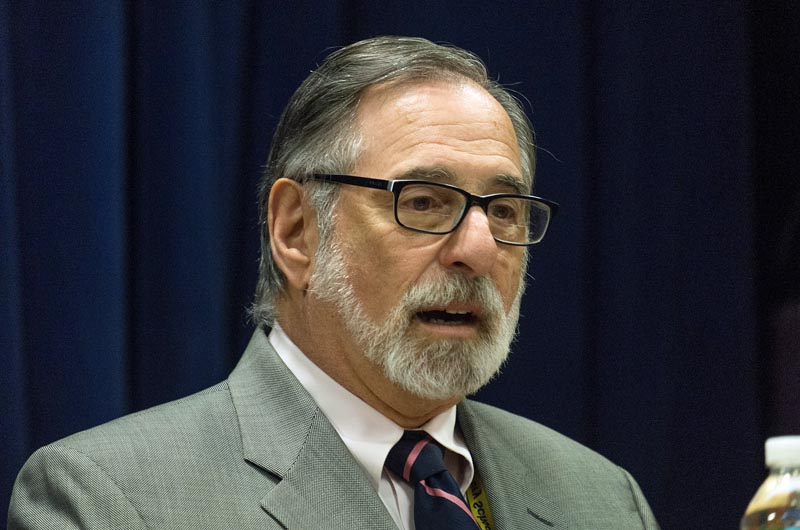
Outgoing Superintendent Broaches Touchy Topic for Vineyard Schools: Regionalization
<p>Each of the five traditional public school districts on the Vineyard does its own thing, right down to the toilet paper, schools superintendent Dr. James H. Weiss said in the first of five forums on the state of the schools.
Each of the five traditional public school districts on Martha’s Vineyard has its own budget, school committee and administrative support. The schools manage their own facilities and operate their own lunch programs.
In short, they all do their own thing.
Right down to the toilet paper.
“No two schools use the same thing,” said schools superintendent Dr. James H. Weiss this week. “They come in different sizes, colors and shapes, and they go into different holders in the bathrooms.”
The remarks came Wednesday during the first of five stops on a farewell tour Mr. Weiss is giving before the summer, sponsored by the League of Women Voters. After a decade in office, he will retire June 30.

Community members gave Mr. Weiss a warm reception in Tisbury last week. He speaks next in Oak Bluffs on May. 7.
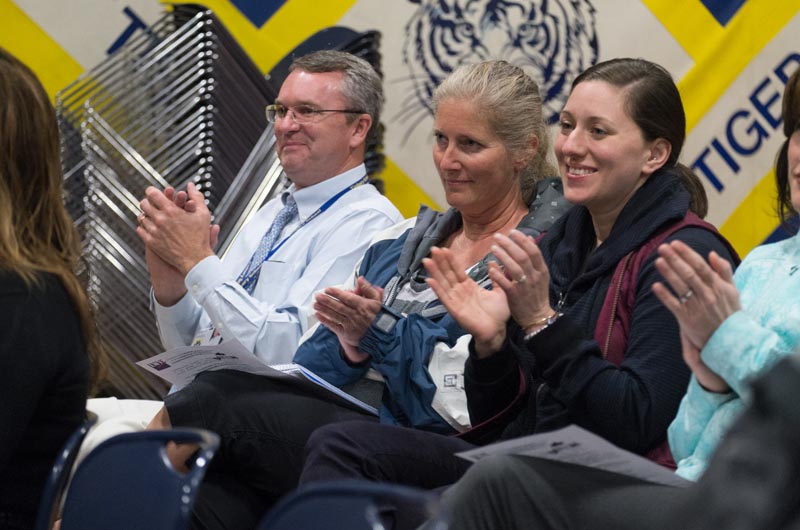
Community members gave Mr. Weiss a warm reception in Tisbury last week. He speaks next in Oak Bluffs on May. 7.
Before he goes, he’s delivering a swan song to each of the towns he’s served.
On May 7, he will speak to Oak Bluffs residents at 7 p.m. at the Oak Bluffs school cafeteria.
Last Wednesday, he spoke at the Tisbury School gymnasium.
In an hour-long speech to a crowd of 20 community members, Mr. Weiss praised the schools’ academic achievements, extracurricular opportunities and ability to accommodate learners of all types.
He also pointed to some deficiencies. For one, he said the school buildings have not been properly maintained and have fallen into disrepair.
The Chilmark School, built in 1999, has already cost the district more than $1 million in repairs.“It wasn’t built properly, it wasn’t maintained properly, and shame on us for not doing that,” he said.
He also said there was room for improvement in the area of school safety. Currently, three out of five schools have dedicated police officers, who “help hold our students a little safer,” Mr. Weiss said. “I am not advocating a police state, but I am saying that if it can happen in Newtown, Conn., it can happen here,” he said.
Later, he added that the foreign language program was outdated. The current program offers French, Spanish, German and Portuguese, but Mr. Weiss said he’d like to see Mandarin and Russian taught in the schools. “The world has broadened and we have not,” he said.
Finally, he broached the subject of regionalization, always a controversial topic on the Island, where few services are regionalized and six towns maintain six independent governments.
There are two regional school systems — the regional high school and the up-Island regional school district, which serves Aquinnah, West Tisbury, and Chilmark. The other schools are independent entities.
Mr. Weiss started by acknowledging the barriers to regionalizing the schools.

League of Women Voters member Judy Crawford introduced Mr. Weiss.

League of Women Voters member Judy Crawford introduced Mr. Weiss.
For one, each school has its own identity and loyal alumni, who have deep-seated personal ties to their alma mater, he said. “There’s that community connection that makes it difficult to talk about regionalization,” he said. In addition, regionalizing would present a loss of control for the towns and would necessitate compromise.
But Mr. Weiss sees regionalizing the schools as a way to save money and eliminate overhead.
A concrete area of savings, he said, would be bulk purchasing for all five districts.
In rough terms, the schools spend about 80 per cent on people and 20 per cent on “stuff,” he said.
“We could save money on that stuff if we all decided to order the same thing, in bulk, and share it,” he said.
For example, toilet paper.
During the facilitated conversations that followed, community members discussed the possible benefits of sharing resources between school districts.
Some suggested a move toward regionalizing school library resources and cafeteria food purchasing. Others said regionalizing the curriculum across the Island might resolve inequities between the districts.
When the tour is over, the League will release a report summarizing Islanders’ thoughts and opinions on the state of the schools.
The schedule for the superintendent’s tour is as follows:
Mr. Weiss will appear Thursday, May 7, at the Oak Bluffs school cafeteria, and Tuesday, May 19, at the Edgartown school cafeteria. He will be at the West Tisbury school cafeteria on Thursday, May 21, and he will address Chilmark and Aquinnah audiences on Tuesday, June 9, at the Chilmark Community Center. All events will take place from 7 to 9 p.m.
For more information contact local school PTO chairmen or League of Women Voters member Lolly Hand at 508-687-9955.
Comments
No to regionalization. No to
William EdgNo to regionalization. No to regionalization. No to regionalization.
Besides, I heard the toilet paper was better in Edgartown.
It's time to regionalize the
Paulli D EdgartownIt's time to regionalize the schools, fire, police and other government services. It will save tax dollars,
And while you are at it, replace town meetings with a island mayor and island council
Time to face reality people - the world is changing, and it's time we change too. Possibly be on the cutting edge for the state, that has to many towns too!
The vast majority of
Ken Esq EdgartownThe vast majority of personnel should be teachers/classroom aides and regionalization wouldn't cut down on how many of them we have (except in some very specific areas).
I do believe that the superintendent's office could have a purchasing person who negotiates pricing on bulk items with vendors and makes it available to the schools. This could include technology like the software used to track school cafeteria balances, attendance/school register, etc.
It seems that the schools already share, and work together, in a number of areas where it makes sense. However, I don't see any advantage to giving up local control of our K-8 programs.
The state of the buildings is sad. Who built them? Why weren't the builders held to higher standards...why was maintenance deferred/ignored? More importantly, how do we fix this issue and make sure the buildings are repaired and properly maintained from here on out. I don't think any town wants to be faced with spending $50+ million on a new school.
Farewell speaking tour? What
Rex Treadwell TisburyFarewell speaking tour? What a ridiculous display of grandiosity and pomposity. Even the most exalted of world leaders would likely be derided for such a self-important undertaking while still in office. Utter absurdity.
Regionalization of tangible
Susan EdgartownRegionalization of tangible items--school supplies, library resources, technology purchases, cafeteria food, etc..will save a lot of money. This money can be used for building repair and much needed maintenance.It should not be feared and does not create a "slippery slope" where each school will lose its autonomy in how it chooses to educate their children. Rather, each school can focus more on instruction, curriculum development and professional training since the other non-essential (but time consuming) duties will be off-loaded to a central office.
Back in the 70s and early 80s
Sara Crafts Oak BluffsBack in the 70s and early 80s, when the fabled Estelle Surprenant was my boss and she and I did all the clerical, reception, secretarial, etc. work in the Superintendent's office (that was before computers, young'uns...) the thought used to cross both our minds that at the very least, without the dreaded "R" word, bulk buying would certainly be beneficial to everyone's bottom line. There are already services that get billed through the Superintendent's office and back out to the towns. If there were a storehouse here for tangible items (yep, toilet paper), so much the better, but with near-instant delivery service now available it would seem to me that at the least, a purchasing person might be a savvy investment.
Common sense. How Uncommon.
skip OBCommon sense. How Uncommon. Super intended
If the Island is going to be
Richard Toole oak BluffsIf the Island is going to be successful at solving its most important issues, and certainly the education of our children is one of those, we need to think very seriously about more cooperative efforts among our six very independent towns. Smart growth, with sustainable communities suggest more development in towns with existing infrastructure and less where driving distances and more fragile environments dictate leaving more as open space.
To do this we all need to look at the Island as our home and not Oak Bluffs or Chilmark. The more we work together to share all the costs the better off Martha's Vineyard will be and the more likely we will be to raise the funds to address the issues. Regionalization of our educational system might be a good place to start and teach our children to be good stewards of their Island home and not just their home town.
Add new comment