



Commercial fishermen from on and off the Island provided comments on eight draft and emergency regulations proposed by the Division of Marine Fisheries at a recent meeting at the Katharine Cornell Theatre. The comment period runs through Jan. 23.
New regulations for squid, conch and striped bass fisheries were among the topics of a wide-ranging public hearing Wednesday at the Katharine Cornell Theatre. About 20 people, including commercial fishermen from on and off the Island, provided comments on eight draft and emergency regulations proposed by the Division of Marine Fisheries.
The Vineyard was the first stop in a series of four public hearings that continued Thursday in Nantucket and Buzzard’s Bay, and will conclude Tuesday in Gloucester. Public comment may be submitted through Jan. 23.
Much of the discussion on Wednesday focused on a proposal to rescind new regulations related to squidding in state waters south of the Islands. Beginning last year, small-mesh trawling for squid was allowed between June 10 and the close of the commercial fluke season. But Nantucket officials have since raised concerns about how the increase in fishing and boat traffic would affect fish populations and water quality.

Fisherman from on and off Island attended the meeting.

Fisherman from on and off Island attended the meeting.
DMF director Paul Diodati, who chaired the hearing, said there had been no evidence of problems resulting from the allowance, other than the presence of more commercial boats. He added that last year’s squid catch was somewhere around 4 million pounds, far exceeding anything in recent years.
An online petition to rescind the allowance had collected almost 3,000 signatures as of Friday, but Mr. Diodati said petitions hold less weight with DMF than public hearings.
Buddy Vanderhoop, who runs a charter boat business on the Island, noted a decline this year in game fish around Squibnocket and Noman’s Land.
“They just weren’t there this year and I think it had a lot to do with how badly we were handling the squid out on the south side,” he said. Several fish species feed on both squid and the smaller fish that get caught in the trawlers.
Mr. Vanderhoop said there were nights last summer when he could see the lights of about 40 boats off of Squibnocket Beach in what he believed were state waters, which extend three miles from shore.

Buddy Vanderhoop addressed the new squid regulations.
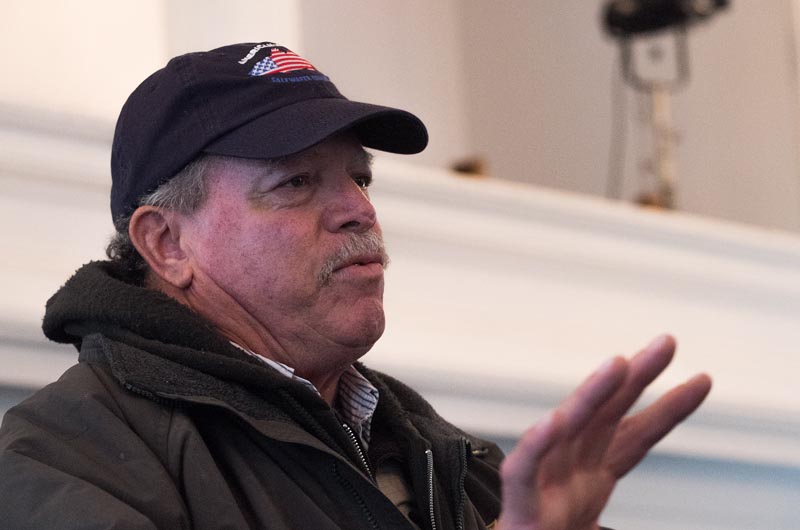
Buddy Vanderhoop addressed the new squid regulations.
Longtime squid fisherman Janet Messineo noted a decline in the number squid and also butterfish in Edgartown Harbor that she believed had contributed to a decline in striped bass and bluefish this year.
“I don’t know what those boats are doing out there,” she added. “But from the shoreline, from Chappaquiddick, I can see the lineup of lights at night.”
Wes Brighton, a commercial fisherman from Menemsha, stressed the importance of squid to state-permitted fishermen, and disagreed with the suggestion that fishermen who only had federal permits were fishing in state waters.
“The reality is there are just really bright lights,” he said, adding that vessel monitoring systems can tell whether federal boats are in state waters. “But it’s very hard, in the dark, to look out and see an extremely bright light and see if that boat is actually fishing within the three miles.”
Andrew Walsh, a commercial fisherman based in Hyannis, said the federal boats this summer were entering state waters to anchor, since those areas are safer in terms of weather and traffic. Of those 50 or so boats, he said, only a few had state permits. “But for the most part, every single boat, every night, is anchored up.”
Another item that drew some interest Wednesday was a proposed regulation for conch fishing. Conch, or whelk, has seen a dramatic decline in recent decades, and the minimum size has incrementally been raised to protect the sexually mature females. Most of the state’s conch fishing is done in Nantucket Sound.

DMF director Paul Diodati said petitions hold less weight than public hearings.

DMF director Paul Diodati said petitions hold less weight than public hearings.
At present, conch must be at least three inches wide to be harvested. The new proposal from the DMF calls for the immediate discarding of undersized catches, the establishment of a one-tote limit for SCUBA and hand-harvesters, and a limit of 15 conchs per day for recreational fishermen.
Some people at the hearing worried that it would be impossible to immediately discard the undersized conchs, since it takes time to sort them. Mr. Brighton said that sorting is an “arduous process” that can occupy an entire trip home after fishing. He said it is uncommon for a conch to be returned to its original location.
Warren Doty, a member of the Martha’s Vineyard Fishermen’s Preservation Trust, noted the increasing size limits, and wondered if it would be possible to pause at three inches, and “look at the fishery and research it and see how it’s going, and maybe not raise the minimum size . . . for a couple years.” Mr. Diodati said the DMF would consider that option.
Islanders also weighed on proposed alternatives to the new regulations for commercial and recreational striped bass fishing that went into effect Jan. 1. In response to high mortality rates in 2012, and after 19 public hearings last year, the Atlantic States Marine Fisheries Commission reduced the recreational catch limit from two to one. It also reduced the commercial striped bass quota by 25 per cent. The goal is to decrease juvenile mortality by 25 per cent in one year (slightly longer for the two Chesapeake Bay states).
But states between Maine and North Carolina now have the option of proposing alternatives, as long as they meet the same mortality reduction goal.
At the request of the charter boat industry, two alternatives have been proposed for Massachusetts. Both will allow recreational fishermen to harvest two fish per day instead of one. The first proposes a 32 inch minimum size for both fish. The second proposes a minimum size of between 28-34 inches for one fish and 40 inches for the other. Among those who spoke Wednesday there was a preference to not adopt an amendment.
Alex Friedman, a charter captain, supported the unaltered regulation. He recalled the collapse of the striped bass fishery in the 1980s and the rebound in the 1990s, which was largely a result of efforts by the ASMFC. “It’s terrifying that what we had 10 years ago is slipping through our fingers,” he said.
Mr. Vanderhoop believed it would benefit charter companies to have a two-fish limit.
Mr. Diodati noted that while the ASMFC allows for some flexibility, it also encourages a uniform size limit among its jurisdictions. He also seemed to favor the unaltered regulation.
“If we are all at similar sizes and bag limits and regulations then it gives us a better understanding, I think, of the performance of the resource and the fishery,” he said. “It’s easier to analyze.”
Other proposals at the hearing included limits on retail boat permits, a seasonal haul-out period for pots and traps, guidelines for commercial and recreational fishing during the same day, and reducing the maximum size of clam and ocean quahaug dredges. A proposal to prohibit the at-sea finning of spiny dogfish, a member of the shark family, is aimed partly at reducing illegal shark finning in general.
Written comments on all of the proposals may be sent to 251 Causeway Street, Suite 400, Boston, MA 02114; or [email protected]. Comments should be addressed to DMF director Paul Diodati.
Comments
My boat has a Federal Permit
Dick Grachek Narragansett, RIMy boat has a Federal Permit for Loligo Squid. We do not fish in MA State waters. For a couple of months last summer the Squid were caught 7nm to 8nm out to 12nm off of Nantucket. Fishing drops off at night so boats lay to inside away from the weather and boat traffic. We are monitored by NOAA 24/7 and we inform NOAA Law Enforcement that we are laying to and not ending our fishing trip. They know exactly where we are at all times. But please allow me to repeat, the Federally Permitted boats LAY TO in MA State waters with deck lights on for safety. They are NOT FISHING. They are getting some precious rest.
If there's no Squid or Butters in your harbors maybe look to other factors around your islands, because there's no shortage of Squid and Butters in the rest of the ocean. Your gamefish should have had quite the feast last year because there was plenty of feed for them. If you can't catch them maybe think about releasing some of the prized trophy cow Bass that produce all the eggs because it's not for lack of Squid or Sand Eels or Butterfish.
Oh yes, and will ya' let go of that Sylvia Earle stuff about the "industrial trawlers 'scooping up' everything in sight"? It's really silly.
The boats you see at night are local boats mostly from Rhode Island and MA and struggling to make a living like everyone else. We have 5 or 6 weeks of Squid fishing around the Shoals every June thru early to mid-September; then the Squid spread out and migrate offshore and we're gone to fish for other species.
on the bass, it's essential
Jason DeLand montaukon the bass, it's essential to keep the proposal from asmfc intact. One fish per day above 28. Anything less is not solving the problem. And if they allow for two fish, people will just take more. Big female bass in the lay eggs. Plus the bigger fish are loaded with pcb's. Eating them is bad for everyone.
The simple common sense
chip bourget woods holeThe simple common sense solution..eliminate"regulatory discards"ie:dead discards/wanton waste>gear has net mesh size to be adjusted to stop by catch or stop fishery>wanton waste got us here> (groundfish- everything in the net has to come ashore or increase mesh size to meet that requirement -worrying about regulatory discards is like worrying about gravity after you jump of the Cliff.
Add new comment