

<p>Aquinnah landowners who have been battling for nearly 18 years to develop some 30 acres of land off Moshup Trail won a favorable decision this week from the state Court of Appeals, but the convoluted legal saga continues.</p>
Aquinnah landowners who have been battling for nearly 18 years to develop some 30 acres of land off Moshup Trail won a favorable decision this week from the state Court of Appeals, but the convoluted legal saga continues.
The latest ruling in a complex set of cases originally brought in 1997 by Bear Realty Trust, its principals, James M. Decoulos and Maria A. Kitras, and others relates to their effort to establish easements to landlocked parcels. If a property does not have legal access to a public road, it cannot be developed.
The Hon. Janis M. Berry, writing the majority opinion for a three-judge panel of the appellate court, ruled that a long tradition of common access to the land when it was owned by the Wampanoag tribe of Gay Head (Aquinnah) in effect created an implied easement that remains with the property to this day. The appeals court panel voted 2-1 to send the case back to land court to figure out what those easements are.
But in a dissent almost twice as long as the opinion, the Hon. Peter W. Agnes Jr. said his fellow judge’s reasoning was “an extraordinary alteration of traditional principles of Massachusetts law,” and suggested the Supreme Judicial Court should review it. An appeal to that body appears inevitable.
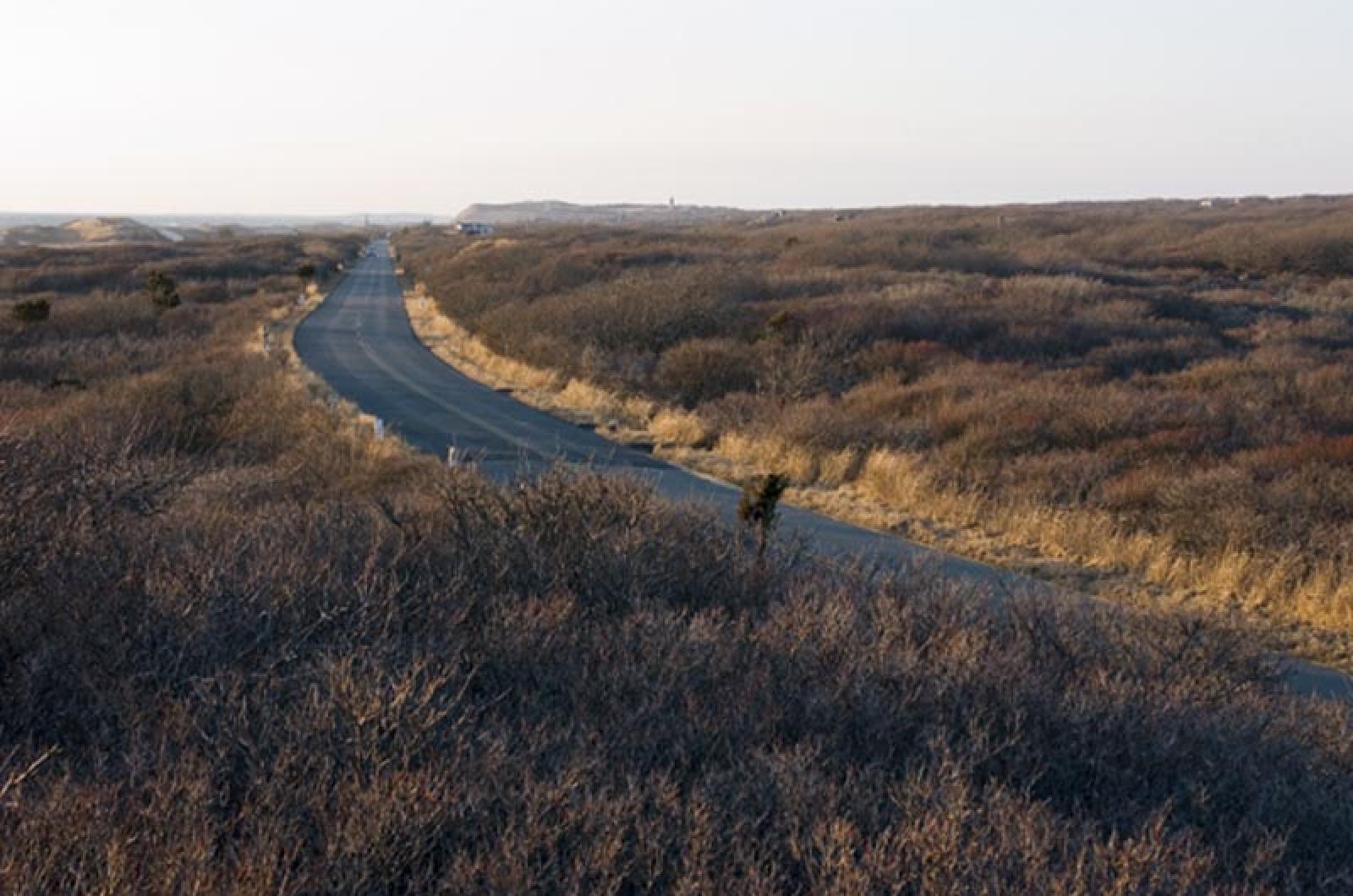
The case is one of several related cases that will ultimately decide the fate of a large swath of salt-blasted coastal heathland in a part of Aquinnah known as Zack’s Cliffs. In addition to the town of Aquinnah, other defendants in the long-running litigation include the Vineyard Conservation Society, the Martha’s Vineyard Land Bank, the state Department of Environmental Protection, and Caroline Kennedy and Edwin Schlossberg, who own property nearby. Issues relating to zoning are being litigated in other pending cases.
This case, which has bounced back and forth between the land court and the appeals court, draws on the land’s complicated tribal history and hangs on an arcane legal doctrine called easement by necessity.
Up until the late 19th century, much of the land in what is now Aquinnah was held in common by the Wampanoag tribe. In the 1860s and 1870s, the Massachusetts legislature took several actions designed to provide tribal members with the same rights as other citizens, including the incorporation of the town of Gay Head. A process called partition was undertaken in 1871 and 1878 in which commissioners appointed by a probate court judge split up the land into set-off lots and deeded them to tribal members.
In her opinion, Justice Berry found that tribal members had a long custom of sharing access to the land that was unchanged even after it was divided. Since the historical record shows no specific intention to negate that common access, the continued easement is implied, the judge ruled.
“We conclude that the ancient origins of that common access — dating back before the late eighteenth century — establish the equivalent of a chain of title, with access rights that would not yield landlocked parcels,” the judge wrote in a 14-page opinion released Wednesday. The Hon. R. Marc Kantrowicz was the concurring judge.
The decision reversed a land court ruling in August 2010 that came to the opposite conclusion. And in his dissent, Justice Agnes also took a different view, saying that under Massachusetts law, the landowners needed to prove there was an affirmative intent to grant access easements when the property changed hands.
“It may be that a presumption should exist that when land previously held in common by members of a Native American tribe is partitioned pursuant to an act of the Legislature, preexisting tribal rights are perpetuated and become binding on the successor grantees in perpetuity,” he wrote. “However, to date there is no such presumption under the law.”
Comments
Nice photo, but it shows none
James J. Decoulos BelmontNice photo, but it shows none of our land in this case. Our land is more than 700 feet back from Moshup Trail in woodlands, not alleged heathland. Get the facts @ http://decoulos.com/kitras238738.htm
The land is north of or above
Dick aThe land is north of or above Moshup Trail? Opposite of Zacks' Cliffs? Just curious.
I believe it's behind that
AR AquinnahI believe it's behind that photo shot you're looking at…..going away from the lighthouse…..between Zacks Cliffs and the Kennedy property on the ocean side. May not be a perfect description but, I think that's close.
When lands come wholly under
Richard West TisburyWhen lands come wholly under the writ of a State, (as Aquinnah did in the late 1800’s) the sovereign confers all right, title and privilege to the landowner. The laws of the State apply from that point forward.
The acts of the 1870’s were land grants to the then inhabitants of Gay Head: not land grabs. The entire multi-decade process was designed to enfranchise these new citizens of Massachusetts. It was not a grim plan to steal property from them.
Equally, the partition and conveyance of the common lands granted complete ownership to individuals, with rights and privileges; not barriers to entry to land they could formerly use. The first grantees were vested with all necessary rights and privileges, especially the most basic of rights: the right to access their newly granted property.
Any other conclusion would be an obscene ruse.
"The entire multi-decade
TOM HODGSON wt"The entire multi-decade process was designed to enfranchise these new citizens of Massachusetts." Really? That's pretty patronizing. "Enfranchise" them? Many see the forced partitioning and distribution of land in Gay Head (now Aquinnah) as the deliberate destruction of the tribal way of life. Post-partition, opportunists soon began buying the partitioned lots, and the loss of ownership by tribal members has continued to this day. To use ancient customs of shared use and access to tribal land as a legal tool and justification to force "Realty" driven development and construction seems to me to be a perverse use of law.
It is misleading and
Richard West TisburyIt is misleading and historically inaccurate to use terms such as “forced” partitioning and “loss” of ownership when referring to Aquinnah’s original incorporation as a town. As the Legislative Acts of the 1860’s & 70’s show, it was exactly the opposite. Occurring during the Civil War period, the term “enfranchisement” is precisely accurate to describe the intention of those living at that time to bring universal suffrage to all members of society, not just the enslaved. “Patronizing” is the last description one could use to describe the process of granting full rights of citizenship -- especially the rights and privileges that go along with the full enjoyment of newly acquired property.
I would not have used those
TOM HODGSON wtI would not have used those terms if I felt they were misleading and inaccurate. Wasn't the division and "enfranchisement" of Gay Head something enacted and imposed by the Commonwealth of Massachusetts? That is a forcible action, isn't it. That act was done with the law, not guns, and was probably done with the best of intentions. The loss of ownership did not happen "at" the incorporation of the town, but afterwards, as opportunists moved in. And yes, "Patronizing" is exactly what I meant. Partition was the "Great White Fathers" in action. (The Great White Mothers weren't involved, because the Great White Fathers didn't allow them to vote.) The same sort of "enfranchising" with good intentions may be seen elsewhere in the nation's history. For generations, Indian Boarding Schools took from their parents thousands upon thousands of the children of the continent's first people. Sometimes forcibly. Those children were put in schools where their family and tribal structure was no longer present. Many were forbidden to speak their own languages. Boys had their hair cut off, and were given good "Christian" names. Few of these schools are left today, but as recently as the 1970's they contained 60,000 children. Partition cut two ways. It can be argued that the State's wonderful gift of incorporation, with the "rights and privileges of fully enjoying property", was a knife with a blade for a handle.
I have to agree with Mr. H
paolo gay headI have to agree with Mr. H here. The White man's treatment of the Native Americans has been dominating and destructive marked by exclusion, isolation, broken agreements,lies, manipulation,and, yes, patronage. Today, things are somewhat better, almost to the point of giving too much. This case, however, seems to harken back to the 19th century of using Native American customs when advantageous to the White man's needs, calling on old easements for the sake of greed and development. I rest my case.
Why Jim? Why?
Bruce Willis West TisburyWhy Jim? Why?
Add new comment