

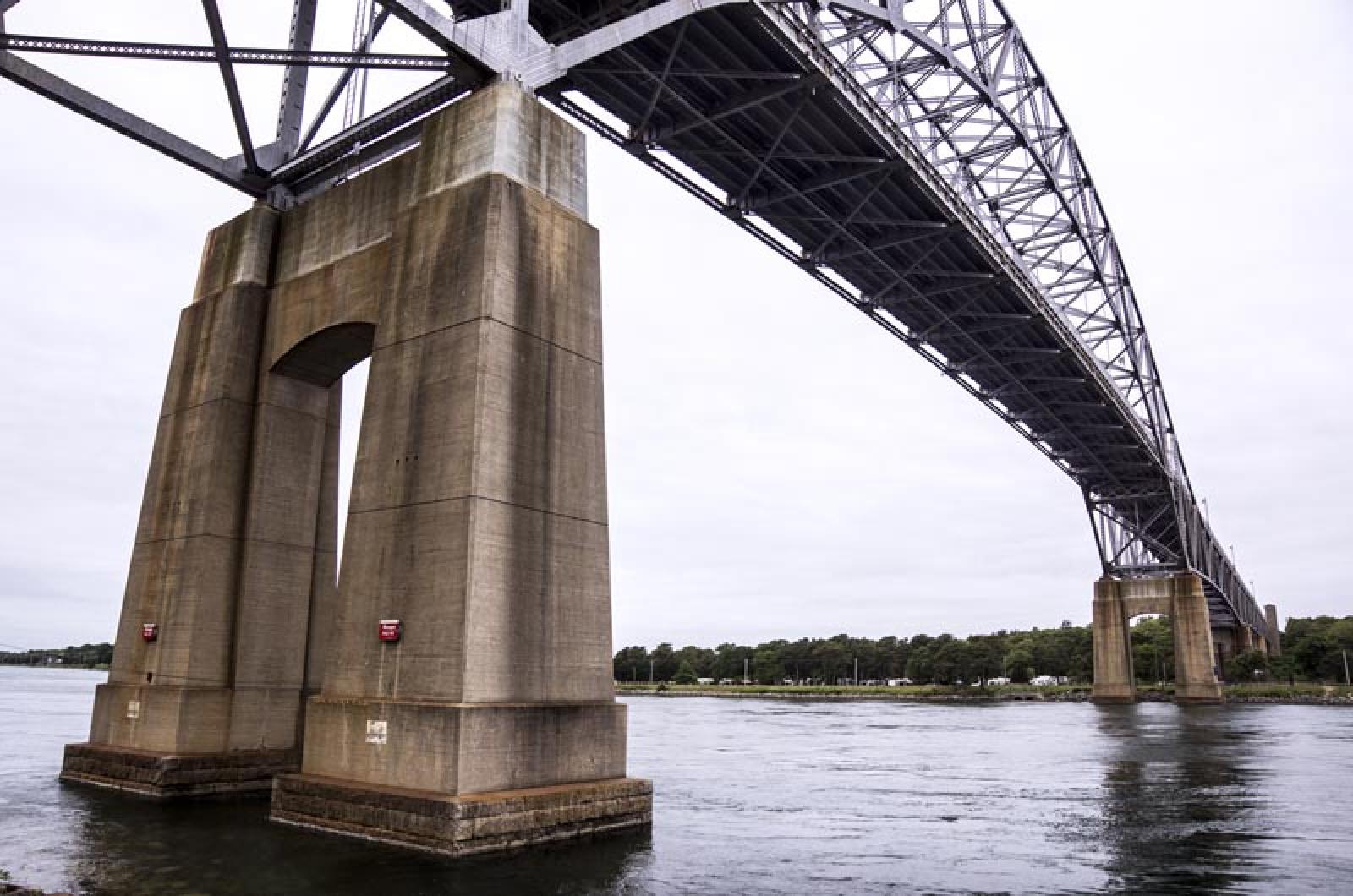
If ever there was an issue crying out for a plebiscite, the proposed third bridge is it. The decision on this dubious improvement is crucial to the quality of life of everyone living on Cape Cod now and into the future.
If ever there was an issue crying out for a plebiscite, the proposed third bridge is it. The decision on this dubious improvement is crucial to the quality of life of everyone living on Cape Cod now and into the future. The people who will be most affected by it, for better or worse, should have a chance to vote it up or down.
In any case, before we go to the trouble, expense, and massive inconvenience of greasing the skids for tourists to get to us, we might want to consult Martha’s Vineyard on the virtues of bottleneck living.
The Island seems in fact committed, both residents and visitors, to living with much more difficult access than that of the Cape, with not only the canal to get over but five miles of Vineyard Sound before you’re home free. The Vineyard is just as popular, if not more so, than the Cape, but apparently have no thought of making it easier to get there.
Yes, a bridge to the Vineyard would be a bit more of a project than one over the canal, but there’s something else operating besides resignation to insularity: a whole different mindset. (From what I have picked up from a fair amount of time spent there visiting relatives over decades, the idea of a bridge has always been raised only as a joke.)
I don’t know how daily commuters to mainland jobs feel about it, but most Islanders seem actually to appreciate the bottleneck, realizing that relative inaccessibility is key to quality of life for residents and tourists alike. Inconvenience seems built into the treasured ruralness and remoteness. On Cape or Islands, you can’t have it both ways.
I suppose you can’t compare inching along in gridlocked summer traffic with a picturesque ferry ride. Maybe the key is to shift Cape visitors to another sort of antiquated transportation. The Cape’s version of the Vineyard ferry could be to require all summer visitors to board a picturesque train when they hit the canal.
Or, maybe somebody could come up with a smart phone app to help visitors stuck in summer traffic get in touch with their inner ferry.
This piece was first published in the Cape Cod Times on Oct. 20. It appears here with permission.
Comments
Based on Google Maps Draft
Richard Diaz Blanding, UTBased on Google Maps Draft Logic, the shortest route from Vineyard to Mainland Massachusetts for a bridge is just 3.5 miles. It's from Nobska Point Ledge, Mainland to West Chop, Vineyard. And since the drive to Nobska would be far, a better route for a bridge could begin at the coast of the large town of Falmouth would be just 6 blocks longer or 4.1 miles long. Also based on Google Maps Draft Logic, the depth of the water almost never exceeds 80 feet. So if a bridge were built, the bridge sections could be installed just a few yards above the sea floor. Also, the bridge would not need a single bridge tower or a single such large bridge pier. The support of the bridge could be similar to that of the Lake Pontchartrain Causeway Bridge near New Orleans, LA. Lake Pontchartrain has a maximum depth of 60 ft. Yet, the size of the bridges' support columns are all identical in width above the sea floor. So a difference of 25 ft would not mean rather the need of bridge support on a larger scale more similar to that of the Confederation Bridge linking Prince Edward Island, Canada to Mainland. And while construction of the Lake Pontchartrain Causeway Bridge is 24 miles long and cost $30.7 million in 1956 ($267 million in today's money), the Golden Gate Bridge, only 8,981 ft long, yet cost $2.33 billion in today's money. The Vineyard Sound Bridge would be 4.1 miles long and would still cost less. And the Lake Pontchartrain Causeway is composed of not 1 bridge, but 2. The Vineyard Sound Bridge would only need to be a single, 2-lane bridge (northbound and southbound). So while construction of the twin bridges of the Lake Pontchartrain Causeway cost $11.1 million per mile in today's money, a length of 4.1 miles for the Vineyard Sound link would cost $44.6 million. And that's for 2 twin bridges. A single bridge would cost $22.3 million. A round toll price of $10 would mean profit after 2.23 million vehicles. If within a year after opening, that would be 1 vehicle in every 14 seconds. Although that rate sounds too good to be true, a rate of 1 vehicle per minute would take only 4.4 years for profit to begin. And whichever rate sounds more likely, the rate would result in low traffic and thus a single bridge with only one lane per bound would be perfect in both cost in construction and low traffic rates. If traffic rates were to escalate, building a second bridge would be profitable yet. Possibly even if composed of 4 lanes, or 2 decks. The landscaping on the island must be not just beautiful along the main roads, but different to make it look nothing like that in mainland to make it attract more visitors who could only get the same inspiration anywhere else, but in Vineyard. With only few roads and enough driving distance to make one loop drive around the island before considering visiting places they passed earlier, given the significant number of choices, but not enough time to go in every place, tourist satisfaction would be inevitable. Places 100 feet apart, beautiful property landscaping extending from the sidewalk to behind the places (gift stores, parks, small restaurants with large, beautiful outdoor eating areas and many different cultural restaurant designs and styled food. Those restaurants extending far and attracting many customers without such a large interior and thus high profit. The hotels and apartments already there would be satisfying to tourists. It's good Vineyard already has a hospital, police and fire departments. But to keep residents undisturbed, tourist destinations should only be on the coastal main street(s). Residential neighborhoods should be away from the outer region. The main residential streets leading away from the coastal main street(s) should be enclosed and only residents should be permitted to enter through security gates at the perimeters near the coastal main street(s). Security gates with either a control panel that would require a code, card, or easiest of all, the residents could just carry an EASY PASS tag in their vehicles that a sensor could detect and operate the gate once the proximity of the vehicle to the security gate is enough for the sensor to detect the EASY PASS tag and thus operate the security gate. If unauthorized vehicles immediately following authorized vehicles were a concern, then the solution in the security entry would not be traffic arms, since even they are slow. But piston-bollards. A motion sensor could confirm the authorized vehicle had passed, the piston-bollards down for the authorized vehicle comes back up from the pavement, not enough for illegal trespassers. And illegal attempts would not just fail, but would result in car damage, a disabled vehicle, criminal charges and the last laugh would not be by the illegal trespasser. The gate would still be needed to keep out illegally-trespassing pedestrians. If either a pedestrian or a motorcyclist gets past the stop point, then with the help of a security guard at the inner end of each entry and another security gate and surveillance cameras, the residential neighborhoods could remain safe from illegal-trespassers at all times. With heat sensor surveillance cameras, illegal attempts on foot in the night and in dark clothing would not make a difference. The security guard shack could have a door on both sides and could extend inside and outside the end of the entry so they could go either way, except the door knobs could be the kind that are always locked only on the outside for security reasons.
Add new comment