

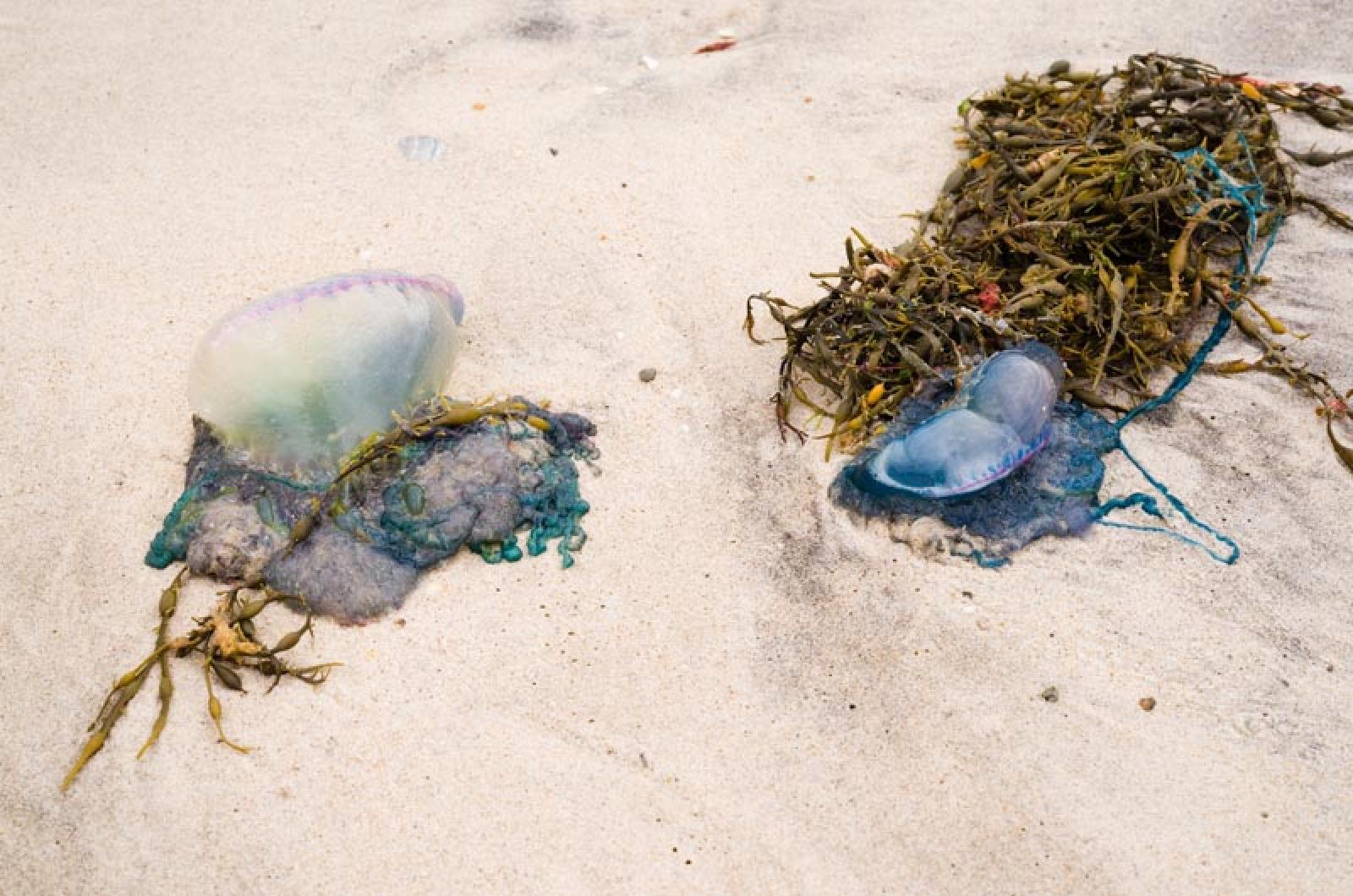
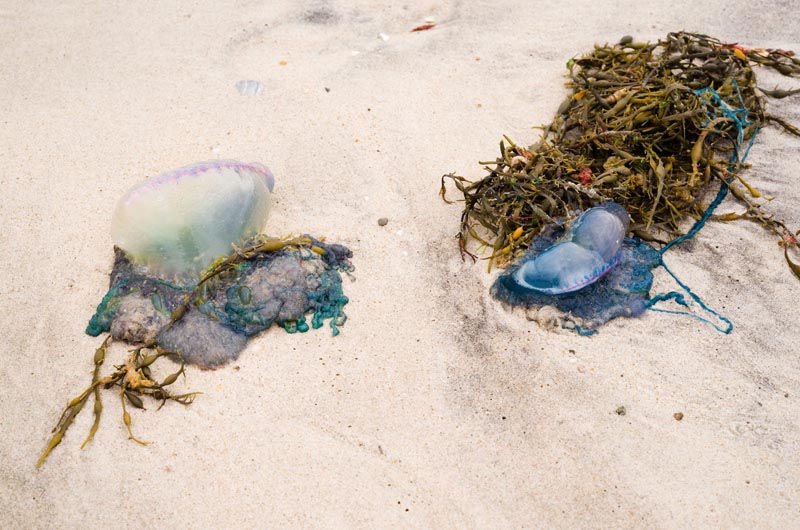
<p>Vineyard beach managers are reporting sightings of Portuguese man-of-war on south-facing beaches this month, with one report of a person stung.</p>
Vineyard beach managers are reporting sightings of Portuguese man-of-wars on south-facing beaches this month, with one report of a person stung.
The jellyfish-like creatures have washed up in Chilmark and Edgartown, with the most reported on Norton Point Beach off Katama.
One Chilmark beachgoer was stung by a man-of-war that washed up on Lucy Vincent Beach in early July, said Karen Pietruska, acting beach superintendent in Chilmark. She said the beach has a first aid protocol for such events, but didn’t elaborate on the incident.
The Trustees of Reservations collected 17 man-of-wars at Norton Point on July 17, as well as one at Long Point Wildlife Refuge in West Tisbury and another at Wasque on Chappaquiddick.
Several have also been spotted at South Beach, in the Katama section of Edgartown. Beach patrols remove the creatures as soon as they are seen, said town parks administrator Marilyn Wortman.
Beachgoers who spot man-of-wars are advised not to touch the creatures, but to alert beach personnel.
“People don’t need to be afraid of them, but just to be aware that they are around,” said Martha’s Vineyard Trustees of Reservations superintendent Christopher Kennedy.
Though similar in appearance to jellyfish, the creatures actually belong to a related phylum: siphonophores. Each man-of-war is made up of multiple mutually benefitting organisms, including a balloon-like compartment that allows the creature to float, and tentacles that hang down into the water.
“They look like a blue balloon when they hit the beach, which attracts the children to them,” Ms. Wortman said.
Man-of-war tentacles can be 10 to 20 feet long, and the balloon-like part is generally 6 to 12 inches in diameter, Mr. Kennedy said. The creatures feed primarily on larval and juvenile fish, stinging their prey to kill it and digesting the nutrients in one of their many stomachs.
They also occasionally sting humans, even after they have washed up on shore. The stings, though painful, are not lethal to humans.
Portuguese man-of-wars typically appear on Vineyard shores in the summer, though their numbers vary. They also washed up in large numbers last year.
The man-of-wars tend to frequent south-facing beaches because they ride in on the Gulf Stream, typically on a southwest wind, Mr. Kennedy said.
Comments
What is the correct plural of
Truthteller caWhat is the correct plural of Portuguese man o' war?
Portuguese's
Larry DruckenbrodPortuguese's
So how many are there?
Thomas Hodgson wtSo how many are there?
One?
More than one?
From Merriam Webster: Portuguese man–of–war noun: plural Portuguese man–of–wars, also Portuguese men–of–war.
We consulted The Associated
Editors Vineyard GazetteWe consulted The Associated Press, which uses "man-of-war" for both the singular and plural forms. After some discussion, however, we agree that "man-of-wars" makes more sense for the plural, and will amend the Gazette stylebook accordingly.
What is using the word
Jannie KatamaWhat is using the word Portuguese being racist because they are dangerous? My goodness!!
Growing up I learned that Man
Stephanie Young Dublin NHGrowing up I learned that Man O Wars can grow tentacles much longer. I believe these creatures have suffered shorter lifespans over the last 45 years due to commercial overfishing, nets and now our shockingly polluted oceans. It is a good thing we had Green Peace at least back then to start awareness...Recently, I read Peter Benchley's book Shark Trouble which mentioned Man o Wars tentacles grew up to 100 feet in our healthier oceans again decades ago.. Various jellys washed up in New Rochelle NY when I was a kid. I was stung I remember, they were hard to avoid; mostly the egg-sized clear ones. We'd poke them then watch amazed as they melted in the sand!
Stephanie Young
Add new comment