

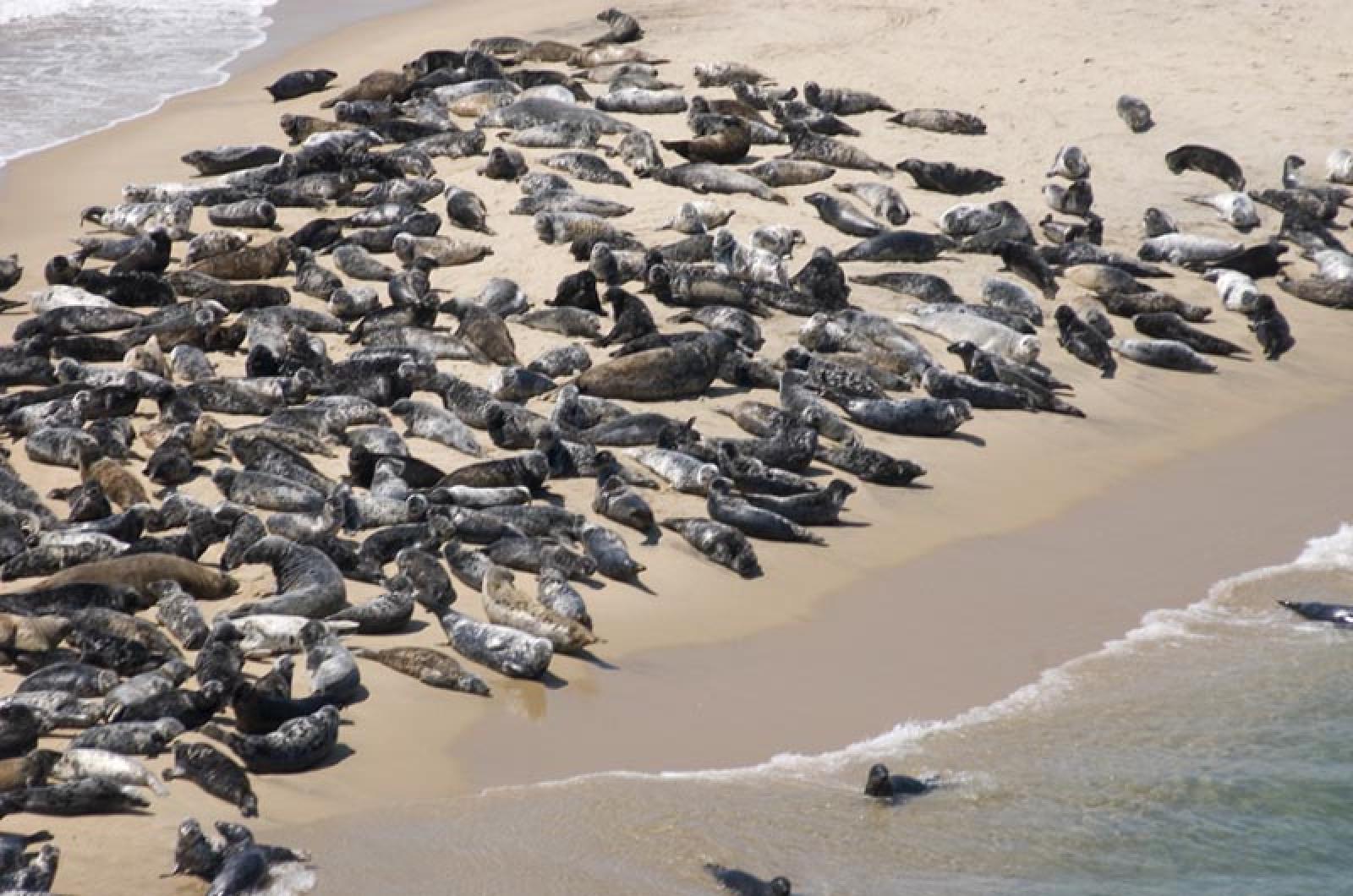
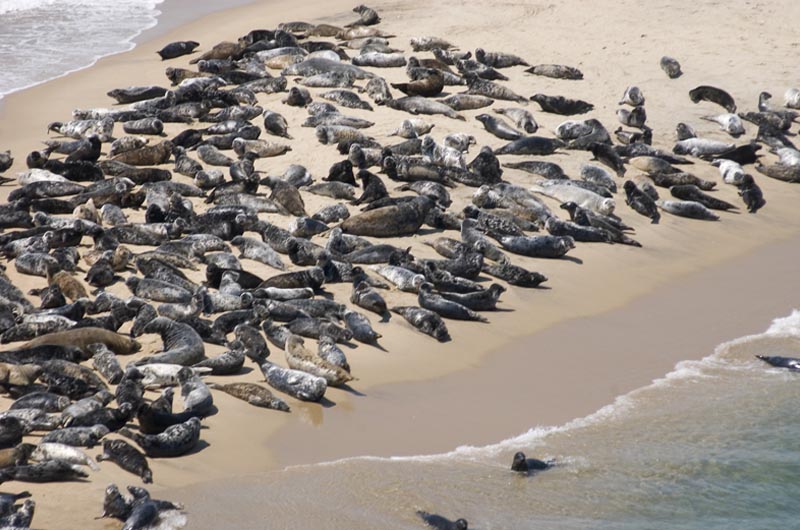
On the surface it seems like a simple and straightforward equation: more seals equals more great white sharks. The connection, however, is likely far more complicated.
On the surface it seems like a simple and straightforward equation: more seals equals more great white sharks. The connection, however, is likely far more complicated. More science about both sharks and seals is needed to better understand what is coincidence and what is cause and effect.
What does it mean to live with rebounding populations of marine animals? We are watching predator/prey dynamics shift in the Cape and Islands marine ecosystem. Over the past 50 years, since the establishment of the National Seashore and legal protection of certain species, the shorelines and wildlife of the region have been changing around us. The changes are due to both human-induced and natural changes to the marine environment. In addition, increasing human presence on the coast has meant increasing contact with coastal and near coast wildlife.
In discussing the presence of gray seals and white sharks, it is critical to understand what we know of their past and present numbers, their ecological role and the gaps that remain in our knowledge.
Archaeological records, some dating back 4,000 years, document that harbor and gray seals were distributed along the U.S. coast from Maine to Long Island prior to European settlement (Bowen 2012). In 1888 Massachusetts began what may have been the longest-running seal bounty program on record: 74 years, ending in 1962. During the bounty years, seal noses or tails were turned in to the state as an attempt to address the issue of declining fish stocks. Although the number of seals in New England’s coastal waters prior to the bounty system is unknown, it is estimated that between 72,000 and 136,000 were killed for bounties. A benefit to fish stocks has never been documented.

State ran 74-year bounty program; by early 1960s seals were virtually absent from shorelines.
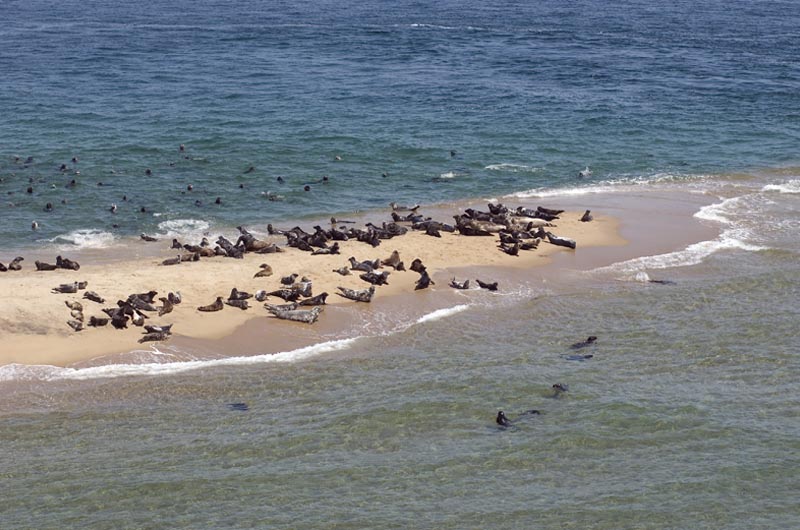
State ran 74-year bounty program; by early 1960s seals were virtually absent from shorelines.
By the early 1960s, seals — gray seals in particular — were virtually absent from our shores. In 1962, the state of Massachusetts stopped paying bounties on seals. In 1972, all marine mammals were federally protected by the Marine Mammal Protection Act.
Seals responded to protection in both Canada and the U.S. and their numbers began to rebound. Gray seals tagged and marked in Canada were regularly sighted in U.S. waters, indicating that they move freely between Canada and the U.S. In 1988, five gray seal pups were recorded on Muskeget Island by biologists. During spring counts of all seals at Muskeget and Monomoy in 1994, 2,010 individuals were counted. In 1999 during a similar spring survey of Muskeget Island and Monomoy, 5,611 seals were counted. In March 2011 a maximum count of 15,756 was obtained in southeastern Massachusetts coastal waters.
Not only have gray seals reappeared on the Cape and Islands, another species has attracted attention on Cape Cod: the white shark.
White sharks have had some level of protection in federal waters since 1997 and in Massachusetts state waters since 2005. In 2008, the Atlantic States Marine Fisheries Commission (ASMFC) implemented the Interstate Fisheries Plan for coastal sharks that was adopted by Massachusetts. Federal and state regulations prohibit the landing of white sharks by both recreational and commercial fishermen.
White sharks are not newcomers to the Cape, and they have been documented off the coast of Maine as well. There are records of white sharks in Massachusetts waters dating back to the 1800s. Similar to the gray seal population, there is no historic population estimate for white sharks in this area. Nor is a current abundance estimate available, although they are listed as a vulnerable species by the International Union for Conservation of Nature. Shark sightings appear to be on the rise — it is unclear if this is due to a real increase in the population or simply a redistribution of white sharks to local waters. The reason for the redistribution is also unclear. It is tempting to connect the coincident increase in shark sightings with the increased seal presence on the Cape. What is needed is data to connect the dots.
Given the lack of historic data and the significant changes in the coastal ecosystem, it is hard to predict the trajectories of gray seals and white sharks. Research from areas outside of Cape Cod where pinniped and shark populations overlap, such as central California, indicates the diverse diet of white sharks includes seals. Also, data from local seal surveys, marine mammal stranding organizations and shark tagging efforts indicate that white sharks frequent the waters near seal haul outs, such as Monomoy. However, we do not know the numbers of animals, frequency of their presence, or even the energetic needs of individuals. Scientists are currently working to gather information and data about both sharks and seals in our waters and on our shores. Dr. Greg Skomal of the Massachusetts Division of Marine Fisheries began tagging great white sharks around Cape Cod in 2009 to study local movements, site fidelity, and residency. The Northwest Atlantic Seal Research Consortium has been approaching the question of seal populations through a variety of studies.
The consortium and its partners recently deployed satellite tags on gray seals on Cape Cod with the goal of getting a better understanding of gray seal seasonal and day-to-day movements. Both entities are also working to get a clear understanding of what each species needs, calorically, to survive here, and whether diet and behavior differ between life stages and sexes of both animals.
Although progress has been made by researchers, the questions outweigh the answers at present. Only by increasing efforts to study both seals and sharks can we hope to understand what links the two species and to provide residents and managers with sound information for the decisions that will no doubt need to be made in the years to come.
This is a collaborative piece written by the steering committee for the Northwest Atlantic Seal Research Consortium. It was provided to the Gazette by Cathrine Macort, executive assistant at the Center for Coastal Studies in Provincetown.
Comments
Here we go again. Jesus
Joel Hovanesian Pt. Judith RIHere we go again. Jesus Christ Almighty, has common sense completely left the barn?
The problem as I see it is we have to many scientists who have to do a study of anything and everything just to justify their existence and to garner millions of dollars in grant money so they can put their name on a piece of paper and show the rest of us under educated idiots how smart they are.
The saying PHD = Piled higher and deeper has never been more appropriate!
if the seals eat all the fish
john burton vermontif the seals eat all the fish, then we eat the seals. if the sharks eat all the seals, then we can only hope they develop an affinity for politicians and scientists.
There is no need to use Jesus
IMH MAThere is no need to use Jesus' name in this way while trying to make your argument - while this may not be offensive to you, it is to those who are committed Christians. Would you use the name of Buddha or Allah in the same way?
Wow. It is funny that you
RachelWow. It is funny that you think scientists (particularly marine scientists) are showered in riches. I happen to know that the particular Research Consortium mentioned in the article is a modest operation that has done amazing work. In addition, the small staff works tirelessly with local fishermen on how to decrease interactions between marine mammals and fishing gear, saving countless dollars for the local fishing community and meeting federally mandated conservation objectives, all on a shoestring budget. Maybe do a little research yourself before you condemn a small group of committed scientists who work for almost nothing.
This is a really interesting
Candy Shweder Chilmark, MAThis is a really interesting article. I await more research and reporting with bated breath.
These 2 species have managed
Sue Cimmino Palm Harbor, FlThese two species have managed to co-exist for centuries as it was intended. They manage to work it out according to what is pre-ordained. Scientist should devote their time, energy and our money trying to solve the important issues facing our fragile ecosystem, the erosion of our Island and other areas that affect MVI, instead of wasting time on seals and sharks who will do what they want anyway.
Scientists are here to help
George Bourne, MAScientists are here to help and understand our world. That's what research is about. To Joel Hovanesian: 'Common sense' was making us think that the planet was flat until some 'snobby' scientists who just want their name of a piece of paper proved us wrong. They're not here to make money or become famous, they're here to help. Let me know when you see a scientist making more money than a CEO, a football player, a wall street trader, a celebrity, and I will be reconsidering your argument. Until then please show some respect.
I've been reading many
Ann HaverhillI've been reading many articles about the great white sharks that are coming to Cape Cod. Since the United States has protected the seals and sea otters living in our waters the number of shark sightings have increased. The adult white shark needs the fat content from the blubber rich seals to help it survive during lean times and seasonal conditions. IE: were you have seals you have white sharks all over the world. It's great scientists are studying the sharks, since the research will help prevent then from extinction, but it's just the way of nature.
We cull the White-Tailed Deer
Alex EdgartownWe cull the White-Tailed Deer herd, as they no longer have sufficient wild predators and their interactions with people (car crashes, Lyme disease and crop/garden destruction) have deleterious consequences. We cull the Canada Goose flocks, as their numbers have exploded to the point that many no longer migrate South, and they also lack sufficient natural predation. The fact of the matter is Gray and Harbor Seals were part of an ecosystem that had checks and balances for thousands of years - natural predation by bears, wolves, orcas, white sharks etc etc followed by Native American hunters followed by hunting European Settlers. Until only a few years ago. Humans have irreparably changed the complex natural environment, and to selectively protect certain species because they are cute is a grave mistake. Where are the codfish (those left in New England are laden with worms from eating seal feces)? Where are the river herring? Why have the vast majority of Striped Bass moved offshore? The exploding seal populations are an example of humans trying to play species-by-species "whack-a-mole" wildlife management - there have NEVER been seal colonies without sufficient predators to maintain a balance, so forget the fantasy of returning to a pre-Columbian utopian natural state. Embrace the White Sharks, cull the exploding seal herds, and while we're at it, can New England finally adopt some sensible controls (like the Great Lakes have) on the scourge of Cormorants (invasive species, no predators, senseless protection and the greatest threat to our native coastal fish populations)?
Seals are cute but so are deer - our influence upon the natural environment is long-standing and here to stay, thus we must be responsible stewards of nature. We need to supplement the long-gone predators on the seals with sensible management.
Add new comment